How To Calculate Theoretical Yield
Theoretical Yield Calculator
Calculate theoretical yield, limiting reactant, and percent yield based on stoichiometry.
Calculation Results
Step-by-Step Calculation
Core Formulas & Reference
Theoretical yield represents the maximum possible mass of product predicted from the complete reaction of the limiting reactant under stoichiometric conditions.
Whether you’re carrying out a chemistry experiment in the laboratory or solving reaction problems on paper, knowing the theoretical yield helps you predict the highest possible amount of product a reaction can produce. A theoretical yield calculator makes this process quick and accurate by performing the necessary calculations in seconds.
Simply enter the required reaction details, and the calculator will instantly determine the maximum expected yield. If you’d like to understand the science behind the calculation, this guide also explains the key concepts, including:
- What theoretical yield means and why it is important in chemistry.
- How to calculate theoretical yield using the correct formula and reaction data.
- Practical examples showing how the theoretical yield equation is applied in real laboratory experiments and chemistry calculations.
This knowledge is useful for students, researchers, and anyone working with chemical reactions, as it allows you to compare the expected product with the actual amount obtained and evaluate the efficiency of a reaction.
Chemical Reactions
A chemical reaction is a process in which one or more substances, known as reactants, undergo a chemical change to produce one or more new substances called products. During this process, existing chemical bonds are broken and new bonds are formed, resulting in substances with different chemical properties.
The rearrangement of atoms is the foundation of every chemical reaction and plays a central role in chemistry. Based on whether a reaction can proceed in both directions or only one, chemical reactions are generally classified into two main types:
- Reversible chemical reactions – These reactions can move in both the forward and reverse directions, allowing reactants and products to convert into one another until a state of equilibrium is reached.
- Irreversible chemical reactions – These reactions proceed in only one direction. Once the reactants are converted into products, the reaction does not naturally reverse under the same conditions.
Understanding the difference between reversible and irreversible reactions is essential for predicting reaction behavior, calculating yields, and designing successful laboratory experiments.
What Is Theoretical Yield?
Before understanding theoretical yield, it’s important to know what reaction yield means. In chemistry, the yield of a reaction refers to the amount of a specific product formed from a given quantity of reactants after the reaction is complete.
In real laboratory experiments, achieving the expected amount of product is challenging because several factors can reduce the final yield, including:
- Experimental or procedural mistakes
- Systematic measurement errors
- Environmental conditions such as temperature or humidity
- Loss of product during handling or purification
- Other practical limitations that occur during the experiment
As a result, the actual amount of product obtained is usually lower than the maximum amount that could theoretically be produced.
Understanding Theoretical Yield
Theoretical yield is the greatest possible amount of a desired product that can be formed from a chemical reaction under ideal conditions. It assumes that:
- All reactants are completely pure.
- The reaction proceeds with 100% conversion of reactants into products.
- No side reactions occur.
- Every product molecule formed is recovered without any loss.
Because real-world experiments always involve some degree of error or product loss, achieving the theoretical yield is practically impossible. Instead, it serves as a benchmark for comparing the actual yield of an experiment.
What Determines Theoretical Yield?
The theoretical yield is determined entirely by the limiting reactant the reactant that is consumed first and therefore limits the amount of product that can be formed. Once the limiting reactant is exhausted, the reaction stops, even if other reactants remain in excess.
How to Calculate Theoretical Yield
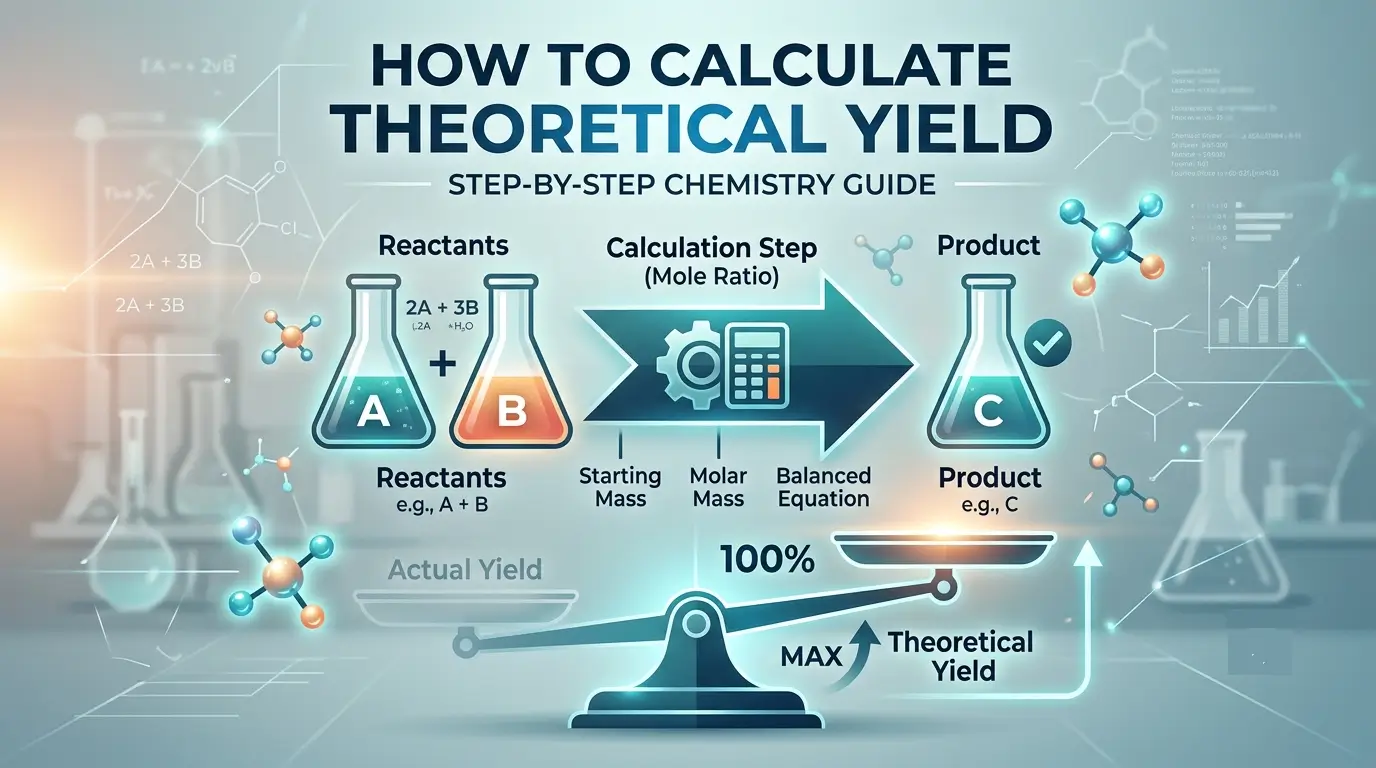
Calculating the theoretical yield involves using the balanced chemical equation and identifying the limiting reactant the substance that is consumed first and determines the maximum amount of product that can be formed.
Once the limiting reactant is known, the theoretical yield can be calculated using the stoichiometric relationship between the reactants and products.
Theoretical Yield Formula
The mass of the product is calculated using the following equation:mproduct=Mproduct×(nlimiting×cproduct)
Where:
- mproductm_{\text{product}}mproduct = Mass of the product produced
- MproductM_{\text{product}}Mproduct = Molar mass of the product
- nlimitingn_{\text{limiting}}nlimiting = Number of moles of the limiting reactant
- cproductc_{\text{product}}cproduct = Stoichiometric coefficient of the product from the balanced chemical equation
Finding the Moles of the Limiting Reactant
Before calculating the theoretical yield, determine the number of moles of the limiting reactant using its mass and molar mass:nlimiting=Mlimitingmlimiting
Where:
- nlimitingn_{\text{limiting}}nlimiting = Number of moles of the limiting reactant
- mlimitingm_{\text{limiting}}mlimiting = Mass of the limiting reactant
- MlimitingM_{\text{limiting}}Mlimiting = Molar mass of the limiting reactant
If the balanced chemical equation contains coefficients other than one, use the stoichiometric ratio to convert the limiting reactant into the corresponding amount of product before calculating the final mass.
Steps to Calculate Theoretical Yield
- Write and balance the chemical equation.
- Convert the given mass of each reactant into moles.
- Identify the limiting reactant by comparing the available mole ratios.
- Use the stoichiometric coefficients to calculate the number of moles of the desired product.
- Convert the product’s moles into grams by multiplying by its molar mass.
Why the Limiting Reactant Matters
The theoretical yield depends entirely on the limiting reactant because it is the first substance to be completely consumed during the reaction. Once it is exhausted, the reaction stops, even if other reactants are still available in excess. For this reason, accurately identifying the limiting reactant is the key to obtaining the correct theoretical yield.
Note: In chemistry, the symbol nnn represents the number of moles. It should not be confused with the refractive index used in optics and material science, where the same symbol has a different meaning.
How Do You Find the Limiting Reactant?
The limiting reactant is the substance that is used up first during a chemical reaction. Because the reaction cannot continue once this reactant is completely consumed, it determines the maximum amount of product that can be formed and, therefore, the theoretical yield.
To identify the limiting reactant, calculate the number of moles available for each reactant and compare them with the stoichiometric ratios given in the balanced chemical equation. The reactant that can produce the smallest amount of product or has the lowest adjusted mole ratio is the limiting reactant.
Steps to Determine the Limiting Reactant
- Write and balance the chemical equation.
- Convert the mass of each reactant into moles using its molar mass.
- Divide the moles of each reactant by its stoichiometric coefficient in the balanced equation.
- Compare the adjusted values. The reactant with the smallest result is the limiting reactant.
Example
Suppose a reaction requires a 1:1 stoichiometric ratio, and you have:
- Reactant A: 4 moles
- Reactant B: 2.5 moles
Since the reaction needs one mole of each reactant, Reactant B will be completely consumed first. Although 4 moles of Reactant A are available, only 2.5 moles can react because there is no more Reactant B remaining.
As a result:
- Limiting reactant: Reactant B
- Excess reactant: Reactant A
- Maximum amount of product: Determined by the 2.5 moles of Reactant B
Correctly identifying the limiting reactant is essential because it forms the basis for calculating the theoretical yield and estimating how much product can be produced under ideal conditions.
How to Calculate Theoretical Yield: Example
Let’s apply the theoretical yield formula to a real chemical reaction. In this example, toluene is produced by reacting benzene with methanol.
Chemical Equation
C6H6+CH3OH→C6H5CH3+H2O
Suppose you begin the reaction with:
- 100 g of benzene (C₆H₆)
- 80 g of methanol (CH₃OH)
Step 1: Calculate the Molar Mass of Each Reactant
The molar masses are:
- Benzene (C₆H₆): 78.11 g/mol
- Methanol (CH₃OH): 32.04 g/mol
Since every substance in the balanced equation has a stoichiometric coefficient of 1, no coefficient adjustment is required.
Step 2: Convert the Reactants to Moles
Use the formula:Moles=Molar MassMass
For benzene:78.11 g/mol100 g=1.28 mol
For methanol:32.04 g/mol80 g=2.50 mol
Step 3: Identify the Limiting Reactant
Compare the number of moles for each reactant:
| Reactant | Available Moles |
|---|---|
| Benzene | 1.28 mol |
| Methanol | 2.50 mol |
Because the reaction follows a 1:1 ratio, benzene has fewer moles and is therefore the limiting reactant. This means it determines the maximum amount of toluene that can be produced.
Step 4: Calculate the Theoretical Yield
The molar mass of toluene (C₆H₅CH₃) is 92.14 g/mol.
Using the theoretical yield formula:Theoretical Yield=Moles of Limiting Reactant×Molar Mass of Product =1.28 mol×92.14 g/mol =117.96 g
Final Answer
Under ideal conditions, the theoretical yield of toluene is 117.96 g. This value assumes:
- The reaction proceeds with 100% efficiency.
- All of the limiting reactant is converted into the desired product.
- No side reactions occur.
- No product is lost during the experiment.
In practice, laboratory reactions rarely achieve a 100% yield. Product losses during handling, purification, incomplete reactions, and experimental errors often reduce the actual yield, which may be significantly lower sometimes around 50%, depending on the reaction conditions and laboratory techniques.
This example demonstrates how identifying the limiting reactant and applying stoichiometric calculations allows you to determine the maximum amount of product that a chemical reaction can theoretically produce.
FAQs
Conclusion
Understanding theoretical yield is essential for predicting the maximum amount of product a chemical reaction can produce under ideal conditions. By identifying the limiting reactant, applying stoichiometric calculations, and comparing the theoretical yield with the actual yield, you can evaluate the efficiency of any chemical reaction. Whether you’re solving chemistry problems, conducting laboratory experiments, or using a theoretical yield calculator, these concepts provide a reliable foundation for accurate calculations and a deeper understanding of reaction outcomes.