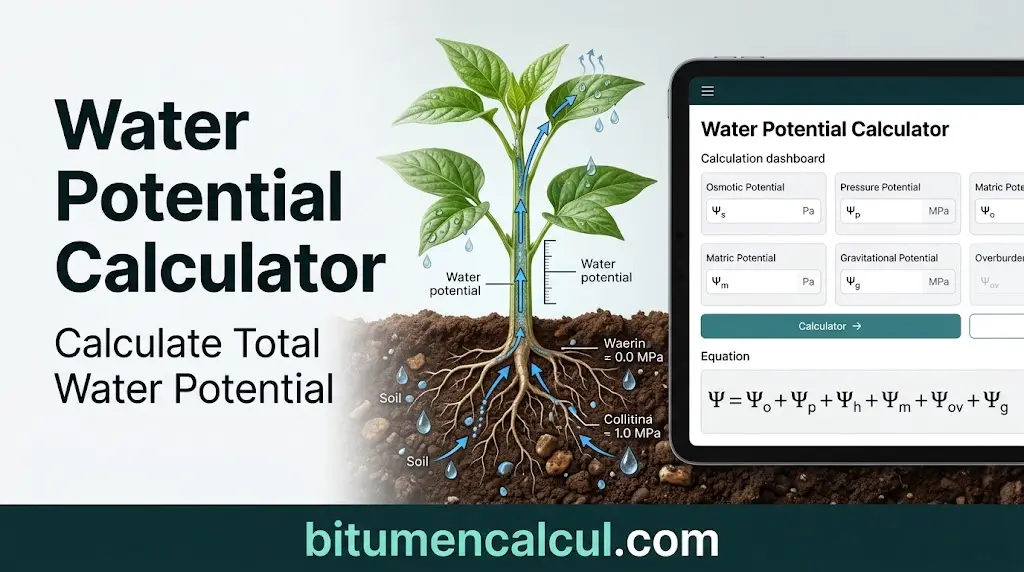
Water Potential Calculator Calculate Total Water Potential
Water Potential Calculator
Calculate solute potential (Ψs), pressure potential (Ψp) and total water potential (Ψw).
Uses Ψw = Ψs + Ψp and Ψs = −iCRT with R = 0.0083145 L·MPa/(mol·K). 1 MPa = 10 bar = 1000 kPa. Results assume an ideal solution.
Water potential determines the direction in which water moves through plants and other biological or engineering systems. A water potential calculator makes it easier to calculate this value across a range of different situations.
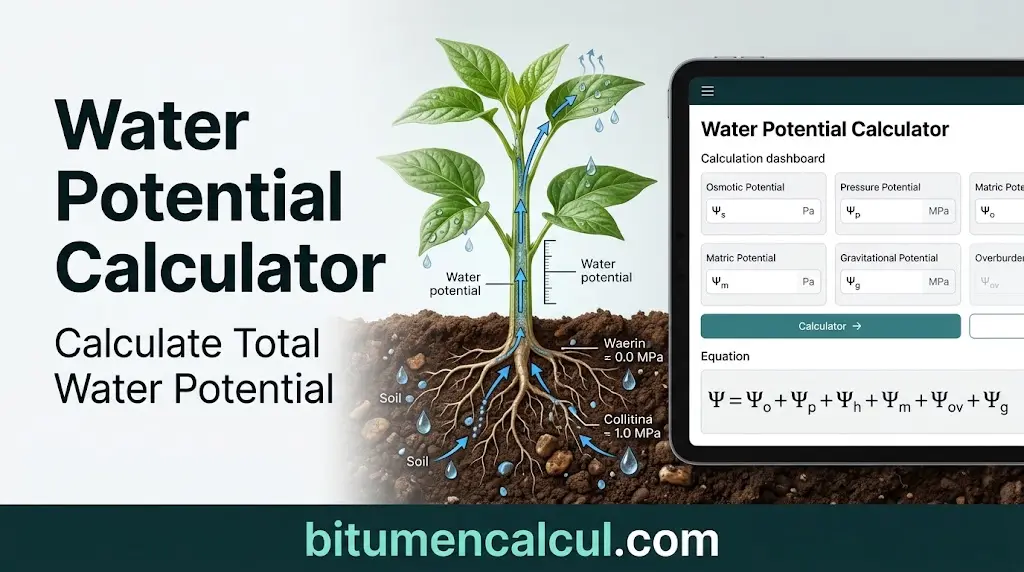
Water potential helps explain how trees can grow to great heights, how plants draw water from the soil into their roots, and even how tree roots can push through solid sidewalk concrete. Keep reading to learn more about water potential and how to calculate it in plants.
Measurement Units of Water Potential
Water potential is measured in terms of energy density, which represents the amount of energy per unit of volume or mass.
Volumetric energy density is expressed in J/m³, which is equivalent to the pressure unit Pa.
In certain cases, the specific energy (J/kg) and volumetric energy density (J/m³) of a substance have the same numerical value. This is particularly true for pure water under standard conditions, where 1 kg = 1 m³. For this reason, this water potential calculator uses Pa as its measurement unit.
Components of Water Potential
Several factors contribute to water potential, although only a few components are typically relevant to a particular problem.
The water potential equation can include the following components:
- Osmotic potential is the energy difference associated with reaching equilibrium between a solution and pure water separated by a semipermeable membrane. It can never have a positive value. To learn more, try our osmotic pressure calculator.
- Pressure potential refers to the hydrostatic pressure acting on water. Its value can be positive or negative. You can learn how to calculate it using our hydrostatic pressure calculator.
- Pneumatic potential represents the external pressure applied to a liquid, which may be either positive or negative.
- Matric potential describes the attraction between water and a surrounding matrix, such as soil. It must be zero or negative.
- Overburden pressure potential is similar to pressure potential, but it results from the pressure the surrounding matrix exerts on the water. It is especially important in deeper soil layers, where the weight of the overlying material becomes significant. Its value can only be positive or zero.
- Gravitational potential describes how gravity affects the energy of water based on its position in a gravitational field. You can calculate it using our potential energy calculator.
How Do I Calculate Water Potential?
Calculating water potential in plants or other systems is straightforward with this calculator. Simply follow these steps to find the result:
- Select the water potential components that apply to your problem. To access less commonly used components, expand the Additional Components section.
- Enter the corresponding values for each selected component, leaving any unused fields blank.
- The water potential calculator will automatically calculate and display the final result.
How Is Water Potential Calculated?
Water potential is calculated by adding together its different contributing components. The general water potential equation is:
[
\psi = \sum_i \psi_i
= \psi_o + \psi_p + \psi_h + \psi_m + \psi_{ov} + \psi_g
]
Several forms of this equation exist, so this calculator uses the most general form found in the literature, as presented in the book Developments in Soil Science.
Each component is calculated using a different formula:
Osmotic potential
[
\psi_o = -\nu \cdot c \cdot X \cdot R \cdot T
]
Where:
- (\nu) = Number of ions produced when a solute molecule dissociates.
- (c) = Concentration in mol/kg.
- (X) = Osmotic coefficient.
- (R) = Gas constant (8.314 (m³ · Pa)/(K · mol)).
- (T) = Temperature in K.
Pressure, hydraulic, and overburden potentials
Pressure potential ((\psi_p)), hydraulic potential ((\psi_h)), and overburden potential ((\psi_{ov})) are all associated with pressure, so they use the same calculation method:
[
\psi_i = \frac{P_i}{\rho_w}
]
Where:
- (P_i) = Pressure associated with the (i)th component (one of the three).
- (\rho_w) = Water density.
Matric potential
Matric potential is related to the capillary flow equation and is calculated as:
[
\psi_m = -2 \cdot \frac{\sigma}{r \cdot \rho_w}
]
Where:
- (\sigma) = Surface tension at the interface.
- (r) = Pore radius.
Gravitational potential
Gravitational potential is calculated using the standard relationship:
[
\psi_g = -g \cdot z
]
Where:
- (g) = Gravitational acceleration (9.81 m/s²).
- (z) = Height difference from a reference level.
Why Is Water Potential Important?
Water potential helps explain how water moves through plant tissues and why it flows in a particular direction.
Water generally moves from an area of higher water potential to an area of lower water potential. Understanding this principle is essential for studying osmosis, water absorption by roots, transpiration, and water movement between plant cells.
A Couple of Examples of How Water Potential Works
Seeds must absorb a significant amount of water to begin growing, even though they have no roots or leaves to help them. They are simply tiny capsules waiting to sprout! The water potential of a dry seed typically ranges from -50 MPa to -350 MPa, which helps explain why seeds need to absorb so much water.
Life as a tree is not as easy as it might seem, especially when viewed from our busy, constantly moving perspective. One of the biggest challenges a tree faces each day is transporting water and nutrients to the leaves on its highest branches without moving from its position.
Essentially, this process depends on creating a difference in water potential, with the lowest value at the top of the tree and the highest value near the roots. Every small contribution matters, particularly when a tree can grow to nearly 116 meters tall.
The process begins when the tree absorbs water from the soil surrounding its roots. At this stage, osmotic potential plays an important role. Water moves into the tree because the soil has a higher water potential than the root cells, where the value ranges from -0.5 MPa to -1.0 MPa. Once inside, water travels through the tree's xylem, a system of vessels extending from the roots to the leaves.
A clear water potential gradient drives this movement. Under dry conditions, the atmosphere has a water potential of around -100 MPa, with pneumatic potential being the relevant component. Inside the tree, pressure potential ranges from approximately -1.2 MPa in the xylem to -3.0 MPa in the highest leaves. Meanwhile, gravitational potential works against the upward movement of water, potentially reaching +1 MPa in the tallest trees.
At the final boundary between the leaf cells and the atmosphere, the large difference in water potential causes water to leave the leaves. This process also allows carbon dioxide to enter, providing a resource for photosynthesis. Light is another essential requirement for photosynthesis. Use our daily light integral calculator to estimate how much light a plant receives each day.
All these processes are made possible by the remarkably efficient system that trees have developed over millions of years. They demonstrate how effectively nature manages the movement of water. Trees are all around us, and it is easy to take them for granted, but beneath their bark lies an impressive network of biological engineering. The next time you see one, take a moment to appreciate it—and perhaps even give it a hug!
FAQs
Conclusion
Water potential plays an important role in understanding how water moves through plants, soil, and other systems. By combining factors such as osmotic, pressure, matric, and gravitational potential, this calculator makes it easier to determine total water potential and understand processes like root water absorption, seed germination, and water transport to leaves.
Read More: