
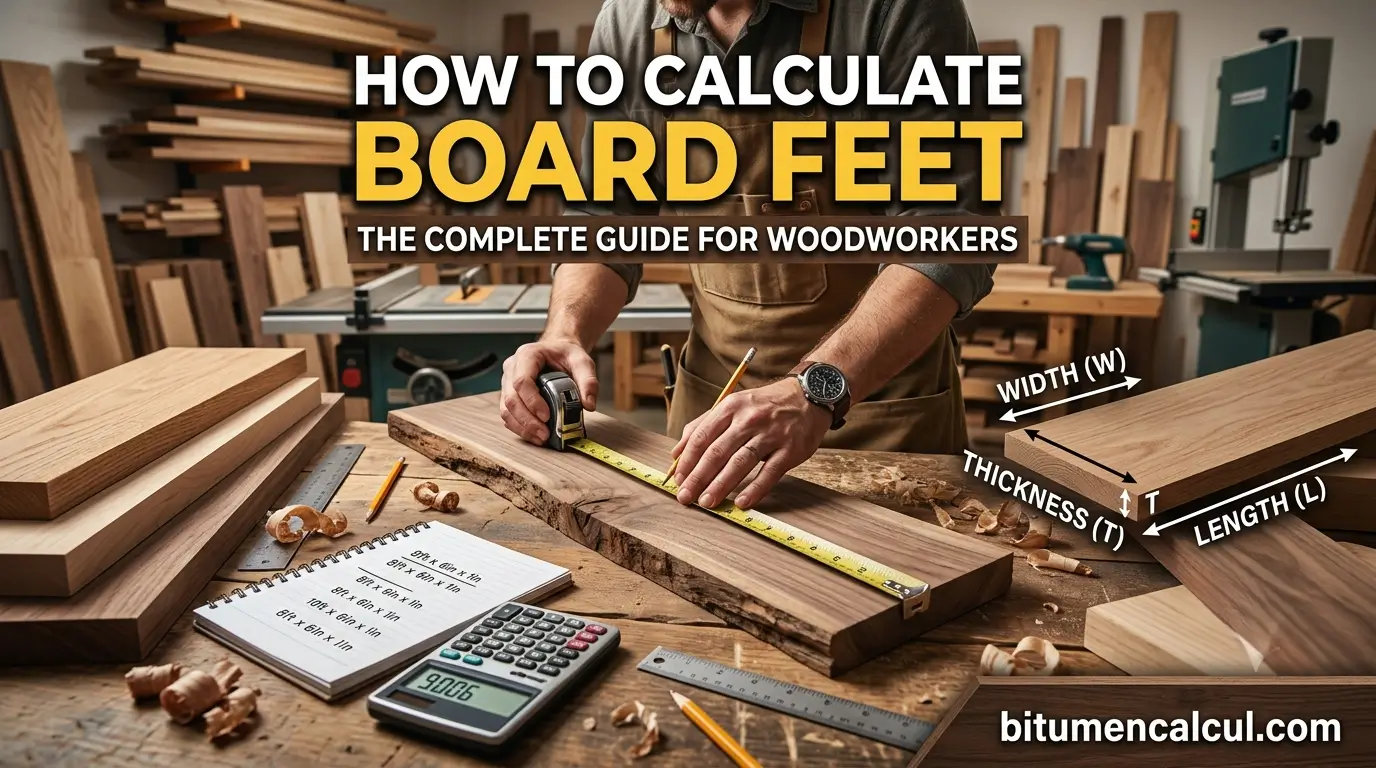
How to Calculate Board Feet
|

How to Calculate Board Feet 2026?

Board Foot Calculator

Calculate total board feet and volume for your lumber project.

in
in
ft
pcs
Try an Example:

Enter the required measurements into each field, then click the “Calculate” button. The calculated Board Foot value will be displayed in the Results section below. If you calculate multiple items, the Total Board Feet will automatically update and keep a running total until you click Reset.
How to Calculate Board Feet

Board Foot Calculator

Use this Board Foot Calculator to quickly estimate the amount of lumber you need for your project. Simply enter the thickness, width, length, and quantity of your boards, then click Calculate. The calculator will instantly display the Board Feet for the current entry and automatically update the Total Board Feet for all calculations until you reset the calculator.

Notes

  1. Hardwood lumber is typically sold by the board foot, a unit of volume equal to a board measuring 1 inch thick × 12 inches wide × 12 inches long (144 cubic inches). Lumber thickness is commonly expressed in quarters of an inch. For example:
    • 4/4 = 1 inch
    • 6/4 = 1½ inches
    • 8/4 = 2 inches
    These measurements represent nominal (rough-sawn) dimensions, not the finished or surfaced size.
  2. Thickness is rounded up automatically to the nearest ¼ inch (1/4″). Any lumber thinner than 4/4 (1 inch) is treated as 4/4 material. For example, a thickness of 3/4 inch will be calculated as 4/4 (1 inch).
  3. Dimensions can be entered as either decimals or fractions. For example, you can enter 12.75 or 12 3/4. When using fractions, include a space between the whole number and the fraction (for example, 12 3/4).
  4. Board length is rounded according to grading standards. Under NHLA (National Hardwood Lumber Association) grading rules, board lengths are rounded down to the nearest whole foot, so an 8′ 11″ board is calculated as 8 feet. In H.I. Exotic Species grading, lengths are rounded down to the nearest half foot instead.

What Is a Board Foot?

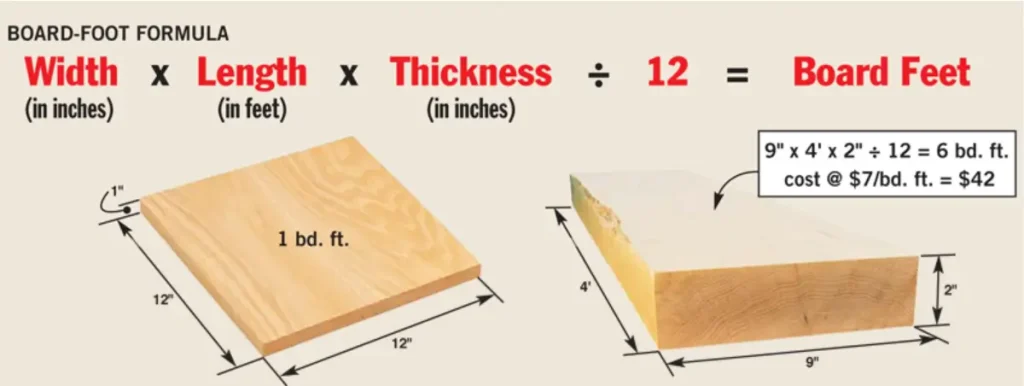
A board foot is a unit of volume used to measure lumber. Unlike square footage, which measures surface area, board footage measures the amount of wood in a board. This makes it the standard unit for buying and selling hardwood lumber in different thicknesses and dimensions.

By definition, one board foot is equal to a board that measures:

  • 1 inch thick
  • 12 inches wide (1 foot)
  • 12 inches long (1 foot)

This equals a total volume of 144 cubic inches.

Board Foot Conversion

The following conversions are commonly used:

  • 1 Board Foot = 144 Cubic Inches
  • 1 Board Foot = 1/12 Cubic Foot

Knowing these conversions makes it easier to estimate lumber quantities and compare measurements when planning woodworking or construction projects.

How Much Lumber Can You Get From Your Trees?

If you own standing timber, knowing how much usable lumber it can produce is important before harvesting. This is where log board feet come into play. A board foot is the standard unit used to measure lumber volume, while log board feet estimate how many board feet of finished lumber can be sawn from a log.

The estimated yield is calculated using a log’s diameter, length, and a log scaling rule that accounts for factors such as taper, saw kerf, and natural defects. Because of these variables, the actual amount of usable lumber may differ slightly from the estimate.

Estimating log board feet helps landowners, foresters, and sawmills:

  • Estimate the amount of lumber a tree or log can produce.
  • Determine the potential value of standing timber before harvesting.
  • Compare different logs based on their expected lumber yield.
  • Plan lumber requirements for woodworking and construction projects.

While board feet measure the volume of finished lumber, log board feet provide a practical estimate of the usable wood that can be recovered from a log, making them an essential tool for timber valuation and forest management.

FAQs

A 2x4x8 board contains 5.33 board feet, calculated using the standard formula of (thickness × width × length in feet) ÷ 12, which gives you (2 × 4 × 8) ÷ 12. This common lumber size is frequently used in framing and construction projects, and it’s helpful to remember that the “2” and “4” refer to nominal dimensions, while actual dimensions are slightly smaller.

A 2x4x10 yields 6.67 board feet, making it slightly more material than the 8-foot version while remaining one of the most economical lumber choices for general building. The calculation (2 × 4 × 10) ÷ 12 is straightforward, and many builders prefer 10-foot boards for projects requiring longer spans without additional joints.

Board feet are divided by 144 because one board foot equals 144 cubic inches by definition—that’s a 12×12×1-inch piece of wood—so when all dimensions are expressed in inches, dividing by 144 converts that volume to the standard board foot measurement used in lumber pricing and inventory.

A 1x12x12 board contains exactly 12 board feet, representing a full square foot of lumber material, which makes mental math simple for this particular size. This dimension is popular for shelving, furniture making, and trim work where width matters more than thickness.

A 2x6x10 contains 10 board feet, making it an excellent choice for deck joists, deck boards, and structural applications requiring more material than a 2×4 but still economical. The calculation (2 × 6 × 10) ÷ 12 illustrates why wider boards become cost-effective for projects requiring strength and durability.

To calculate board feet, multiply the nominal thickness in inches by the nominal width in inches by the length in feet, then divide by 12—for example, a 2×6 board that’s 12 feet long equals (2 × 6 × 12) ÷ 12 = 12 board feet. This universal formula works for any dimension combination and is how lumber pricing is standardized across the industry.

The board foot formula is (T × W × L) ÷ 12, where T is thickness in inches, W is width in inches, and L is length in feet, or alternatively (T × W × L) ÷ 144 when all dimensions including length are in inches. Understanding this formula prevents costly miscalculations when estimating material needs or comparing lumber prices between suppliers.

A 2x6x16 board contains 16 board feet, calculated as (2 × 6 × 16) ÷ 12, making it a substantial piece of lumber often used for beams, large headers, or premium shelving applications. The longer length means more material per board, which is why 16-foot lengths are common for structural and architectural projects requiring minimal joints.

A 2x3x10 piece of lumber contains 5 board feet, calculated using (2 × 3 × 10) ÷ 12, and while less common than standard 2×4 or 2×6 sizes, it’s useful for specialty trim, backing boards, and custom framing where you need less material than a full 2×4. This size demonstrates that board feet calculations work for any lumber dimension, not just common sizes.

A 2x6x12 board equals 12 board feet, one of the most common lumber configurations for deck building, residential framing, and furniture construction due to its balance of strength and manageable weight. This size is widely stocked at lumber yards and represents a good value for projects requiring dimensional lumber with moderate material thickness.

Common board feet errors include using actual dimensions instead of nominal dimensions (forgetting that a 2×4 is really 1.5×3.5 inches), failing to convert length to feet before calculating, confusing board feet with linear feet or square feet, and not accounting for waste and cutting losses when estimating material needs. Avoiding these pitfalls saves money on material procurement and prevents project delays from under-ordering lumber.

A 1x8x10 board contains 6.67 board feet, calculated as (1 × 8 × 10) ÷ 12, making it popular for siding, shelving, and decorative applications where a thinner, moderately wide board is desired. This size is versatile enough to work as a single-width shelf or as flooring material in certain applications.

A 1x6x16 board equals 8 board feet, serving applications like flooring, siding, and exterior trim where the narrow profile and longer length accommodate larger surface areas without additional seams. The calculation (1 × 6 × 16) ÷ 12 shows that even thin lumber accrues significant board feet when length increases.

A 2x2x12 contains 4 board feet, calculated as (2 × 2 × 12) ÷ 12, and while less common in structural framing, it’s useful for posts, rails, trim details, and specialty carpentry where a smaller, compact lumber section is needed without over-specifying material.

Conclusion

Whether you’re estimating lumber for a small woodworking project or a large construction job, this Board Foot Calculator provides a fast and reliable way to measure the amount of wood you need. By using standard board foot calculations and common lumber measurement rules, it helps reduce estimation errors, improve material planning, and simplify purchasing decisions. Use it whenever you need an accurate board foot estimate to save both time and unnecessary lumber costs.

Read More:

Similar Posts

Leave a Reply

Your email address will not be published. Required fields are marked *