
Age Calculator – Calculate Your Exact Age in Seconds
Age Calculator
Calculate your exact age in years, months, days, and time lived.
The Age Calculator helps you determine a person's exact age or calculate the time difference between any two dates. It provides a detailed breakdown of the result in years, months, weeks, days, hours, minutes, and seconds, making it easy to measure the precise length of time between the selected dates.

How Age Is Calculated
Different countries and cultures use different methods to determine a person's age. This calculator follows the standard system used in most Western countries, where a person's age increases on their birthday each year.
For example, if someone has lived for 3 years and 11 months, they are still considered 3 years old. They will officially turn 4 on their next birthday, even if it is only one month away.
How Do You Calculate Age from a Date of Birth?
To calculate your chronological age, begin by subtracting your birth year from the current year. If your birthday has not yet occurred during the current year, subtract one additional year from the result.
For example, if you were born on 15 May 1990 and the reference date is 14 April 2026:
- Current year: 2026
- Birth year: 1990
- Initial calculation: 2026 − 1990 = 36
- Since 15 May has not yet arrived in 2026, subtract 1.
Age = 35 years
To determine the exact age, the remaining months and days are then calculated. After completing 35 full years, the date becomes 15 May 2025. From 15 May 2025 to 14 April 2026, the elapsed time is 10 complete months and 30 days.
Final result: 35 years, 10 months, 30 days
This method follows the calendar duration approach defined by ISO 8601:2019, ensuring consistent and accurate age calculations.
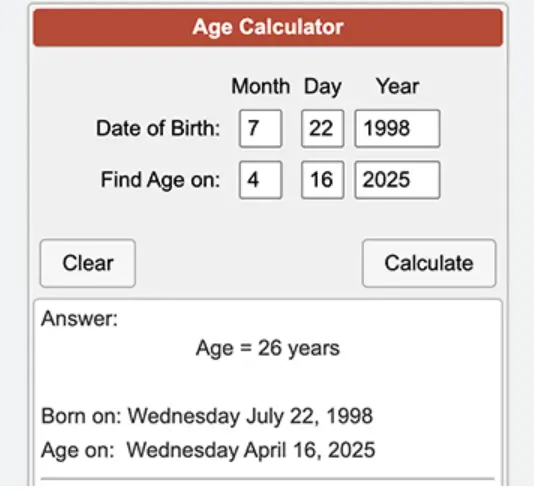
How Can You Calculate Your Age Manually?
You can work out your age yourself by following these simple steps:
- Write down today's date and your date of birth in Year–Month–Day format.
- Subtract the birth year from the current year.
- Check whether your birthday has already occurred this year. If it has not, subtract 1 from the total years.
- Calculate the months by subtracting the birth month from the current month. If the answer is negative, add 12 months and reduce the year count by one.
- Calculate the days by subtracting the birth day from the current day. If the result is negative, borrow the required number of days from the previous month, using the month's actual length (28, 29, 30, or 31 days).
Example of a Manual Age Calculation
Suppose a person was born on 14 March 1979, and today's date is 15 April 2026.
- Years: 2026 − 1979 = 47
- The birthday (14 March) has already passed, so the age remains 47 years.
- Months: April (4) − March (3) = 1 month
- Days: 15 − 14 = 1 day
Final age: 47 years, 1 month, 1 day
This step-by-step method provides an accurate age calculation and correctly handles leap years and months with different numbers of days.
Different Cultural Age Systems
Not every culture calculates age in the same way. In some traditions, age is counted by including the current year of life. As a result, someone who is 20 years old may also be described as being in their 21st year.
A traditional Chinese age system works differently as well. Under this method, a baby is considered 1 year old at birth, and everyone becomes one year older on the Traditional Chinese New Year instead of their individual birthday. For instance, if a child is born one day before the Traditional Chinese New Year, they will be regarded as 2 years old just two days later, despite being only two days old.
How Months and Days Are Counted
The month and day calculations can sometimes appear unusual, especially when the starting date falls at the end of a month.
For example, the period from 20 February to 20 March is counted as exactly one month. However, calculating the time between 28 February 2022 and 31 March 2022 can produce different results depending on the calculation method used.
One approach counts 28 February to 28 March as one full month, leaving an additional 3 days, for a total of 1 month and 3 days. Another method treats both 28 February and 31 March as the final day of their respective months, resulting in an age difference of exactly 1 month.
Both methods are reasonable, and similar situations occur with dates such as 30 April to 31 May or 30 May to 30 June. These differences arise because calendar months do not all contain the same number of days.
This age calculator uses the first method, where the calculation is based on the matching calendar date before adding any remaining days.
What Is Chronological Age?
Chronological age refers to the actual amount of time that has passed from a person's date of birth to a specific reference date. It is typically measured in years, months, and days according to the Gregorian calendar.
This standard method of calculating age is widely used for important purposes such as medical treatment and dosage calculations, legal age verification, school admissions, retirement planning, and population research. The Age Calculator above follows ISO 8601:2019 date interval calculations, ensuring accurate and consistent results based on the same internationally recognised standard used by healthcare systems, government organisations, and actuarial professionals.
How Does the Age Calculator Work?
The Age Calculator determines your exact age by calculating the time between your date of birth and the current date using precise Gregorian calendar calculations. It displays the result across multiple time units at the same time, including years, months, weeks, days, hours, and seconds, so you can view your age in different formats without changing any settings.
To ensure accurate results, the calculator automatically accounts for leap years, including birthdays that fall on 29 February, helping to avoid common one-day calculation errors. Simply enter your date of birth in the calculator above, and your age will be calculated instantly with a complete breakdown of each time unit.
How Does the Age Calculator Handle Leap Years?
The Age Calculator accurately accounts for leap years, including birthdays that fall on 29 February. Following the internationally recognised civil registration standard, a person born on 29 February reaches their legal birthday on 28 February during non-leap years, as 29 February does not exist in those years.
For example, someone born on 29 February 2000 turns 25 years old on 28 February 2025, which is not a leap year. Their next birthday on the actual date of 29 February occurs in 2028, the next leap year. This approach prevents chronological drift, ensuring age calculations remain accurate over time without accumulating errors every four years.
Gregorian Leap Year Rules
The calculator follows the official Gregorian calendar rules to determine whether a year is a leap year:
- A year is a leap year if it is divisible by 4.
- However, years that are divisible by 100 are not leap years.
- The exception is when a century year is also divisible by 400, in which case it is a leap year.
For example:
- 2000 was a leap year because it is divisible by 400.
- 2100 will not be a leap year because it is divisible by 100 but not by 400.
- 2400 will be a leap year because it satisfies the 400-year rule.
The Age Calculator applies these rules automatically to deliver precise and reliable age calculations for every date.
How Is Age Counted in Different Parts of the World?
Age is not calculated the same way in every country. Around the world, three main age-counting systems are used. The Age Calculator on this page supports both the Western age system and the traditional Korean age system, allowing you to compare the results easily.
Western Age System
The Western age system is the standard method used in most countries for legal, medical, educational, and official purposes. Under this system:
- A person is 0 years old at birth.
- Age increases by one year on each birthday.
- This is the most widely accepted method of calculating chronological age.
Traditional Korean Age System
The traditional Korean age system (Sae-neun-nai) follows a different approach:
- A baby is considered 1 year old at birth, reflecting the time spent during pregnancy.
- Everyone becomes one year older on 1 January, regardless of their actual birthday.
Although South Korea officially replaced this system for legal and administrative purposes in June 2023, it continues to be used in everyday conversations and cultural settings.
East Asian Lunar Age System
Another traditional method is the East Asian lunar age system, where age increases at the Lunar New Year instead of on a person's birthday.
For example, a child born on 30 December may be considered 1 year old at birth and then 2 years old just a few days later when the next Lunar New Year begins. As a result, a person's cultural age can be significantly different from their chronological age.
If the Age Calculator includes a Korean age option, you can enable it to compare your Western age with your traditional Korean age instantly.
When Do You Need an Exact Chronological Age Calculation?
An exact chronological age is essential in situations where even a small difference in age can affect legal rights, medical decisions, or financial outcomes. Instead of using an estimated age, professionals rely on precise calculations to ensure accuracy and compliance.
Below are some of the most common situations where an exact age calculation is required.
Medical Treatment and Medication
Healthcare professionals often need a patient's precise age when prescribing medication or providing treatment.
- Newborns may require age to be calculated in days during the first month of life.
- Infants and young children are commonly assessed in months for growth monitoring and weight-based medication dosing.
- Clinical research studies also use exact age to determine participant eligibility.
Retirement and Government Benefits
Many retirement programmes and government benefits are based on specific age milestones rather than approximate years.
Examples include:
- US Social Security full retirement age, such as 66 years and 10 months for people born in 1959.
- IRA penalty-free withdrawals beginning at 59½ years.
- Medicare enrolment periods, which depend on reaching a particular age by an exact date.
Legal Documents and Estate Planning
Legal agreements often include age-based conditions that must be calculated precisely.
These may include:
- Wills
- Trusts
- Beneficiary distributions
- Contracts with age-related eligibility requirements
Using an exact chronological age helps ensure legal documents are interpreted correctly.
School Admissions
Many schools determine eligibility based on strict enrolment cut-off dates.
For example, Pennsylvania, California, and several other US states use a 1 September cut-off date to decide which grade a child may enter. In these cases, even a one-day difference in age can affect school placement.
Insurance Underwriting
Insurance providers frequently use exact age when calculating premiums.
Life insurance rates often change when a person reaches a new age bracket. Qualifying for a lower premium before an age anniversary can significantly reduce long-term insurance costs.
Genealogical and Historical Research
Researchers and family historians often calculate exact lifespans using historical birth and death records.
For older records, particularly those dated before 1923, age calculations may also require converting dates between the Julian and Gregorian calendars to maintain historical accuracy.
The Age Calculator above provides precise chronological age calculations, making it a reliable tool for personal, legal, medical, educational, financial, and historical purposes.
What Is the Difference Between Chronological Age and Biological Age?
Although both terms describe ageing, chronological age and biological age measure different things.
Chronological age is the amount of time that has passed since your birth. It is calculated using the calendar and expressed in years, months, and days. This is the official age used for legal documents, medical records, education, employment, and government services.
Biological age, on the other hand, reflects how your body is ageing based on its overall health and physical condition. It is estimated using scientific indicators such as:
- Telomere length
- DNA methylation patterns
- VO₂ max (cardiorespiratory fitness)
- Cardiovascular health
- Inflammation biomarkers
Because biological age is influenced by lifestyle, genetics, and overall health, it may not match your chronological age.
For example, two people who are 50 years old chronologically can have very different biological ages. Someone who exercises regularly, eats a balanced diet, and maintains good health may have a biological age of 40, while another person of the same chronological age who smokes and leads a sedentary lifestyle could have a biological age of 60.
Which Age Is Officially Recognised?
For legal, administrative, and clinical purposes, chronological age is the only officially recognised measure. It is the standard used for:
- Government records
- Passports and identification documents
- School admissions
- Employment eligibility
- Retirement benefits
- Medical documentation
While biological age is becoming increasingly valuable in longevity research and personalised medicine, it has no legal status for official documentation.
The Age Calculator on this page calculates chronological age, providing the precise age required for official and everyday use. Estimating biological age requires specialised medical assessments, including epigenetic clock tests such as GrimAge and PhenoAge, along with other clinical health evaluations.
How Is Age in Days, Hours, and Seconds Calculated?
The Age Calculator determines the total time you have lived by calculating the exact number of calendar days between your date of birth and the current date. The calculation includes every leap year encountered, ensuring an accurate total.
Once the total number of days has been calculated, the remaining time units are derived using standard conversions:
- Hours: Total days × 24
- Minutes: Total days × 1,440
- Seconds: Total days × 86,400
For example, a person who is approximately 30 years old has lived for around 10,957 days (depending on the number of leap years), which is roughly 263,000 hours or 946 million seconds.
Live Seconds Counter
The Age Calculator features a live seconds counter that updates continuously in real time. Using JavaScript's requestAnimationFrame API, the total number of seconds increases every second, allowing you to watch your lifetime count grow as you view the results.
If you want to measure the duration between any two dates instead of calculating age from birth, you can use a Time Between Dates Calculator. For additional birthday-related information such as your zodiac sign, planetary ages, or life path number a Birthday Calculator provides a more detailed personal profile.
Conclusion
Knowing your exact age is useful for much more than simple curiosity. Whether you need it for official documents, school admissions, healthcare, retirement planning, or personal records, an accurate age calculation helps you make informed decisions. This Age Calculator provides precise results across multiple time units while accounting for leap years and international age-counting methods, making it a reliable tool whenever you need to calculate age with confidence.