
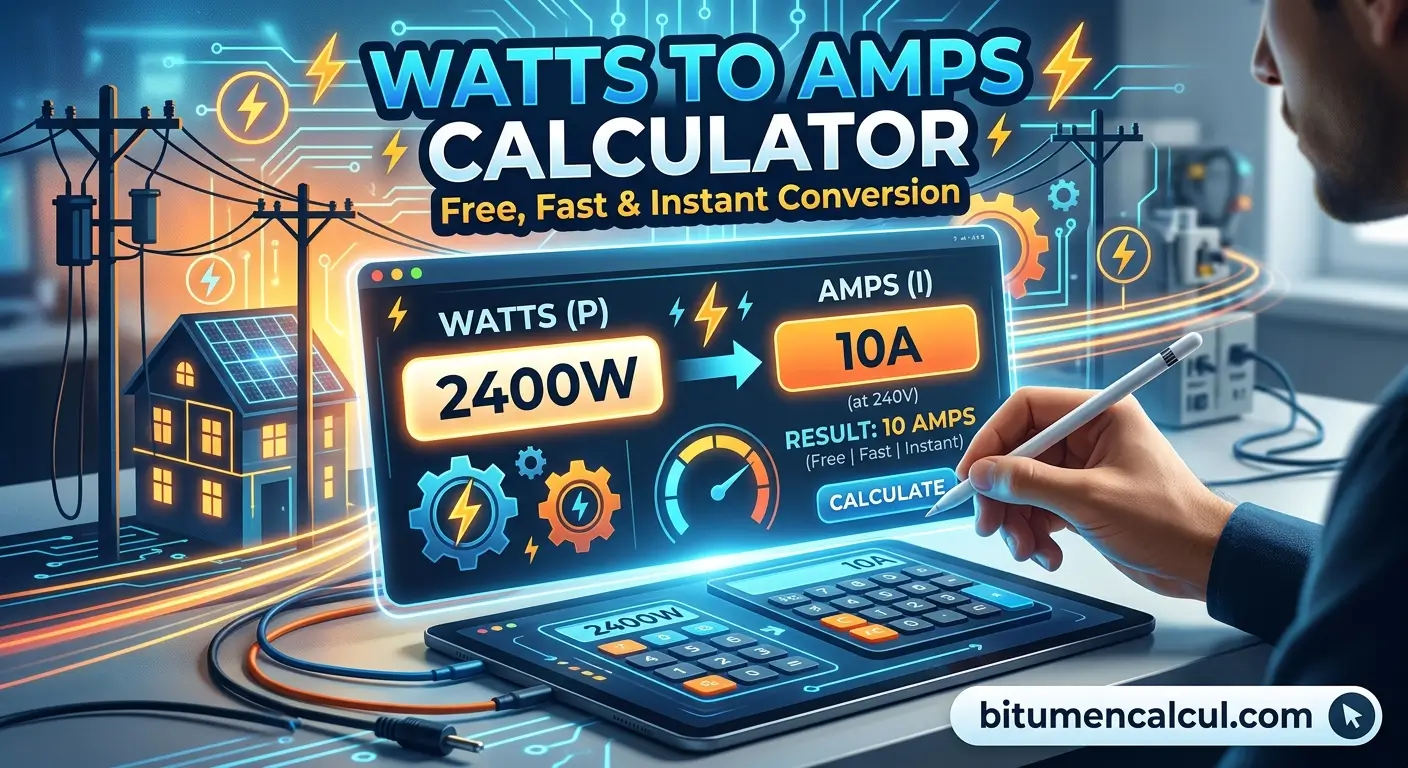
Watts to Amps Calculator Free, Fast & Instant Conversion
Watts to Amps Calculator
Convert electrical power in watts to current in amps easily.
Examples & Reference Formulas
- DC: I = P ÷ V (e.g., 1000W ÷ 120V = 8.33A)
- AC Single Phase: I = P ÷ (V × PF) (e.g., 1000W ÷ (120V × 0.8) = 10.42A)
- AC Three Phase: I = P ÷ (√3 × V × PF) (e.g., 1000W ÷ (1.732 × 400V × 0.8) = 1.80A)
Use our streamlined online tool to seamlessly calculate conversions between watts and amps. You can easily switch your parameters to accommodate either alternating currents (AC) or direct currents (DC) configurations.
Electrical Units: Amps, Volts, and Watts

Grasping how electrical systems operate starts with three primary metrics:
- Amps (A): Short for amperes, this measures total electrical current the volume of electricity moving through a circuit (like water volume flowing through a pipe).
- Volts (V): Measures the electrical pressure or force driving current through a conductor (like water pressure in a hose).
- Watts (W): Quantifies total power consumption or energy transfer rate ($1\text{ Watt} = 1\text{ Joule/second}$). Multiplying Amps by Volts gives total Watts.
How to Calculate Power (DC and AC Systems)
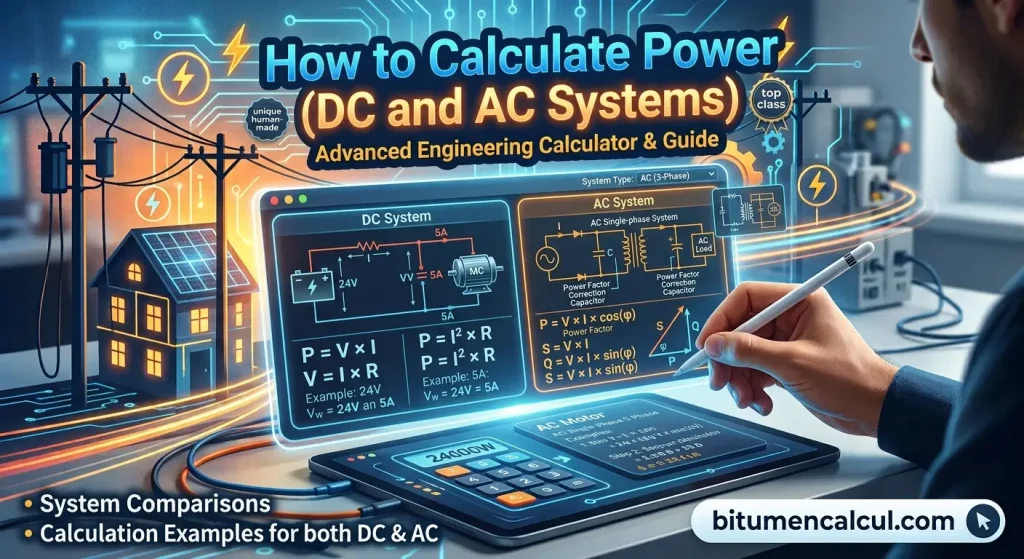
Direct Current (DC) Systems
In DC circuits such as battery-operated devices current flows in a single, constant direction:
$$P_{(W)} = I_{(A)} \times V_{(V)}$$
Single-Phase AC Systems
Alternating current periodically shifts direction. Calculating active power requires accounting for efficiency via the power factor (PF):
$$P_{(W)} = PF \times I_{(A)} \times V_{(V)}$$
Three-Phase AC Systems
Evaluating active power across three-phase configurations depends on your voltage reference:
- Line-to-Line Voltage ($V_{L-L}$):$$P_{(W)} = \sqrt{3} \times PF \times I_{(A)} \times V_{L-L(V)}$$
- Line-to-Neutral Voltage ($V_{L-N}$):$$P_{(W)} = 3 \times PF \times I_{(A)} \times V_{L-N(V)}$$
Ohm’s Law and Electrical Safety
Formulated by Georg Ohm, Ohm’s Law defines the fundamental relationship between voltage, current, and resistance. Resistance describes how strongly a material opposes current flow longer conductors increase resistance, whereas thicker wires reduce it.
Why It Matters: Every household circuit has a maximum current capacity measured in amps. Plugging high-draw appliances into lightweight extension cords creates excessive heat. Tracking total wattage prevents overloaded circuits, tripped breakers, and severe fire hazards.
Equipment and Lighting Power Factor Guide
Power factor (PF) measures how efficiently an electrical device converts incoming power into useful work. Devices with motors or ballasts draw reactive power, lowering total system efficiency.
| Equipment or Light Type | Power Factor (PF) | Operational Summary |
| Resistive Loads (Standard Bulbs, Heaters, Ovens) | 1.0 | Perfect efficiency; uses 100% of consumed energy. |
| Commercial / Industrial LED Lights | 0.9 or higher | Highly efficient modern solid-state lighting. |
| Fluorescent Tube Lights | 0.5 – 0.95 | Efficiency depends on electronic vs. magnetic ballast. |
| Compact Fluorescent Lamps (CFLs) | 0.5 – 0.6 | Lower efficiency; typical for legacy residential bulbs. |
| Induction Motor (Full Load) | 0.85 | Runs efficiently under standard active load. |
| Induction Motor (No Load) | 0.35 | Very inefficient when idling without a mechanical load. |
| High-Pressure Sodium (HPS) & Metal Halide | 0.8 – 1.0 | Common for high-power streetlights and outdoor lamps. |
| Neon Signs | 0.6 – 0.7 | Uses step-up transformers causing moderate energy loss. |
(Note: Always consult manufacturer specification sheets for precise engineering calculations.)
Current to Power Reference Table (120V Circuit)
This reference conversion breakdown links electrical current directly to total power output on a standard 120-volt system:
| Current (Amps) | Voltage (Volts) | Power (Watts) |
| 0.1 A | 120 V | 12 W |
| 0.5 A | 120 V | 60 W |
| 1.0 A | 120 V | 120 W |
| 2.0 A | 120 V | 240 W |
| 5.0 A | 120 V | 600 W |
| 10.0 A | 120 V | 1200 W |
Milliamperes Conversion: For low-power electronics, $1\text{ Ampere (A)} = 1000\text{ Milliamperes (mA)}$.
FAQs
Conclusion
The core relationship between watts, volts, and amps along with factors like power factor and voltage phase is essential for accurately calculating current draw and preventing electrical overloads. Whether you are balancing household loads, selecting proper wiring, or managing industrial equipment, evaluating these parameters ensures your electrical systems operate safely, efficiently, and well within continuous breaker limits.
Read More:





One Comment