

Freight Linear Feet Calculator: Free LTL & Trailer Usage Tool
Linear Feet Calculator
Calculate total linear footage from multiple items in feet or inches.
When transporting less-than-truckload (LTL) cargo, the physical floor space your goods occupy on a trailer is just as critical as their total weight. Logistics providers frequently evaluate linear footage measuring the total length required along the trailer floor to determine space requirements, particularly when dealing with oversized items or non-stackable pallets.

To streamline this process, toolkits like FreightRun’s Freight Linear Feet Calculator allow shippers to accurately determine required trailer space, helping avoid unexpected extra charges while securing precise freight quotes for both LTL and partial truckload shipments.
What Is a Freight Linear Feet Calculator?

A freight linear-foot calculator determines the precise amount of longitudinal floor space a shipment occupies inside a standard cargo trailer. By measuring pallet footprints prior to booking, less-than-truckload (LTL) and full truckload shippers can secure accurate rate estimates while avoiding unexpected carrier adjustments or re-classifying charges.
Entering the total pallet count alongside standard dimensions allows the tool to project overall trailer deck consumption. These calculators operate with maximum precision when handling uniform pallet sizes; however, shipments featuring mixed dimensions, oversized crates, or non-standard configurations typically require a tailored quote from a freight specialist.
Establishing exact space requirements creates mutual transparency between consignors and transport providers well before the vehicle arrives for loading. This upfront clarity prevents billing disputes triggered by inaccurate initial measurements and ensures trailer capacity is used efficiently without wasted deck area.
How to Calculate Linear Feet for Freight Shipping

Computing linear feet for standard palletised freight is a straightforward process.
To determine your shipment's total linear footprint, follow this sequence:
- Tally Total Pallets: Count the exact number of pallets comprising your consignment (for example, 10 pallets).
- Halve the Pallet Count: Divide your total by two to reflect how cargo fits side by side inside a standard trailer (10 ÷ 2 = 5).
- Apply Pallet Length: Multiply by the length of your base. While standard North American industrial setups typically use a 48" × 40" footprint, specialized or international export equipment requires substituting the appropriate length measurement.
- Convert Inches to Feet: Divide your total inches by 12 to establish the final linear footage (240 ÷ 12 = 20 linear feet).
Why Linear Feet Matter in LTL Shipping
Linear deck space serves as a primary metric for pricing in Less-than-Truckload (LTL) logistics, where space inside a single vehicle is allocated across multiple clients. Transport providers rely on these footprint measurements to optimize deck layout and maximize the usable capacity of every haul.
Accurately determining trailer space helps shippers to:
- Prevent unexpected adjustments on final invoices
- Steer clear of carrier re-rate and reclassification surcharges
- Secure precise upfront rate estimates
- Maximize cargo placement inside the vehicle
- Identify when transitioning to Partial (PTL) or Full Truckload (FTL) becomes the more cost-effective option
Transport companies routinely enforce linear foot rules and revised pricing structures whenever a single order consumes a significant portion of the total trailer length.
What Is a Linear Foot in Freight Shipping?
A linear foot represents a continuous 12-inch measurement taken along the floor of a cargo trailer. In freight logistics, hauliers assess shipment size by evaluating the straight-line deck space cargo occupies, rather than relying strictly on total surface area or overall volume. When moving palletised goods, this front-to-back dimension serves as the core metric for determining your total linear footprint.
Linear Foot Estimations for Standard Cargo
| Pallets | Dimensions | Linear Feet |
| 2 | 48" × 40" | 4 ft |
| 4 | 48" × 40" | 8 ft |
| 6 | 48" × 40" | 12 ft |
| 8 | 48" × 40" | 16 ft |
| 10 | 48" × 40" | 20 ft |
How Many Linear Feet Is One Standard Pallet?
A single standard 48" × 40" pallet equals roughly 1.67 linear feet of space along a trailer floor. That said, actual deck usage can vary based on pallet positioning, whether goods can be double-stacked, trailer width variations, overall cargo dimensions, and specific carrier loading methods.
Individual pallets are seldom priced using linear-foot metrics alone, as transport providers generally assess the total footprint of the complete consignment.
Linear Feet vs Square Feet vs Cubic Feet
Misinterpreting physical space metrics is a frequent error in haulage operations. Freight transport relies on measuring longitudinal trailer floor usage, which differs significantly from flat surface area or overall spatial capacity.
Comparison of Freight Measurement Units
| Metric | Measurement Focus | Primary Practical Application |
| Linear Feet | Longitudinal trailer floor space used | LTL deck allocation and billing |
| Square Feet | Total floor surface area | General flooring or decking requirements |
| Cubic Feet | Three-dimensional total volume | Assessing cargo density calculations |
Because hauliers focus primarily on the practical arrangement and positioning of cargo inside the vehicle deck, relying on simple surface-area conversions like square-feet-to-linear-feet often yields inaccurate estimates for transport logistics.
Standard Dry Van Trailer Specifications
- Length: 53 feet
- Width: 102 inches
- Height: 110 inches
Because internal width is fixed, transport providers must meticulously manage how cargo occupies the available floor layout. Consignments that absorb a substantial portion of the vehicle's deck risk triggering specific rating mechanisms, including:
- Linear foot pricing adjustments
- Volume LTL rate structures
- Recommendations to upgrade to partial truckload (PTL) services
- Surcharges for freight reclassification
What Is the Linear Foot Rule?
The linear foot rule is a standardized pricing threshold applied by Less-than-Truckload (LTL) carriers. Transport providers typically enforce this rule under specific cargo conditions, such as when:
- Cargo absorbs 10 or more linear feet of continuous trailer floor space
- Freight consists of large, non-stackable items
- Shipments feature oversized or non-standard pallet footprints
When triggered, carriers alter their standard rate calculations by assessing freight at a minimum billed weight often 1,000 lbs per linear foot occupied regardless of whether the physical weight of the consignment is substantially lower.
Why Non-Stackable Freight Costs More
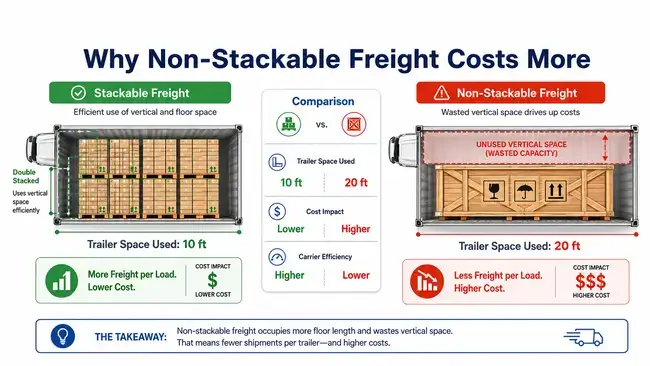
Cargo that cannot be top-loaded absorbs significantly more deck space, as carriers are unable to place additional items above it. Common examples of non-stackable items include industrial machinery, delicate freight, large custom crates, point-of-sale displays, and high-value electronics. Because these shipments consume a larger vertical footprint per unit moved, transport providers must charge higher relative rates to compensate for the lost vertical trailer capacity.
Space Usage and Cost Comparison
| Freight Type | Trailer Capacity Usage | Relative Shipping Cost |
| Stackable Pallets | Lower | Lower |
| Non-Stackable Freight | Higher | Higher |
LTL vs FTL: When Linear Feet Matter Most
Linear foot calculations carry the most weight in LTL logistics due to the shared nature of trailer capacity across multiple clients. When cargo absorbs a substantial portion of the trailer floor, logistics specialists often evaluate alternative transit options such as volume LTL, partial truckload (PTL), or full truckload (FTL) to maximize cost efficiency and space usage.
Relevance of Linear Feet Across Shipping Modes
| Shipping Type | Do Linear Feet Apply? | Impact on Pricing |
| LTL (Less-Than-Truckload) | Yes | Common |
| Partial Truckload (PTL) | Sometimes | Possible |
| Full Truckload (FTL) | No | Less common |
Typical Freight Transport Scenarios
- Non-Stackable Industrial Machinery: Heavy equipment generally triggers linear-foot rate rules because additional cargo cannot be safely top-loaded onto it.
- Retail Fixture and Display Consignments: Point-of-sale displays and retail fixtures frequently occupy extensive floor space while remaining relatively lightweight, making linear-foot billing metrics particularly applicable.
- Oversized Crates: Bulky custom crating often extends beyond standard pallet footprints, necessitating direct coordination and manual space planning with the carrier.
- Mixed-Dimension Pallet Loads: Consignments featuring varying pallet sizes typically require customized spatial calculations rather than standard linear formulas.
Frequent Errors in Linear Foot Calculations
- Measuring Width Rather Than Length: Linear footage relies strictly on the length of cargo along the length of the trailer, rather than its width.
- Overlooking Cargo Stackability: Failing to account for whether pallets can be safely top-loaded can lead to overestimating trailer deck usage and paying higher transport fees.
- Disregarding Freight Overhang: Goods extending beyond the edges of a pallet footprint consume additional floor space, making the total footprint larger than the base pallet dimensions indicate.
- Inaccurate Base Measurements: Minor errors in recording pallet dimensions can distort overall space estimates, leading to re-rate adjustments and unexpected carrier charges.
The Critical Impact of Precise Cargo Measurements
LTL carriers routinely inspect and verify pallet dimensions during terminal handling and transit processing. Recording inaccurate freight measurements can lead to several operational and financial consequences, including:
- Reweigh Surcharges: Additional fees assessed when carrier scale checks contradict billed dimensions or weights.
- Freight Reclassification Charges: Price adjustments applied when inaccurate dimensions shift cargo into a higher, more expensive freight class.
- Invoice Adjustments: Unexpected billing additions applied after delivery to cover unquoted deck consumption.
- Delivery and Logistics Delays: Hold-ups during terminal transit while hauliers re-measure, re-weigh, and update billing details.
Calculating linear footage accurately upfront eliminates these billing disputes, ensures seamless transit, and guarantees accurate quotes from the start.
When Freight Density Takes Precedence
While linear foot measurements capture cargo footprint, transport providers also evaluate volume and mass when handling lightweight, bulky shipments. Consignments such as pillows, foam products, un-filled containers, and hollow retail packaging occupy substantial trailer capacity while contributing minimal weight.
When handling high-volume, low-mass freight, carriers assess:
- Freight Density: The ratio of shipment weight relative to the overall space it consumes.
- Cubic Feet: The total three-dimensional volume occupied within the vehicle.
- Freight Class: The standardized classification determining base rating categories.
Utilising dedicated density and cubic volume calculation tools alongside freight classification guides ensures precise planning and rate accuracy for low-density cargo.
Best Practices for Freight Planning
- Measure Cargo Post-Packaging: Stretch wrapping, strapping, and physical overhang frequently expand the final footprint. Always record precise length, width, and height after packaging is fully completed.
- Confirm Stackability Status Prior to Transit: Misrepresenting non-stackable cargo as stackable can trigger carrier disputes and generate unexpected rate increases.
- Evaluate LTL Against Partial Truckload Options: Consignments occupying 10 to 12 linear feet or more may secure better rates and efficiency by shifting from standard LTL to a partial truckload (PTL) service.
- Ensure Bill of Lading (BOL) Precision: Entering inaccurate freight dimensions on official BOL documentation can cause delivery delays, reclassification surcharges, and costly billing disputes.
Expert Assistance for Freight Planning and Trailer Allocation
Navigating trailer space requirements, specialized cargo, and carrier pricing rules requires precision to keep transport operations running smoothly. FreightRun assists shippers with:
- Carrier Rate Comparison: Evaluating competing LTL carrier quotes to secure cost-effective shipping options.
- Freight Management & Coordination: Streamlining logistics processes for both Less-than-Truckload (LTL) and Full Truckload (FTL) transport.
- Trailer Usage Estimation: Calculating precise deck footprints to prevent billing adjustments and reclassification fees.
- Custom Cargo Solutions: Providing tailored support and direct quotes for oversized crates, non-stackable equipment, and mixed-dimension pallet loads.
Utilise FreightRun’s suite of digital freight tools or reach out directly to the logistics team for expert guidance on complex freight configurations.
FAQs
Conclusion
Accurately calculating linear feet is crucial in freight logistics and construction because it measures the exact straight-line deck or surface space cargo or materials occupy, preventing costly billing surcharges, reclassification fees, and operational delays. Whether optimizing LTL trailer floor space or planning material orders like trim and lumber, taking post-packaging measurements and understanding length metrics ensures upfront price transparency, seamless transit, and precise budgeting across all transport and building projects.
Read More: