

Displacement Calculator Powerful Tool to Calculate Displacement
Displacement Calculator
Calculate displacement using the physics formula: Δx = x_f − x_i
The Engine Displacement Calculator helps you calculate engine displacement using either the metric system or the US standard system, making it easy to determine the engine's total cylinder volume.
Engine displacement is calculated by multiplying the engine cylinder bore area by the crankshaft stroke length, then multiplying the result by the number of cylinders. This calculation gives you the engine's total swept volume.
How to Find Displacement Using the Displacement Calculator?
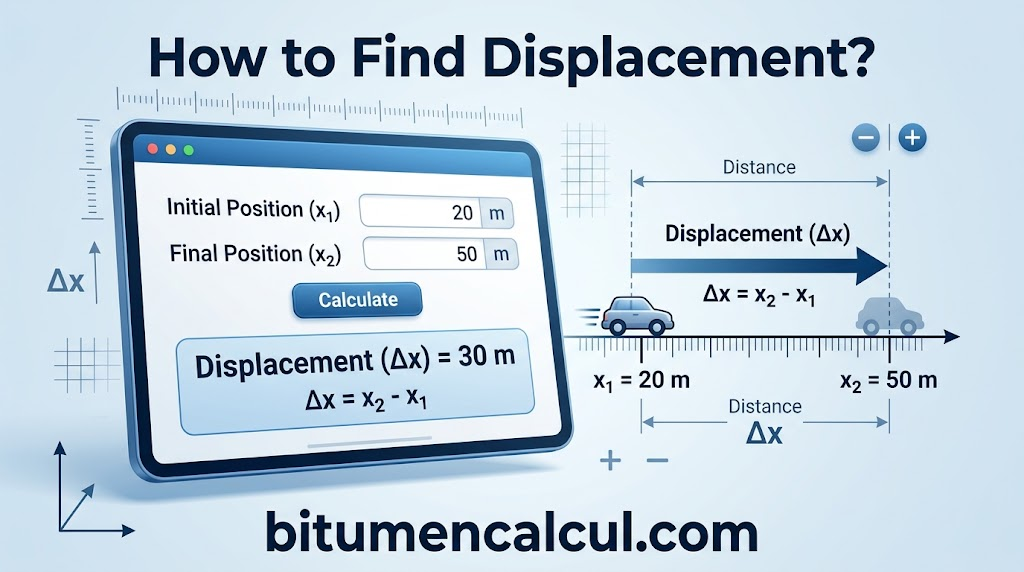
In the displacement calculator shown on the left, you will find three different calculation modes. The default option is the simplest way to determine displacement, using constant velocity and the time taken. The second mode involves a slightly more detailed calculation, allowing you to find displacement using the initial and final velocities or acceleration.
The third mode of the displacement calculator lets you enter up to 10 different velocities, along with the time spent at each velocity. The calculator then determines the total displacement based on your inputs. Whenever you enter a velocity, another input field will appear, making it easy to add more values.
Example: How to Find Displacement Using Acceleration and Time
Follow these simple steps to calculate displacement:
- Enter the time for which the object is moving.
- Provide the object's acceleration.
- Enter either the initial velocity or the final velocity.
- The calculator will automatically determine the resulting displacement using the information you provided.
As an additional benefit, the calculator can also calculate the missing initial or final velocity, depending on the values you enter.
Now that you understand how to calculate displacement, you may also want to explore how displacement differs from distance. Let's look at the key differences between these two concepts!
How to Calculate Displacement: Displacement Formula
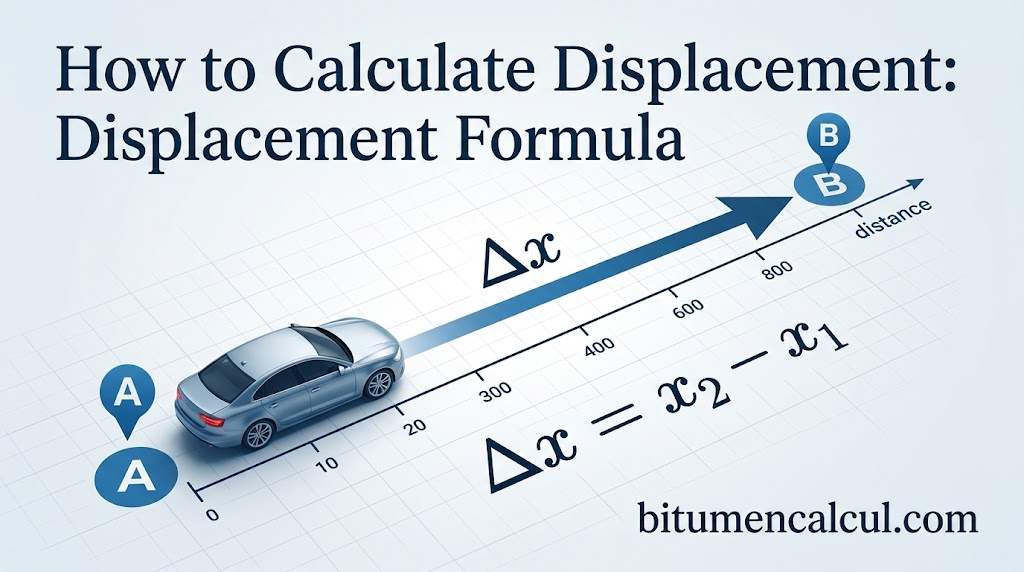
So, how to calculate displacement when it differs from the total distance traveled? To understand this, let's look at the displacement formula and focus on how displacement is calculated rather than comparing displacement and distance. There are several ways to express the displacement formula, but the basic equation we need is:
where:
drepresents the displacement;tis the time taken to move from the starting point to the finishing point; andvis the average velocity between the two positions.
The key factor here is velocity, not speed. Velocity takes into account the direction of motion, while speed only describes how fast an object moves. You can learn more about this distinction in our guide on how to calculate velocity.
When studying displacement in physics, we can also determine average velocity using the acceleration calculator or the acceleration formula, provided that acceleration remains constant:
where:
arepresents the acceleration;v₀is the initial velocity; andv₁is the final velocity.
Using this information, we can calculate displacement with the following equation:
Another approach is to find the average velocity from several different velocity values. This can be done by calculating a weighted average, where each velocity is assigned a weight based on the amount of time the object spends moving at that velocity. Our weighted average calculator can help you perform this calculation conveniently.
If you're interested in finding the average rate at which distance changes over time, which is known as average velocity, visit our average rate of change calculator for further guidance.
Displacement Definition: What Is Displacement?
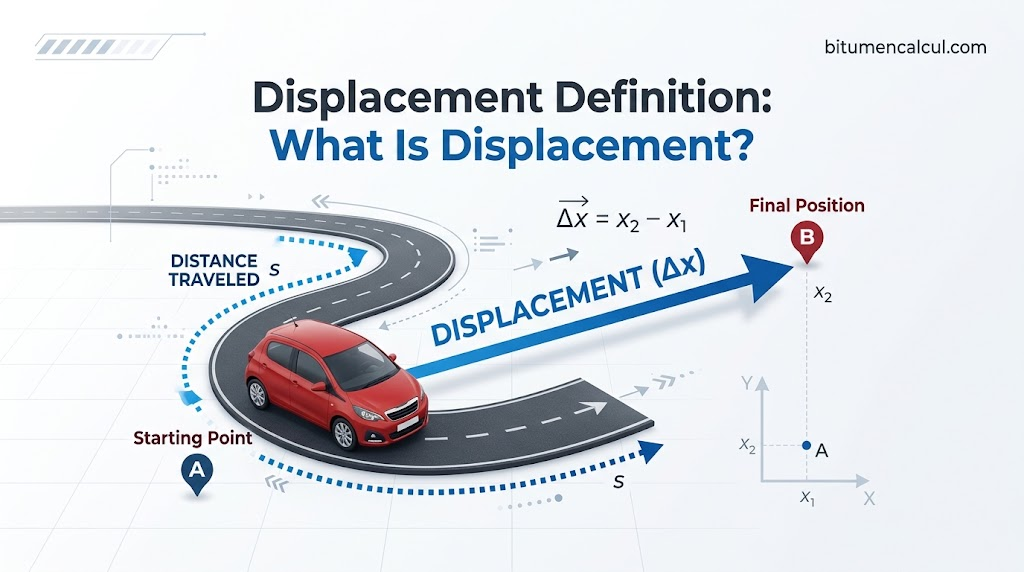
Let's begin by understanding the displacement definition. The meaning of displacement can vary depending on the context, so what does it mean in physics? In physics and geometry, displacement refers to the change in an object's position, regardless of the path taken to reach its destination.
As we will explain further when discussing the displacement formula, displacement can be understood as the straight-line distance between an object's initial and final positions. It does not consider the route followed during the movement. This means displacement is different from the total distance traveled.
For example, consider traveling between New York and Washington. The actual distance between cities depends on the road or route you choose. However, the displacement remains the same regardless of the route because it represents the straight-line distance between the starting city and the destination.
Did you know that angular displacement is another type of displacement? It describes the change in an object's angular position. To explore this concept in more detail, take a look at our angular displacement calculator.
Displacement vs. Distance: Differences and Similarities
Displacement and distance are commonly mixed up because, in everyday conversations, we often use the word distance for both. However, in physics and geometry, they describe two different concepts, much like the difference between velocity and speed.
A simple way to understand the displacement vs. distance comparison is to connect displacement with velocity and distance with speed. When you use speed, which does not include a direction, you measure the total length of the path traveled. In contrast, velocity includes direction, so it can be used to determine the change in position from the starting point to the finishing point, which is the displacement.
Although distance is often the more useful measurement in everyday situations, such as calculating a vehicle's stopping distance, displacement plays an important role in physics. For example, physical quantities such as work are determined using force and displacement rather than the total distance traveled.
FAQs
Conclusion
Understanding displacement becomes much easier when you know how velocity, acceleration, time, and direction work together. Whether using a simple displacement formula or the displacement calculator, you can quickly determine an object's change in position and clearly distinguish it from the total distance traveled.
Read More: