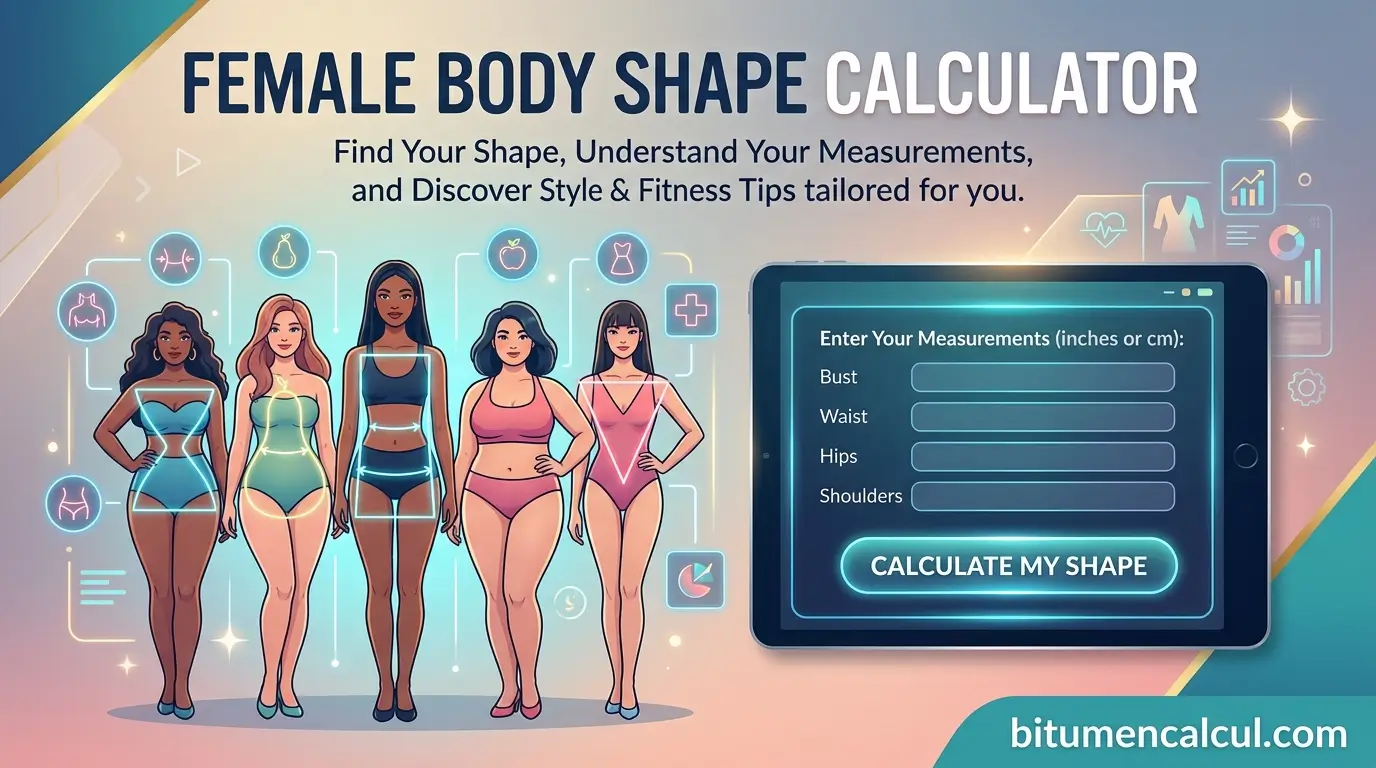
Female Body Shape Calculator
Female Body Shape Calculator
Enter your measurements to discover your proportion classification.
Your Body Shape
—
—
—
Disclaimer: Body shape categories are stylistic approximations based on relative geometric proportions. They are not medical, health, or diagnostic indicators.
How It Works
This tool analyzes the ratio between your bust, waist, and hip measurements. Rather than focusing on size, it evaluates how your proportions relate to each other to identify a general geometric profile.
Common Body Shapes
Hourglass
Bust and hips are roughly equal with a well-defined waist.
Pear / Triangle
Hips are noticeably wider than the bust, with a defined waist.
Inverted Triangle
Bust is noticeably wider than the hips.
Rectangle / Straight
Bust, waist, and hips are relatively uniform in width.
Apple / Round
Waist measurement is close to or larger than bust and hips.
Although a person's physical proportions can offer practical insight when choosing outfits that flatter their frame, using a "body shape" tool like the body type calculator should not be taken as a serious evaluation of health or ideal physical status. While scientific evidence links specific weight distribution patterns to varying medical risk factors, measuring health status is far better reflected by the waist-hip ratio, which is provided alongside the aesthetic estimations within the body shape result of this calculator.
When taking physical measurements, ensure you stand upright with your arms naturally at your sides. The measuring tape should lie flat against your skin without pinching or compressing the tissue, as pulling it too tight will distort your actual dimensions.
- Bust size: Wrapped across the fullest point of your chest while wearing a well-fitting bra.
- Waist size: Taken around the narrowest section of your torso, located slightly above the navel.
- High hip size: Measured around the upper curve of the pelvic area, roughly 18 cm (7 inches) beneath your natural waistline.
- Hip size: Captured around the widest point of the lower body, spanning the fullest part of the glutes.
Female body shapes in the fashion industry

Within the fashion sector, female silhouettes are generally grouped into four main categories:
- Apple, or inverted triangle: Represents a frame where the chest and shoulders are noticeably wider than the hips.
- Banana, straight, or rectangle: Refers to a figure where the waist is fewer than 9 inches smaller than the bust or hip measurements.
- Pear, spoon, bell, or triangle: Highlights a profile where the hips are larger in proportion to the bust.
- Hourglass, X shape, triangles opposing, or facing inwards: Frequently framed as the "ideal" proportion, describing balanced bust and hip dimensions paired with a distinctly narrower waistline.
Research from 2005 involving over 6,000 female participants at North Carolina State University demonstrated that nearly half of the cohort 46% of women featured a banana-shaped frame. The remaining distribution showed that just over 20% were pear-shaped, just under 14% were apple-shaped, and a minimal 8% were hourglass-shaped.
What is my body shape?
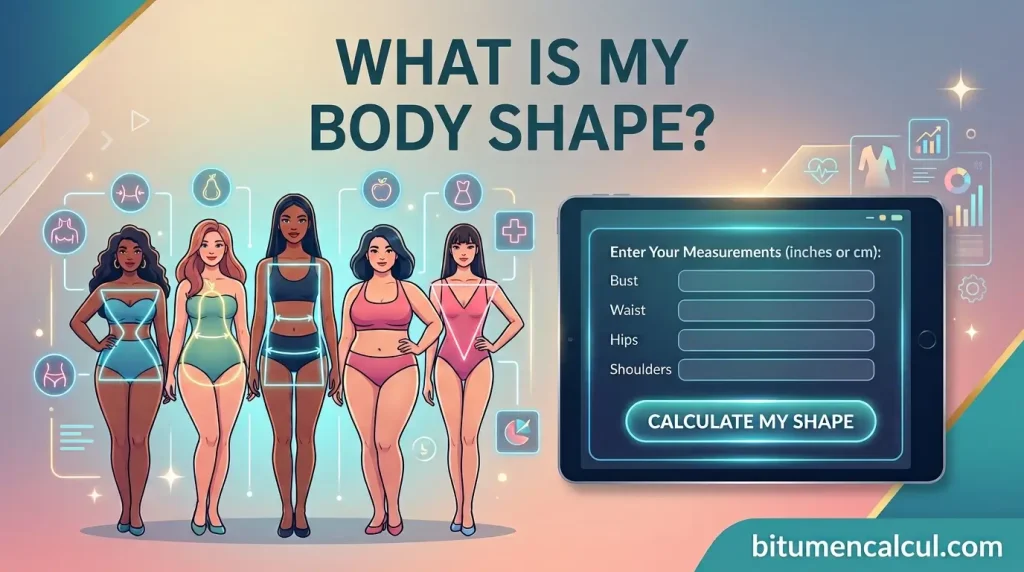
Cultural conventions and societal norms strongly influence how female physiques are defined across different global regions. The logic behind this tool relies on research featured in the International Journal of Clothing Science and Technology, classifying female figures into 7 categories. Given the extensive spectrum of physical proportions, individual dimensions vary significantly, and certain measurements may not align with any single preset category.
The mathematical parameters defining each profile include:
- Hourglass: If (bust - hips) ≤ 1" AND (hips - bust) < 3.6" AND (bust - waist) ≥ 9" OR (hips - waist) ≥ 10"
- Bottom hourglass: If (hips - bust) ≥ 3.6" AND (hips - bust) < 10" AND (hips - waist) ≥ 9" AND (high hip/waist) < 1.193
- Top hourglass: If (bust - hips) > 1" AND (bust - hips) < 10" AND (bust - waist) ≥ 9"
- Spoon: If (hips - bust) > 2" AND (hips - waist) ≥ 7" AND (high hip/waist) ≥ 1.193
- Triangle: If (hips - bust) ≥ 3.6" AND (hips - waist) < 9"
- Inverted triangle: If (bust - hips) ≥ 3.6" AND (bust - waist) < 9"
- Rectangle: If (hips - bust) < 3.6" AND (bust - hips) < 3.6" AND (bust - waist) < 9" AND (hips - waist) < 10"
Waist-hip ratio
The Waist-hip ratio (WHR) measures proportional fat distribution by calculating the quotient of waist circumference divided by hip circumference for instance, a 34" waist alongside a 40" hip yields a waist-hip ratio of 34/40, or 0.85. Beyond simple aesthetics, this metric serves as a vital clinical marker. Organizations like the National Institute of Diabetes, Digestive and Kidney Diseases (NIDDK) highlight that women with WHRs above 0.8 and men with WHRs above 1.0 have higher health risks as a result of their fat distribution, particularly because abdominal fat (which corresponds to people with "apple-shaped" bodies) carries far greater physiological dangers than peripheral fat stores.
In assessing overall health, the World Health Organization (WHO) defines males with a WHR above 0.90 and females with a WHR above 0.85 as obese. This threshold often correlates to a body mass index (BMI) above 30, a key contributor to conditions like hypertension, coronary heart disease, diabetes, some cancers, and more. Notably, research indicates that WHR has been found to be more effective than both waist circumference and BMI for predicting mortality in people above the age of 75, while also serving as a superior indicator for cardiovascular conditions. In fact, a study by Yusuf S, et al. noted that if obesity were to be re-defined based on WHR rather than BMI, the proportion of people who would be categorized as being at risk of heart attack would increase three times.
Outside of metabolic disease, WHR is also correlated with fertility. Data shows that females with WHRs above 0.80 have been found to have significantly lower pregnancy rates than those with WHRs between 0.70 and 0.79, whereas men with WHRs around 0.9 are more fertile, tend to be healthier, and also have a lower chance of both prostate and testicular cancer. Additionally, this ratio has been evaluated in studies concerning cognitive ability, physical attractiveness, and nutritional patterns.
FAQs
Conclusion
A person's body shape is primarily useful for fashion styling rather than measuring health, whereas metrics like the waist-hip ratio (WHR) provide far greater clinical value by evaluating abdominal fat distribution and predicting serious health risks like heart disease and diabetes. While societal ideals, global cultures, and historical eras continuously shift preferences around silhouettes from the common banana/rectangle shape (found in ~46% of women) to the rare hourglass frame (found in ~8% of women) overall vitality, physical fitness, and balanced health indicators remain far more meaningful than any aesthetic category.
Read More:





One Comment