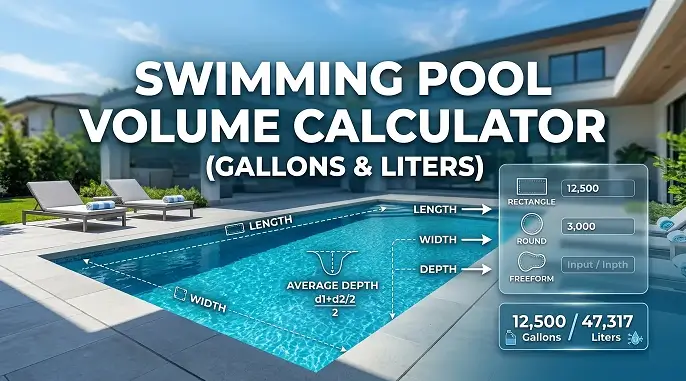
Swimming Pool Volume Calculator (Gallons & Liters) 2026
Tank Volume Calculator
Accurately calculate total and partially-filled tank volume in multiple units.
Formula Applied
Select a tank shape to view the specific mathematical formula.
Note: Results are estimates based on exact geometric shapes and do not account for wall thickness or irregular tank interiors.
Swimming Pool Volume Calculator To determine the precise volume or total capacity of a pool or spa, start by calculating its surface area in square feet. This initial measurement provides the foundation for figuring out total gallonage, establishing safe swimmer capacity limits, and managing key operational details. When taking measurements, always gauge the actual depth of the water rather than the height of the physical wall to keep your figures accurate.
If your pool features an irregular or complex shape, simply break the layout down into simpler geometric sections, calculate each section separately, and combine the totals. You can find detailed breakdown instructions below the calculator, or reach out to a qualified pool specialist for professional assistance.
Determining Pool Surface Area with Basic Geometry
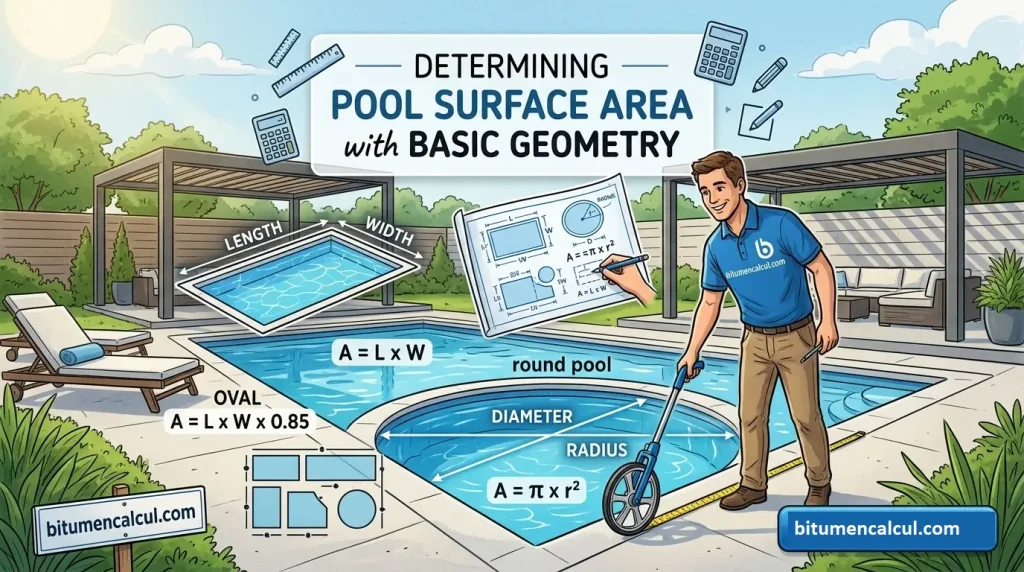
Using fundamental geometric formulas is a simple, effective way to calculate a pool's surface area.
Formula Key:
- A: Area
- L: Length
- W: Width
- H: Height
- r: Radius
- d: Diameter
- Pi ($\pi$): 3.14 (constant)
Basic Surface Area Formulas
- Square or Rectangle: A = L x W
- Right Triangle: A = (L x W) / 2
- Circle: A = Pi x r x r
Factoring Depth to Find Total Volume
Determining a pool’s volume requires introducing water depth into your surface area calculations. To maintain accuracy, divide pools with varying floor levels into distinct depth zones and calculate each section independently.
Constant Depth Pools: Square or Rectangular
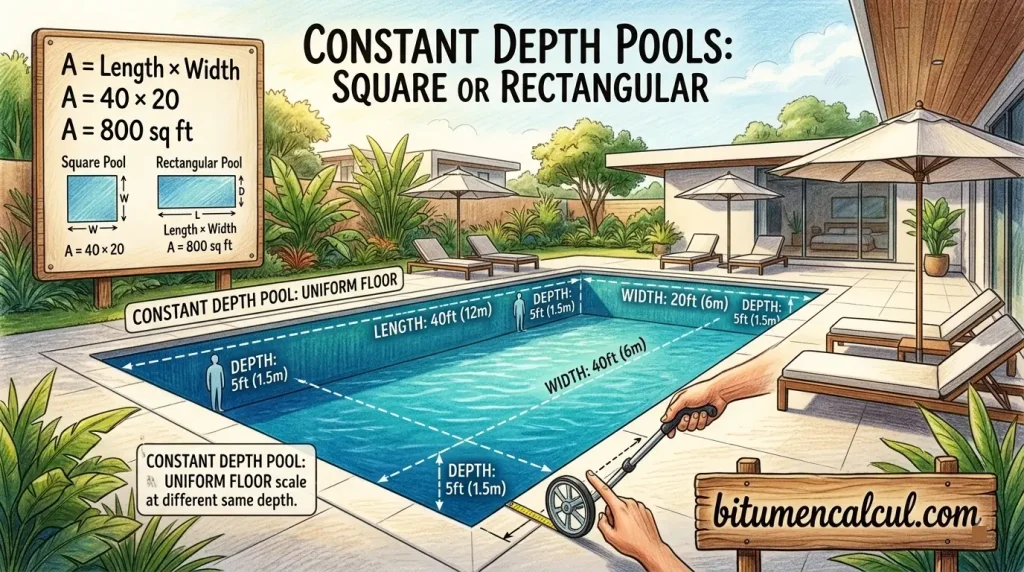
To calculate the volume of a square or rectangular pool with a changing depth, use the formula below:
Length x Width x Average Depth x 7.5 = Volume (in gallons)
Step-by-Step Guide:
- Find the Average Depth: Add the shallowest depth to the deepest depth, then divide the result by 2.
- Average Depth = (Shallow Depth + Deep Depth) / 2
- Calculate Surface Area: Multiply the length by the width.
- Surface Area = Length x Width
- Calculate Cubic Feet: Multiply the surface area by the average depth.
- Cubic Feet = Surface Area x Average Depth
- Convert to Gallons: Multiply total cubic feet by 7.5 (since 1 cubic foot holds roughly 7.5 gallons of water).
- Gallons = Cubic Feet x 7.5
Calculating Gallonage for Variable Depth Pools (Square or Rectangular)

To figure out the capacity of a pool with a sloped floor, calculate the average depth first before finding the total volume.
Formula: Length x Width x Average Depth x 7.5 = Volume (in gallons)
Step-by-Step Breakdown
- Convert Inches to Feet: Round measurements to the nearest foot or decimal fraction. Because 1 inch equals 0.0833 feet, multiply any extra inches by 0.0833.
- Example: 25 ft 9 in = 25 + (9 x 0.0833) = 25.75 ft
- Determine Average Depth: If the slope is gradual and uniform, add the shallow and deep measurements together and divide by 2.
- Formula: Average Depth = (Shallow Depth + Deep Depth) / 2
- Example: A shallow end of 3 ft and a deep end of 9 ft yields an average depth of 6 ft [(3 + 9) / 2 = 6].
- Calculate Cubic Footage: Multiplying the length by the width gives the surface area. Multiplying that figure by the average depth gives the total volume in cubic feet.
- Convert to Gallons: Multiply the total cubic feet by 7.5.
Practical Worked Example
- Length: 25.75 ft
- Width: 10 ft
- Average Depth: 6 ft
25.75 ft x 10 ft x 6 ft x 7.5 = 11,587.5 gallons
Important Considerations
- Uneven Floor Drops: If a pool remains shallow for most of its length before dropping off sharply into a deep end, dividing it into two separate sections delivers a far more accurate figure. Measure, calculate, and convert the shallow and deep areas independently, then add both gallon totals together.
- Measure Water Line, Not Wall Height: Always base calculations on actual water depth rather than total wall height. For instance, using a 4-foot wall height on a spa filled with only 3 feet of water overestimates total volume by 33%. Overestimating volume can lead to severe dosing mistakes when adding pool chemicals. Only use the physical wall height if you are calculating the maximum potential capacity when filled to the brim.
Calculating Gallonage for Circular Pools and Spas
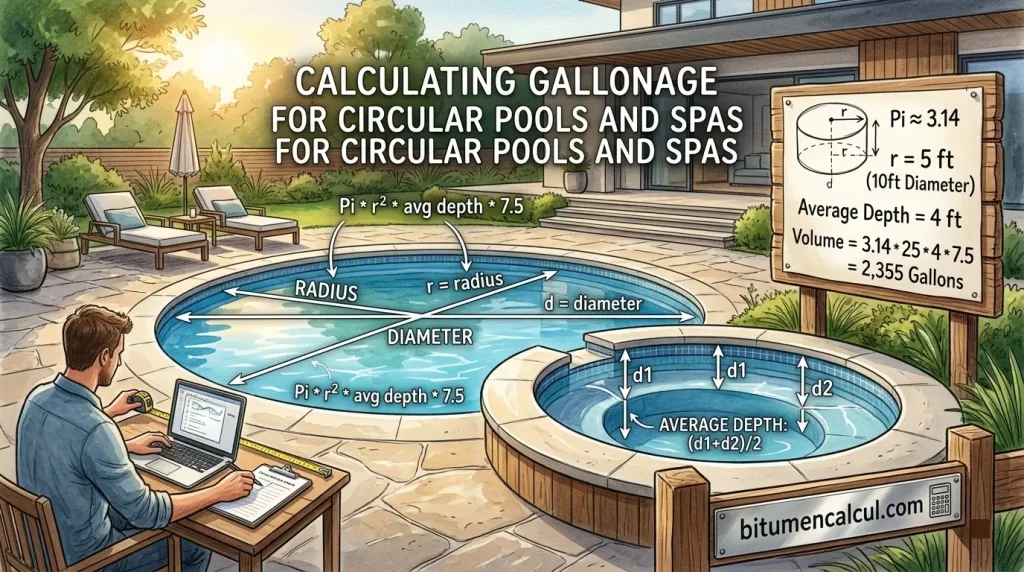
To find the capacity of a round pool or hot tub, incorporate pi and the squared radius into your depth calculations.
Formula: 3.14 x Radius Squared x Average Depth x 7.5 = Volume (in gallons)
Understanding the Components
- Pi (3.14): A fixed mathematical constant.
- Radius: Half of the total distance across the widest point of the circle (Diameter / 2).
- Radius Squared: The radius value multiplied by itself (Radius x Radius).
- Cubic Conversion Factor (7.5): The standard number of gallons contained in one cubic foot of water.
Step-by-Step Worked Example
Using a circular hot tub with a 10-foot diameter and a 3-foot water depth:
- Find the Radius: Divide the 10-foot diameter in half to get 5 feet.
- Square the Radius: Multiply 5 feet by 5 feet to get 25 square feet.
- Apply the Full Calculation:
- 3.14 x 25 ft x 3 ft x 7.5 = 1,766.25 gallons
Handling Built-In Benches and Seating
- Tiered Layouts: Empty round spas with built-in bench seating often resemble an inverted wedding cake. For precision, calculate the upper open area and the lower seating zone as separate circular sections, then sum the total volumes.
- Wooden Hot Tubs: For traditional wooden tubs with minimal bench displacement, you can measure the space as a single open cylinder without accounting for seats, as the volume difference is negligible.
Calculating Volume for Kidney and Irregular-Shaped Pools
There are two primary methods for calculating the capacity of an irregular or kidney-shaped pool or spa:
Method 1: Component Shape Breakdown
Divide the pool layout into smaller, standard geometric shapes (such as distinct circles, squares, or rectangles). Calculate the surface area and volume for each separate shape using the standard formulas, then add those individual volumes together for your total capacity.
Method 2: Kidney Formula Calculation
Use the specialized formula for kidney shapes, which uses width measurements across two distinct points (Width A and Width B):
Formula: 0.45 x (A + B) x Length x Average Depth x 7.5 = Volume (in gallons)
- Surface Area Factor: Multiplying 0.45 by the combined widths (A + B) and the length calculates the total surface area of the kidney shape.
- Worked Example:
- Width A + Width B: 18 ft (total)
- Length: 25 ft
- Average Depth: 5 ft
Understanding Parts Per Million (PPM) and Water Weight
Parts per million (ppm) measures the concentration of solids or liquids dissolved in water. For example, 3 ppm of chlorine indicates three parts of chemical for every one million parts of water.
When managing pool chemistry, liquid volume does not directly equal chemical concentration due to variations in liquid density. Adding one gallon of liquid chlorine to one million gallons of water does not produce 1 ppm because chlorine is denser than water. While one gallon of water weighs 8.33 pounds, one gallon of 15% liquid chlorine weighs roughly 10 pounds.
Key Measurements and Unit Equivalents
- Square Foot (sq ft): 12 in wide x 12 in long
- Cubic Foot (cu ft): 12 in wide x 12 in long x 12 in high
- Cubic Yard (cu yd): 36 in wide x 36 in long x 36 in high
- Volume Conversion: 1 cubic foot of water = 7.48 gallons
- Water Weight: 1 cubic foot of water = 62.4 lbs
- Gallon Weight: 1 gallon of water = 8.33 lbs
- PPM Weight Equivalent: 1 ppm = 8.3 lbs of chemical per 1,000,000 gallons of water
FAQs
Conclusion
Accurately determining your pool's surface area, water depth, and overall volume is the essential foundation for effective maintenance, precise chemical dosing, and managing utility costs. Whether you are calculating dimensions for a small backyard plunge pool or a large residential setup, relying on precise water measurements rather than physical wall bounds prevents costly dosing errors and ensures safe, efficient pool operation.
Read More: