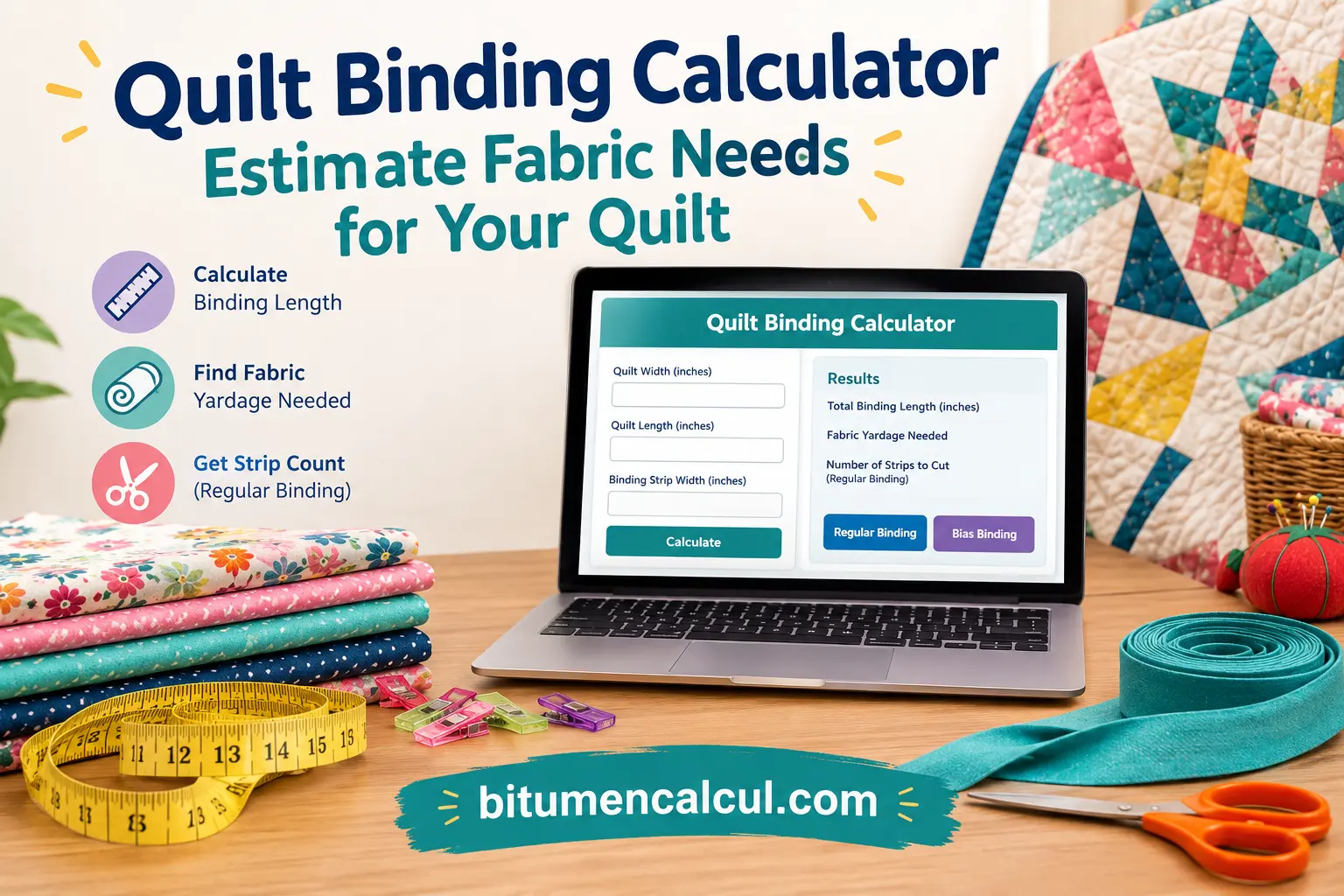
Quilt Binding Calculator Estimate Fabric Needs for Your Quilt
|

Quilt Binding Calculator Estimate Fabric Needs for Your Quilt

Quilt Binding Calculator

Find out how many binding strips to cut and how much fabric to buy.

Double-fold binding is commonly cut 2.25 to 2.5 in wide.
Width of fabric after removing the selvedges (about 40 in for 44/45 in wide fabric).
About 10 in is the usual allowance for mitered corners and the final join.
Fabric to buy
Strips to cut
Strip size
Binding needed
Quilt perimeter
Extra allowance
Total binding length
Length from one strip after joining
Total length of strips cut
Strips are joined with diagonal seams, allowing about 0.5 in (1.3 cm) lost per join. Fabric amount is rounded up to the next 1/8 yard (or 0.05 m).

This calculator helps you determine how much fabric is needed to bind your quilt based on its width, length, and the desired binding strip width. It offers two different calculation options:

  1. "Regular" binding – This method involves cutting the binding strips parallel to the width of the fabric on a bolt.
  2. Bias binding – With this method, the binding strips are cut along the bias of the fabric.

To use the calculator, enter the fabric width (which is set to 43 inches by default), the width and length of your quilt, and the preferred binding strip width. Based on these measurements, the calculator determines:
Quilt Binding Calculator Estimate Fabric Needs for Your Quilt
  1. The total length of binding required, which is equal to the perimeter of the quilt.
  2. The amount of fabric needed to cut the binding strips.
  3. The number of strips that need to be cut from the fabric (for "regular" binding only).

Note on Flange Binding: Flange binding is made by sewing two fabric strips together along their long edges, and each strip can be made from a different fabric. One strip is 1/4" wider than the other to accommodate the seam allowance when the two strips are joined. If you are planning to make a flange binding and want to calculate the required yardage, use the binding calculator twice, once for each strip. Make sure to enter the appropriate binding strip width for each fabric strip.

"Regular" Binding Calculations

Total binding length (inches) =

Number of strips to cut =

Binding Yardage =

Bias Binding Calculations

Bias strips are cut diagonally from a square or rectangular piece of fabric, as illustrated in the diagrams on the right. The calculator determines the amount of fabric required using two different methods:

  1. For a square: The calculator determines the required dimensions of the fabric square needed to cut the bias binding strips.
  2. For a rectangle: The calculator calculates the amount of fabric yardage to cut from a bolt, based on the fabric width entered above.

For both methods, the calculator includes an additional margin in the calculation to help ensure that enough fabric is available. This also prevents you from having to cut bias strips all the way to the corners of the square or rectangle, where the resulting strips would be very short and less practical to use.

Total binding length (inches) =

Square Size (inches) =

Yardage to be Cut from Bolt =

FAQs

To calculate how much binding you need for your quilt, measure its width and length, then add all four sides to find the total perimeter. Add a little extra length to allow for joining the binding strips and finishing the corners neatly. Once you know the total binding length and your preferred strip width, you can estimate the fabric yardage required. A quilt binding calculator makes this process easier and helps reduce fabric waste.

The best width for quilt binding depends on the finished look you want and the seam allowance you plan to use. For most quilts, a 2.5-inch-wide binding strip is a popular choice when folded in half and sewn with a 1/4-inch seam allowance. It usually creates a neat binding that wraps comfortably around the quilt edges. Smaller or larger widths can also work, depending on the quilt's thickness and your preferred finish.

The rule of 7 in quilting is not a universally recognized quilting standard, so its meaning can vary depending on the pattern, instructor, or quilting technique. Some quilters may use the term for a specific measurement, layout, or design guideline. If you encounter this rule in a tutorial, check how the author defines it before applying it to your project. Accurate measurements and consistent seam allowances remain essential for achieving well-aligned quilt blocks.

The 60-30-10 rule is a color-balancing guideline that helps create a visually appealing quilt. It suggests using one dominant color for about 60% of the design, a secondary color for 30%, and an accent color for the remaining 10%. For example, you could use a soft neutral shade for the main background, a complementary color for larger blocks, and a bold color for small details. This approach helps create contrast and keeps the overall quilt design balanced.

Dirty quilting is not a widely standardized quilting term, and its meaning depends on the context in which it is used. It may refer informally to quilting with a deliberately rough, imperfect, or distressed appearance, but it can also be a phrase used in a particular quilting community or tutorial. If the term appears in a specific pattern or video, checking that source will help clarify its intended meaning. Traditional quilting generally focuses on stitching fabric layers together to create texture, warmth, and decorative designs.

A useful rule for quilt borders is to measure the quilt through its center rather than relying only on the outer edges, which may stretch or become uneven. Cut the borders to the measured length and pin them in place before sewing to help the quilt lie flat. Avoid stretching the border fabric or the quilt top while stitching. Properly measured borders improve the quilt's shape and help prevent wavy edges or puckering.

Marie Osmond is widely known as an entertainer, singer, television personality, and entrepreneur, and she has also been associated with dolls and creative products. However, she is not primarily known as a professional quilter. If you have seen her name connected with quilting, it may relate to a particular product, collaboration, or craft-related project. Checking the specific source can help confirm the nature of that connection.

Three yards of fabric can make different quilt sizes depending on the fabric width, block design, seam allowances, and whether the fabric is used for the quilt top, backing, or binding. With standard 42–44-inch-wide quilting cotton, three yards may provide enough material for a small lap quilt or baby quilt top if the design is simple and fabric waste is minimal. However, it will not necessarily provide enough fabric for the backing and binding as well. Always calculate the cutting requirements before starting your project.

The golden ratio in quilting is a design principle based on a proportion of approximately 1:1.618, often used to create visually balanced and pleasing compositions. Quilters can apply this ratio when planning block sizes, dividing sections of a quilt, or positioning contrasting colors and patterns. For example, one section of a quilt might be about 1.6 times the size of another to create a more natural visual balance. This is an optional design technique rather than a strict quilting rule, so you can adjust the proportions to suit your creative vision.

Conclusion

This quilt binding calculator makes it easier to estimate the fabric needed to finish your quilt neatly and efficiently. Whether you choose regular binding or bias binding, it helps calculate the total binding length, required fabric yardage, and number of strips to cut. By entering accurate quilt measurements and selecting the right binding strip width, you can plan your project with greater confidence, reduce fabric waste, and achieve a clean, professional-looking finish.

Read More:

Similar Posts

Leave a Reply

Your email address will not be published. Required fields are marked *