
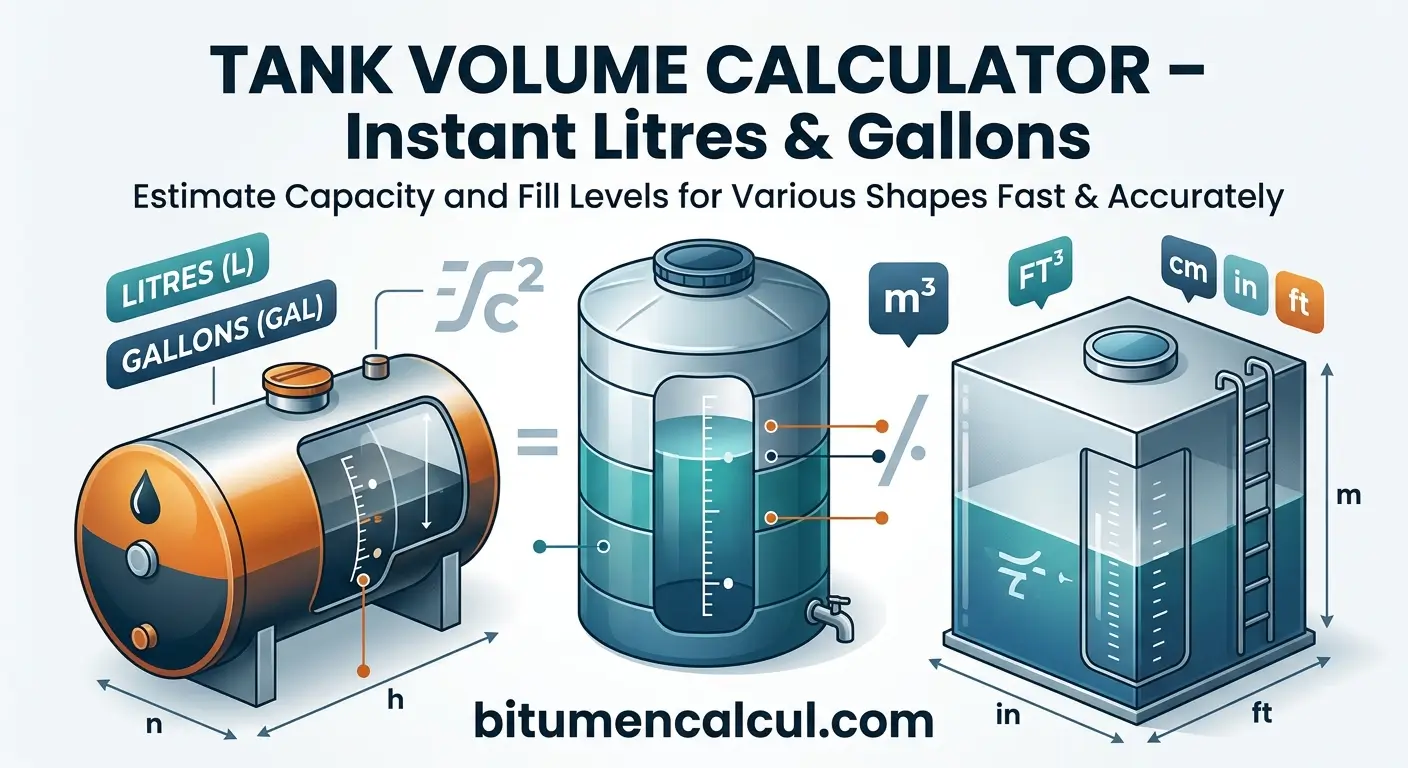
Tank Volume Calculator Uk – Instant Litres & Gallons
Tank Volume Calculator
Accurately calculate total and partially-filled tank volume in multiple units.
Formula Applied
Select a tank shape to view the specific mathematical formula.
Note: Results are estimates based on exact geometric shapes and do not account for wall thickness or irregular tank interiors.
Calculate estimated total capacity and fill volumes for fluid containers, including water and oil storage units, based on internal dimensions.
Input measurements using U.S. units like feet (ft) and inches (in), or metric units such as metres (m) and centimetres (cm). Output values are provided in U.S. fluid gallons, UK Imperial gallons, cubic feet (ft³), metric litres, and cubic metres (m³).
Please note that these calculations serve as estimates. Volumes are determined using exact geometric formulas for standard shapes like cylinders, spheres, and circles. Real-world storage tanks often feature variations in shape, internal fittings, or design details that affect precise capacity.

Methods to calculate the volume of tanks and the volume of a liquid inside a tank
To determine the total capacity of a tank or the volume of liquid currently inside it, you can calculate the geometric volume based on internal dimensions. The results will initially be in cubic units such as cubic feet or cubic metres, which can then be converted into liquid volume measurements like gallons or litres.
Horizontal tank volume calculator
Calculating the liquid volume in a partially filled horizontal cylinder requires finding the area of the filled circular segment and multiplying it by the length of the tank.
Total Volume = pi * r^2 * L (Where r is the radius, which is diameter divided by 2, and L is the tank length.)
Filled Volume = L * (r^2 * arccos((r - h) / r) - (r - h) * sqrt(2 * r * h - h^2)) (Where h is the liquid depth. Note: The arccos function must be calculated in radians.)
Vertical Cylindrical Tank
Vertical cylinders maintain a constant cross-sectional area from bottom to top, making calculations straightforward.
Total Volume = pi * r^2 * H (Where r is the radius and H is the total height.)
Filled Volume = pi * r^2 * h (Where h is the current liquid depth.)
Rectangular Prism / Box Tank
For rectangular tanks, volume is proportional to the depth of the liquid.
Total Volume = L * W * H (Where L is length, W is width, and H is total height.)
Filled Volume = L * W * h (Where h is the current liquid depth.)
Spherical Tank
Spherical tanks use the formula for a spherical cap to determine partial volume.
Total Volume = (4/3) * pi * r^3
Filled Volume = (pi * h^2 / 3) * (3 * r - h) (Where r is the tank radius and h is the liquid depth.)
Liquid Volume Conversions
Once you have calculated the volume in cubic feet or cubic metres, convert to liquid units using standard factors:
From Cubic Feet (ft3):
- U.S. Gallons: Multiply ft3 by 7.48052
- Imperial (UK) Gallons: Multiply ft3 by 6.22884
From Cubic Metres (m3):
- Litres: Multiply m3 by 1,000
Horizontal Cylinder Tank
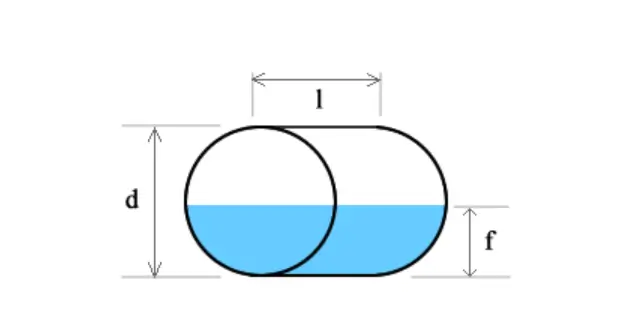
Total volume of a cylinder-shaped tank is calculated by multiplying the area (A) of the circular end by the length (l). The area is A = pi * r^2, where r is the radius (equal to half the diameter, d/2).
Total Tank Volume formula:
V(tank) = pi * r^2 * l
Filled Volume Calculation
To find the filled volume of a horizontal cylindrical tank, first determine the area (A) of the circular segment and multiply it by the length (l).
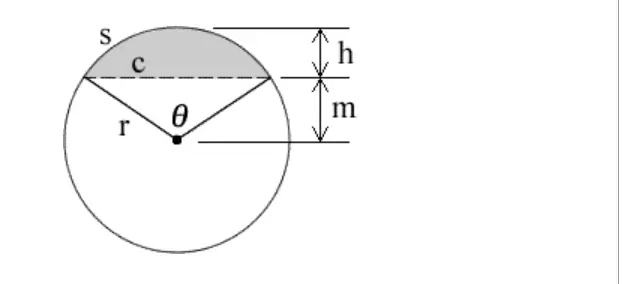
Circular segment area formula:
A = (1/2) * r^2 * (θ - sin(θ))
Where θ = 2 * arccos(m/r) with θ expressed in radians.
Segment Volume formula:
V(segment) = (1/2) * r^2 * (θ - sin(θ)) * l
Fill Height Conditions
To calculate the final fill volume based on fill height (f):
- If the fill height (f) is less than half the diameter (1/2 of d), use the segment created by the liquid height directly:
V(fill) = V(segment) - If the fill height (f) is greater than half the diameter (1/2 of d), calculate the segment formed by the empty space at the top and subtract it from the total volume:
V(fill) = V(tank) - V(segment)
Vertical Cylinder Tank
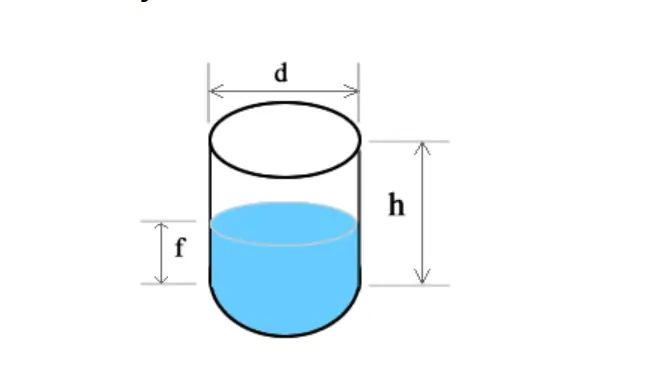
The total capacity of a vertically oriented cylindrical tank is calculated by multiplying the surface area (A) of the base by the total height (h). The base area is calculated as A = pi * r^2, where the radius (r) represents half of the diameter (d/2).
Total Tank Capacity Formula:
V(tank) = pi * r^2 * h
Filled Volume Calculation
Determining the liquid volume inside a vertical cylinder relies on the same base dimensions, as the liquid creates a shorter cylinder of equal radius (r) and diameter (d).
To calculate the fluid volume, replace the total height (h) with the current liquid fill depth (f):
Liquid Volume Formula:
V(fill) = pi * r^2 * f
Rectangle Tank
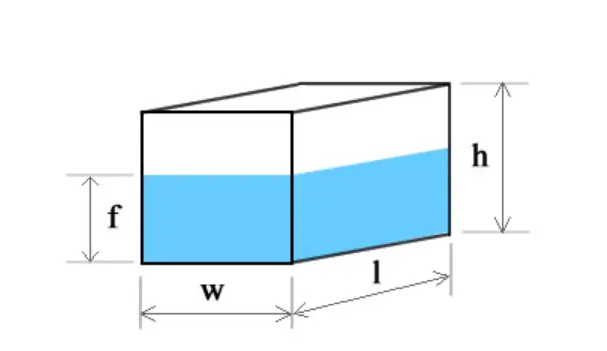
The total capacity of a rectangular prism-shaped tank is calculated by multiplying its length, width, and overall height.
Total Tank Capacity Formula:
V(tank) = l * w * h
Filled Volume Calculation
Calculating the liquid volume inside a rectangular container uses the same length and width, as the fluid simply forms a shorter rectangular shape equal to the depth of the liquid.
To determine the fluid volume, replace the total height (h) with the current fill depth (f):
Liquid Volume Formula:
V(fill) = l * w * f
Horizontal Oval Tank

The total volume of an oval tank (stadium-shaped cross-section) is determined by multiplying the surface area (A) of its flat end by the total length (l). The end area is defined as A = pi * r^2 + 2 * r * a, where the radius is r = h / 2 and the straight edge length is a = w - h (with width w greater than height h).
Total Tank Capacity Formula:
V(tank) = (pi * r^2 + 2 * r * a) * l
Filled Volume Calculation
To determine the liquid volume of a horizontal oval tank, the shape is divided into two parts: two half-cylinders that make up a full horizontal cylinder, separated by a central rectangular section.
The total fluid volume is calculated by combining two separate calculations:
- 1) A Horizontal Cylinder Tank where length = l, fill depth = f, and diameter d = h.
- 2) A Rectangular Tank where length = l, fill depth = f, and width = a (where a = w - h).
Liquid Volume Formula:
V(fill) = V(fill-horizontal-cylinder) + V(fill-rectangle)
Vertical Oval Tank
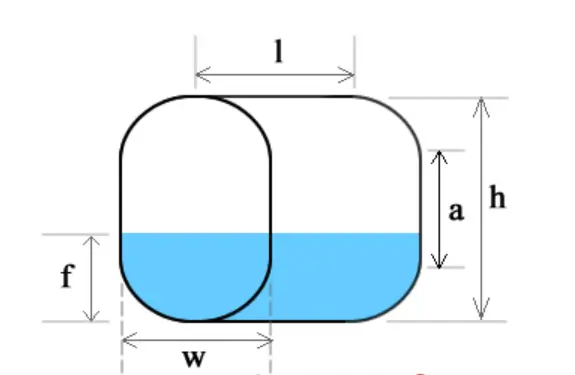
The total volume of a vertically oriented oval tank (stadium shape) is found by multiplying the end surface area (A) by the overall length (l). The area equation is A = pi * r^2 + 2 * r * a, where radius r = w / 2 and straight section length a = h - w (with height h greater than width w).
Total Tank Capacity Formula:
V(tank) = (pi * r^2 + 2 * r * a) * l
Filled Volume Calculation
Calculating partial fluid levels requires treating the tank as two semi-cylindrical ends separated by a central rectangular section. With r = w / 2 representing the radius of the curved ends, fill volume is calculated across three distinct depth zones:
- 1) Fill height is less than end radius (f < r):
Calculate liquid volume using the circular segment method from a Horizontal Cylinder Tank for the bottom curved section. - 2) Fill height is between end radius and rectangular section height (r < f < r + a):
Liquid volume equals half of the full cylinder volume plus the fluid contained within the rectangular middle portion. - 3) Fill height is in the upper curved section (r + a < f < h):
Calculate empty space volume using the circular segment method for the top arc, then subtract that value from the total capacity:
V(fill) = V(tank) - V(segment)
Horizontal Capsule Tank
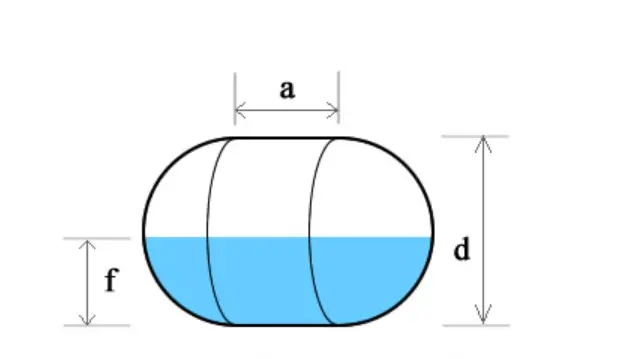
A capsule tank is structured as a sphere of diameter (d) split into two hemispherical ends, separated by a central cylinder of diameter (d) and side length (a). Using the radius r = d / 2, total capacity combines both individual geometric volumes:
Sphere Volume:
V(sphere) = (4/3) * pi * r^3
Cylinder Volume:
V(cylinder) = pi * r^2 * a
Total Tank Capacity Formula:
V(capsule) = pi * r^2 * ((4/3) * r + a)
Filled Volume Calculation

To determine fluid volume in a horizontal capsule tank, liquid levels in the central cylinder and the two outer ends are calculated separately and added together:
- 1) Central Cylinder Portion:
Calculated using the circular segment method applied to a Horizontal Cylinder Tank. - 2) Spherical End Caps:
Calculated using the formula for a spherical cap to determine partial sphere volume.
Spherical Cap Volume Formula:
V(spherical cap) = (1/3) * pi * h^2 * (3 * R - h)
(Where h represents the fluid depth and R is the radius of the spherical ends.)
Vertical Capsule Tank

A vertical capsule tank is calculated by treating the container as two hemispheres of diameter (d) separated by a central vertical cylinder of diameter (d) and height (a). With radius r = d / 2, total volume is the combined capacity of the sphere ends and middle cylinder section.
Total Tank Capacity Formula:
V(capsule) = pi * r^2 * ((4/3) * r + a)
Filled Volume Calculation
Determining liquid volume inside a vertical capsule tank follows a similar approach to vertical oval tanks, dividing the fill depth (f) into three distinct zones based on the end radius (r = d / 2):
- 1) Fill height is in the bottom hemisphere (f < r):
Calculate fluid volume using the spherical cap formula for the filled bottom portion. - 2) Fill height reaches the middle cylindrical section (r < f < r + a):
Fluid volume equals half of the total sphere volume plus the liquid contained inside the vertical cylinder portion. - 3) Fill height enters the top hemisphere (r + a < f < h):
Calculate empty space volume using the spherical cap formula for the top hemispherical cap, then subtract that value from the total capsule capacity:
V(fill) = V(tank) - V(spherical cap)
Horizontal 2:1 Elliptical Tank
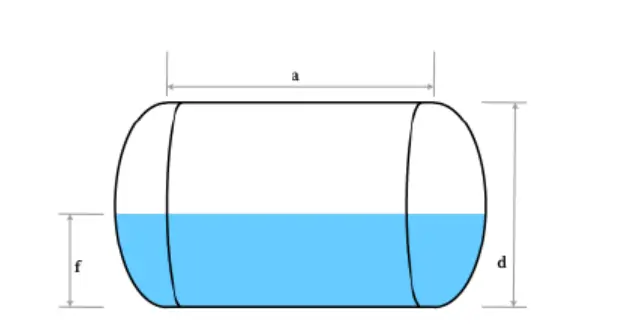
A horizontal 2:1 elliptical tank consists of a cylindrical body fitted with two semi-elliptical heads where the ratio of major to minor axis is 2:1. Total capacity is determined by combining the volume of the central cylinder with the volume of both elliptical end caps.
Total Tank Capacity Formula:
V(tank) = V(cylinder) + 2 * V(head)
Filled Volume Calculation
To calculate liquid volume at a given fill height (f), partial volumes are calculated separately for the cylindrical body and the two semi-elliptical ends:
- 1) Cylindrical Body Portion:
Calculated using the circular segment method applied to a horizontal cylinder. - 2) Semi-Elliptical Heads:
Calculated by applying proportional volume integration for elliptical heads based on current fill depth.
Horizontal Dish Ends Tank
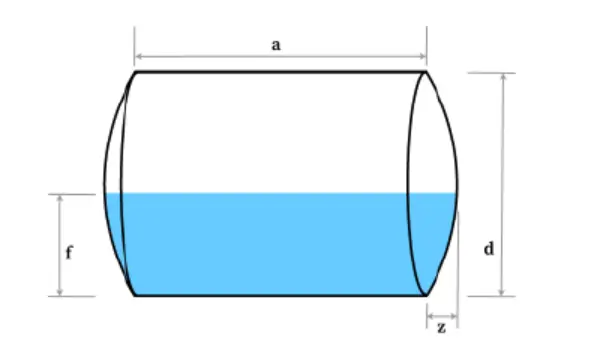
A horizontal dish ends tank features a cylindrical center section with shallow, dish-only end caps (torispherical or dished heads without knuckle radius variations). Total capacity combines the central cylindrical volume and the dished end volumes.
Total Tank Capacity Formula:
V(tank) = V(cylinder) + 2 * V(dished-head)
Filled Volume Calculation
Determining fluid volume involves measuring fill depth (f) across the tank geometry:
- 1) Cylindrical Body Portion:
Calculated using the standard horizontal cylinder circular segment formula. - 2) Dish-Only Ends:
Calculated using spherical segment geometry approximations corresponding to the dish radius and liquid height.
FAQs
Conclusion
Determining total tank capacity or calculating liquid volume across various geometries from basic rectangular boxes to complex capsule and elliptical tanks relies on using internal measurements alongside exact geometric formulas. Converting these spatial measurements into fluid units like litres or gallons provides precise operational insight for storage management, while online tank calculators serve as an ideal shortcut for rapid, automated conversions without manual arithmetic.
Read More: