

Simplifying Radicals Calculator Simplify Roots Step by Step Online
Simplifying Radicals Calculator
Simplify square roots, cube roots and any n-th root with step-by-step working.
Step-by-step solution
Supports whole-number radicands up to 12 digits, coefficients up to 9 digits and root indexes from 2 to 50. Negative numbers under even roots are written using i (imaginary unit).
The first time you come across a radical equation, such as √(x+3)=7, it might feel like math has suddenly become a completely different language. Radicals, which is the proper term for those root symbols, can make even a confident student stop and think for a moment. What does the root symbol actually mean? Why is the variable placed underneath it? And how can you isolate x when it’s hidden inside a square root? If these questions sound familiar, you’re certainly not alone. Radical equations may look more complicated than they really are. At their core, they follow the same basic principles as other equations, with one important difference: the variable you need to solve for appears inside a root. This adds an extra step to the solving process, but it doesn’t make the equation impossible to solve.

In this guide, we’ll explain radical equations through simple, easy-to-follow steps. You’ll work through practical examples, learn how to avoid common mistakes (especially extraneous solutions), and discover how the bitumencalcul Radical Equation Calculator can help you verify your answers or solve more complicated problems that may be difficult to work through by hand.
What Is a Radical Equation?
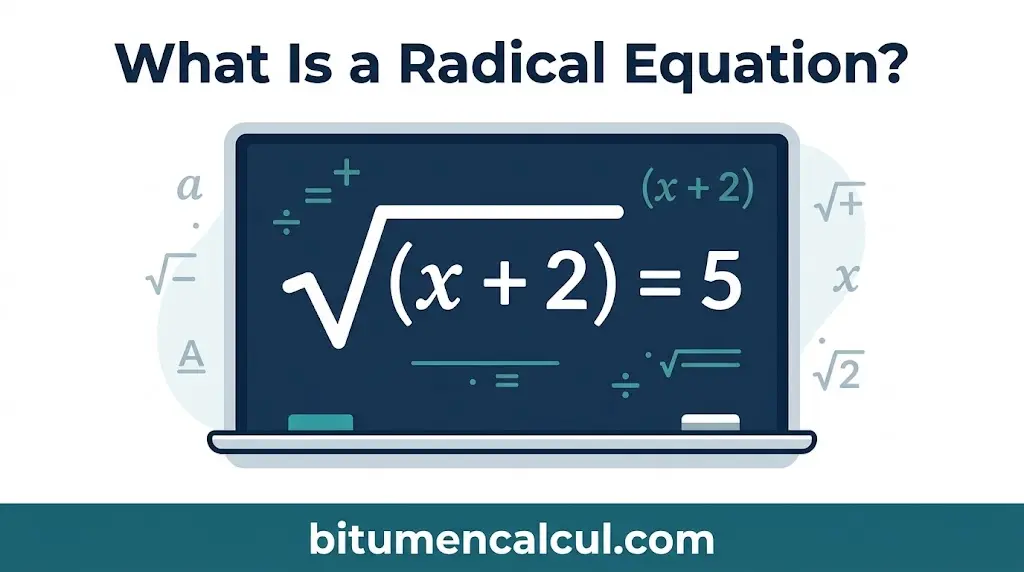
A radical equation is an equation in which a variable appears inside a radical, most commonly a square root (√), although it can also involve a cube root (∛) or other types of roots. The term “radical” refers to the root symbol, which indicates that you need to find the square root, cube root, or another root of a given number or expression.
Simply put, whenever you come across an equation where x appears inside a square root or cube root, you’re dealing with a radical equation.
Here are two examples to help you understand the concept:
√(x+3)=7∛(32x−1)=4
In the first example, the variable x is inside a square root expression, while in the second, it appears under a cube root. As with any other equation, your objective is to solve for x by finding the value that makes the equation true. However, radical equations require a slightly different approach. You can’t always isolate the variable by simply moving terms around as you might in a basic linear equation. Instead, you generally need to eliminate the radical first. You can do this by applying the opposite operation, such as squaring both sides to remove a square root or cubing both sides to eliminate a cube root.
This additional step is what makes radical equations a little different from other types of equations. It’s also where students often make mistakes, particularly when squaring both sides introduces extraneous solutions (we’ll explain these in more detail shortly). The good news is that once you understand the process and know how to check your answers, solving radical equations becomes much easier and more manageable.
A Real-Life Example: Budgeting with a Twist

Let’s look at a practical situation to see how radical equations can be useful in everyday life. Imagine you’re shopping for a birthday present at a trendy gift shop that sells mystery boxes. The contents of each box are a surprise, but the shop uses a mathematical formula to determine the price based on the value of the items inside.
The shopkeeper explains, “The price of each box is the square root of the total value of its contents, plus two dollars for wrapping and packaging.”
You have a budget of USD 6 and want to know how much the items inside the mystery box are worth. Naturally, you’d want to figure out the maximum value you can get without exceeding your budget.
The shopkeeper’s pricing rule can be written as the following equation:
Price=√(value)+2
Since your total budget is USD 6, set the price equal to 6:
6=√(x)+2
Here, x represents the total value of the items inside the box. To determine that value, you need to solve the radical equation.
Step 1: Subtract 2 from both sides.
6−2=√(x)
Simplifying gives you:
4=√(x)
Step 2: Square both sides to eliminate the square root.
Squaring both sides removes the radical and leaves you with:
(4)²=x
Therefore:
16=x
This means the mystery box costs USD 6 but contains items worth USD 16, according to the shopkeeper’s pricing formula.
This example demonstrates how a radical equation can represent a real-world situation and help you calculate an unknown value. From planning a budget for gifts to estimating the time required for a task or working with scientific formulas, radical equations have more practical applications than you might initially expect.
How to Solve Radical Equations (Step-by-Step Guide)
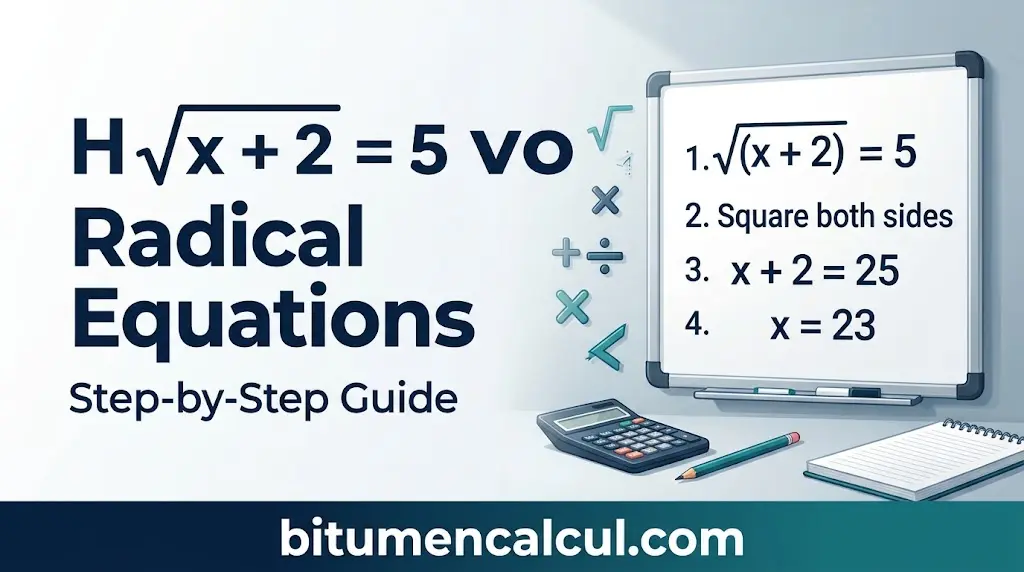
Solving a radical equation involves finding the value of a variable that makes the equation correct, even if the variable appears inside a square root or cube root. The main idea is to isolate the radical expression first and then remove the root by applying the opposite operation. When working with square roots, you square both sides of the equation. For cube roots, you raise both sides to the third power.
Let’s go through a simple example step by step to understand how this process works.
Example Problem:
√(x+2)=5
Step 1: Isolate the radical expression
The first thing you need to do is make sure the radical expression is alone on one side of the equation. In this example, the square root is already isolated, so you can move directly to the next step:
√(x+2)=5
If the equation had additional terms outside the radical, you would first use addition, subtraction, multiplication, or division to separate the radical from those terms.
Step 2: Eliminate the radical
Once the radical is isolated, the next step is to remove the square root by applying its inverse operation. Since the equation contains a square root, square both sides:
(√(x+2))²=5²
This simplifies to:
x+2=25
Squaring the square root cancels it out, leaving the expression inside the radical. Remember that you must square both sides of the equation to keep the equality balanced.
Step 3: Solve the resulting equation
Now that the radical has been eliminated, you’re left with a standard linear equation that you can solve using basic algebra:
x+2=25
Subtract 2 from both sides to isolate x:
x=25−2
Therefore, the answer is:
x=23
Step 4: Check your solution
Checking your answer is an essential part of solving radical equations. When you square both sides, you can sometimes introduce an extraneous solution. This is a value that appears to satisfy the equation during the algebraic solving process but does not actually work in the original equation.
To confirm that your answer is correct, substitute x=23 into the original equation:
√(23+2)=√25=5
The left side evaluates to 5, which matches the right side of the equation. Since the original equation is satisfied, x=23 is a valid solution.
Always remember to check your final answer in the original equation, particularly when working with square roots or other radicals. This simple habit helps you catch extraneous solutions and ensures that your result is correct.
Handling More Complex Radical Equations
Some radical equations are fairly straightforward, with just one root and a few simple steps to reach the answer. Others can be more challenging because they contain multiple radicals, nested expressions, or additional terms that make the calculations less direct. Although these equations may look intimidating at first, the basic approach stays the same: isolate the radical, eliminate it, solve the resulting equation, and check your answer. The main difference is that you might need to repeat these steps to remove each radical one at a time.
Let’s work through a more detailed example and break the process into manageable steps so you can see exactly how each part fits together.
Example Problem:
√(x+2)+√(x−1)=5
At first glance, this equation looks a little more complicated because it contains two square roots on the same side. However, there’s no need to panic. You can still solve it by working through one radical at a time and carefully simplifying each step.
Step 1: Isolate one of the radicals
Begin by moving one radical to the other side of the equation. You can choose either one, but for this example, we’ll isolate √(x+2).
Starting with the original equation:
√(x+2)+√(x−1)=5
Subtract √(x−1) from both sides:
√(x+2)=5−√(x−1)
Now the first radical is isolated, which makes it easier to eliminate the square root in the next step.
Step 2: Eliminate the isolated radical
To remove the square root on the left, square both sides of the equation. Be careful when expanding the right-hand side because it contains a difference of two terms. You’ll need to use the formula ((a-b)^2=a^2-2ab+b^2).
Squaring both sides gives:
(√(x+2))²=(5−√(x−1))²
After expanding and simplifying, we get:
x+2=25−10√(x−1)+(x−1)
Combine the constant terms on the right:
x+2=x+24−10√(x−1)
Next, subtract x from both sides:
2=24−10√(x−1)
Subtract 24 from both sides:
−22=−10√(x−1)
Now divide both sides by −10:
√(x−1)=22/10
Simplifying the fraction gives:
√(x−1)=11/5
Great! We’ve successfully eliminated the first radical and isolated the remaining square root. There’s just one more radical to deal with.
Step 3: Solve for the remaining radical
Since the second square root is now isolated, we can remove it by squaring both sides once again:
(√(x−1))²=(11/5)²
This simplifies to:
x−1=121/25
Add 1 to both sides to isolate x:
x=121/25+1
Write 1 as 25/25 so both fractions have the same denominator:
x=121/25+25/25
Combining the fractions gives us:
x=146/25
This is our possible solution. However, there’s still one important step left. Because we squared both sides twice, we need to substitute the result into the original equation to confirm that it works.
Step 4: Check your solution
To verify the answer, substitute x=146/25 into the original equation:
√(x+2)+√(x−1)=5
Replacing x with 146/25 gives:
√(146/25+2)+√(146/25−1)
Simplify the expressions inside both square roots:
√(196/25)+√(121/25)
Now evaluate the square roots:
14/5+11/5
Add the fractions:
25/5=5
The left-hand side equals 5, which matches the right-hand side of the original equation. Therefore, our answer satisfies the equation and is a valid solution.
Final Answer:
[
\boxed{x=\frac{146}{25}}
]
Complex radical equations can feel like puzzles with several pieces to put together, but the process becomes much easier when you handle one radical at a time. Focus on each algebraic step, simplify carefully, and avoid rushing through the calculations. As you gain practice, you’ll start recognizing the patterns and solving these equations with greater confidence.
If you’re ever uncertain about your result, return to the original equation and check your answer. If it works, you’ve confirmed your solution. If it doesn’t, you’ve found an opportunity to identify and correct a mistake.
A Good Rule of Thumb:
Whenever you square both sides of an equation, whether once or multiple times, remember that you may introduce an extraneous solution. Squaring can produce an equation that has solutions that do not satisfy the original expression, so never assume that every result is automatically valid.
The best habit is to make checking your answer a regular part of your solving process. Just as you might double-check a message before sending it, take a moment to substitute your result back into the original equation. This small step can help you avoid unnecessary mistakes, save time, and improve your accuracy when working with radical equations.
Avoiding Common Mistakes While Solving Radical Equations
Radical equations may look straightforward at first, with their familiar square root symbols and simple expressions, but small mistakes can quickly lead you in the wrong direction. Rushing through calculations, skipping important steps, or applying algebraic rules incorrectly can make an otherwise manageable problem much harder to solve.
The best way to avoid these issues is to understand where mistakes commonly happen and learn how to prevent them. Let’s look at the errors students often make when solving radical equations and the simple habits that can help you solve them more accurately.
Mistake #1: Forgetting to Check for Extraneous Solutions
As mentioned earlier, squaring both sides of an equation can sometimes introduce solutions that don’t satisfy the original equation. These are known as extraneous solutions. Even if your calculations appear correct, you cannot assume that every value you obtain is a valid answer.
What to do instead: Always return to the original equation containing the radical and substitute your proposed solution. Check whether both sides produce the same value. If they don’t match, the result is an extraneous solution and must be rejected.
Mistake #2: Squaring Both Sides Too Early
Another common error is squaring both sides before isolating the radical expression. When other terms remain on the same side, squaring can introduce additional terms and make the calculations unnecessarily complicated.
What to do instead: Take your time and isolate the radical before applying the square operation. Move any extra constants or terms to the opposite side using addition or subtraction, as needed. Once the radical is isolated, squaring both sides becomes much easier to manage.
Mistake #3: Losing Track of Parentheses
Parentheses are especially important when working with radical equations because squaring an entire expression is different from squaring only one of its terms. Leaving out parentheses or placing them incorrectly can change the meaning of an equation and lead to incorrect results.
For example, consider the expression:
Incorrect: √x+2²
Correct: (√x+2)²=x+4√x+4
The second expression makes it clear that the entire quantity √x+2 is being squared. Using the expansion formula ((a+b)^2=a^2+2ab+b^2), we obtain x+4√x+4.
What to do instead: Use parentheses whenever you square an expression containing more than one term. Write each step clearly, especially when expanding brackets, so you don’t accidentally omit a term or apply an operation to only part of the expression.
Mistake #4: Assuming Every Radical Equation Has a Solution
It’s easy to assume that every equation must produce an answer, but that’s not always the case. Some radical equations have one or more valid solutions, while others have no real solution at all. You might even complete several steps correctly and discover that none of the resulting values satisfies the original equation.
What to do instead: Keep an open mind while solving. Don’t force an answer simply because you’ve worked through the calculations. Substitute your possible solutions into the original equation and verify each one. If no real value satisfies the equation, then stating that there is no real solution is the correct mathematical conclusion.
Mistake #5: Confusing Square Roots with Absolute Values
This mistake is a little more subtle, particularly when variables appear inside square roots. A common misconception is that taking the square root of a squared variable always gives the original variable. In reality, the principal square root is nonnegative, which means the result is an absolute value.
For example:
[
\sqrt{x^2}=|x|
]
It is not always equal to x, because x could be negative. If x=−3, for instance, then:
[
\sqrt{(-3)^2}=\sqrt{9}=3
]
However, the original value of x is −3, not 3. This is why the distinction between square roots and absolute values matters when solving more advanced radical equations.
What to do instead: Pay close attention whenever a variable is squared inside a square root. Remember that (\sqrt{x^2}=|x|), while squaring a nonnegative square root gives ((\sqrt{x})^2=x), provided the expression is defined over the real numbers.
Solving radical equations accurately is less about working quickly and more about paying attention to the details. Take your time, write down each step, and make sure you understand why you’re performing each operation. One helpful technique is to explain your calculations as if you were teaching someone else. Doing so can help you spot errors, strengthen your understanding, and approach even complicated radical equations with greater confidence.
Real-World Uses of Radical Equations
Radical equations aren’t limited to classroom exercises or algebra textbooks. They also play a role in many practical situations, helping people calculate unknown values, measure distances, and solve problems across different fields. Here are some common examples of where radical equations are used in real life.
Physics: Square roots are frequently used to calculate the time an object takes to fall under gravity. In free-fall motion, for example, the time can be determined using a formula that includes the square root of the distance fallen.
Engineering: Engineers often work with formulas involving square roots when analyzing forces, stresses, and structural loads. Depending on the particular formula, roots can help determine unknown measurements or evaluate the strength and performance of a structure.
Architecture: Architects use the Pythagorean theorem to calculate unknown lengths, such as diagonal distances and certain ramp dimensions. Since these calculations often involve square roots, radical expressions are useful when planning accurate measurements and designing safe structures.
Finance: Certain financial calculations, including some compound interest formulas and risk models, involve roots. For example, square roots can appear when working backward from an investment’s growth rate or calculating measures of financial volatility.
Medicine: Medical professionals sometimes use formulas involving square roots to estimate body surface area, which can be useful when determining appropriate medication dosages. One example is the Mosteller formula, which uses a patient’s height and weight to estimate body surface area.
Computer Graphics: Square roots are essential for calculating distances between points in two-dimensional and three-dimensional space. These calculations are widely used in video game development, animation, computer-aided design, and other applications that require accurate spatial measurements.
How to Use bitumencalcul Radical Equation Calculator
Learning to solve radical equations by hand is important because it helps you understand the underlying mathematical concepts, recognize the purpose of each step, and identify common errors. However, when you’re learning a new topic, checking homework, or working through a particularly complicated problem, having an additional tool can make the process easier.
That’s where the bitumencalcul Radical Equation Calculator can help. Instead of providing only a final answer, it can show the mathematical steps involved in solving an equation, helping you understand how the result is obtained. Here’s how to get started.
Step 1: Open the Calculator
You can also search for “bitumencalcul radical equation calculator” in your preferred search engine to find the relevant page.
If you’re working on problems in your browser, the bitumencalcul Chrome Extension may also provide a convenient way to access its tools, depending on the extension’s available features.
Step 2: Enter Your Equation
Enter the radical equation into the calculator’s input field. You can use the available mathematical notation to represent square roots, exponents, parentheses, and other operations.
For example, suppose you want to solve the following equation:
√(3x+1)−2=4
You can enter it using standard calculator notation as:
sqrt(3x+1)-2=4
The calculator’s on-screen math keyboard can also help you enter symbols and expressions, including square roots and exponents, without having to remember every notation shortcut.
Step 3: Click “Go”
Once you’ve entered the equation correctly, click the “Go” button to submit it. The calculator will process the expression and provide a solution when supported.
Depending on the problem and the available features, you can review the algebraic operations used to simplify the equation and determine the value of the unknown variable.
Step 4: Review the Step-by-Step Solution
One useful feature of bitumencalcul is its step-by-step approach to solving mathematical problems. Rather than simply displaying the final value of x, the calculator can help you follow the sequence of operations used to reach the answer.
Let’s return to our example:
√(3x+1)−2=4
First, isolate the square root by adding 2 to both sides:
√(3x+1)=6
Next, square both sides to eliminate the radical:
3x+1=36
Subtract 1 from both sides:
3x=35
Finally, divide both sides by 3:
x=35/3
This is the correct solution for the example. If a step-by-step viewing option is available, you can use it to examine each operation individually, take notes, and compare the calculator’s method with your own work.
Step 5: Verify the Solution
As we’ve discussed throughout this guide, checking your answer is an essential part of solving radical equations. Squaring both sides can sometimes introduce extraneous solutions, so a result should always be checked against the original equation.
For our example, substitute x=35/3 into the original expression:
√(3(35/3)+1)−2=4
Simplifying gives:
√(35+1)−2=4
√36−2=4
6−2=4
Since the equation is true, x=35/3 is a valid solution.
You can use bitumencalcul to help check your calculations, but it’s still a good idea to understand how to verify a result yourself rather than relying entirely on the calculator.
Step 6: Explore the Graph
Visualizing an equation can provide another way to understand its solution. bitumencalcul offers a Graphing Calculator that you can use to explore mathematical expressions and their graphical behavior.
For our example, you could graph the function:
y=√(3x+1)−6
The point where this function crosses the x-axis corresponds to a value for which y=0. In other words, it identifies the solution to √(3x+1)=6, which is x=35/3.
Graphing can help you connect the algebraic steps to a visual representation and see how the solution relates to the function. Keep in mind that a graph is most useful when you interpret it alongside the original equation and its domain.
Bonus: Save or Share Your Work
If you want to revisit a solution later, check whether bitumencalcul current features allow you to save or bookmark your work. Depending on the available account options, you may also be able to organize solutions in a notebook or access additional learning assistance.
These options can be useful when you’re practicing for an exam, reviewing homework, or keeping track of different types of radical equations.
Why Use the Calculator?
The bitumencalcul Radical Equation Calculator can be a helpful learning resource for several reasons:
- Understand each step: Follow the algebraic process instead of looking only at the final answer.
- Check your homework: Compare your calculations with the solution provided by the calculator.
- Identify mistakes: Review the steps to help locate errors in your own working.
- Connect algebra with graphs: Use graphical tools to develop a better understanding of equations and their solutions.
- Practice across devices: Access the available tools through supported desktop and mobile experiences.
Whether you’re learning radical equations for the first time, practicing for an upcoming test, or reviewing more advanced problems, the bitumencalcul Radical Equation Calculator can make the process easier to follow. It provides another way to explore mathematical concepts, check your work, and build confidence as you practice.
Ultimately, solving radical equations involves more than finding the value of x. It’s about understanding the relationship between mathematical operations, recognizing when a solution is valid, and learning how to approach unfamiliar problems systematically. By combining step-by-step practice with tools like bitumencalcul, you can develop stronger problem-solving skills and tackle radical equations with greater confidence.
FAQs
Conclusion
Radical equations become much easier to solve when you understand how to isolate radicals, eliminate roots, and solve each step carefully. By practicing simple and complex examples, avoiding common mistakes, and checking for extraneous solutions, you can build confidence and improve your algebra skills. Whether you’re applying radicals to real-life problems or using the bitumencalcul Radical Equation Calculator to verify your work, the key is to understand the process rather than simply memorize the steps. With regular practice and careful calculations, even challenging radical equations become manageable.
Read More: