

FFMI Calculator – Estimate Your True Natural Muscle Limit
FFMI Calculator
Calculate your Fat-Free Mass Index and Normalized FFMI
How FFMI is calculated
Fat-Free Mass (FFM): Weight (kg) × (1 – Body Fat % / 100)
FFMI: Fat-Free Mass (kg) ÷ Height (m)²
Normalized FFMI: FFMI + 6.1 × (1.8 – Height in meters)
Reference Ranges:
- Below 18.0: Lower range
- 18.0 – 19.9: Average range
- 20.0 – 21.9: Above-average muscularity
- 22.0 – 23.9: High muscularity
- 24.0 and above: Very high range
Determining your stage-ready physical potential relies heavily on established scientific research on natural muscle limits. Key research from Casey Butt's research on elite natural bodybuilders provides precise framework calculations for drug-free athletes, while peer-reviewed FFMI data (Kouri 1995, Mäestu 2010, Chappell 2018) helps set objective benchmarks for ultimate muscular development.
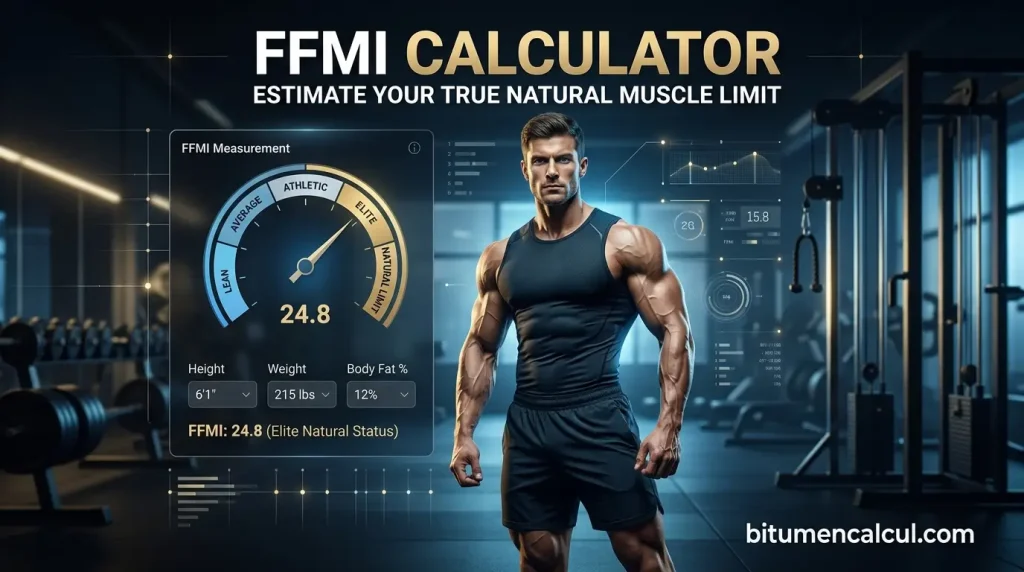
To calculate your personal maximum projection, you will need to gather accurate body measurements using a measuring tape, as these formulas depend on joint girths and frame dimensions. Additionally, these physiological estimates assume you're six-pack lean, meaning your body fat percentage must be in the low single digits to reflect true lean mass potential.
How to use calculator

Operating the tool to estimate your physical potential takes just a few quick inputs:
- Choose the measurement system (imperial or metric): Select your preferred unit scheme to ensure accurate scale conversions.
- Enter your height: Input your total height using feet/inches or centimetres.
- Enter your weight: Provide your current total body weight.
- Enter your body fat percentage: Add your estimated or measured fat ratio.
- Click the "Calculate" button to get the results.: Submit the figures to instantly generate your normalized body composition metrics.
What is FFMI?

The Fat-Free Mass Index (FFMI) is a standardized metric used to assess a person's total muscle mass relative to their height. Unlike the standard Body Mass Index (BMI) which only considers overall weight and often misclassifies muscular individuals as overweight or obese FFMI separates fat mass from lean body mass to provide an accurate picture of physical muscularity.
- Primary Function: Measures lean tissue independent of body fat to help athletes and lifters evaluate true muscular development.
- Key Difference from BMI: Excludes body fat percentage, making it a reliable alternative to BMI for fit individuals.
- Bodybuilding Application: Frequently used by bodybuilders to benchmark their progress, compare muscle mass against peers, and gauge potential drug-free limits.
FFMI formula
Calculating your Fat-Free Mass Index (FFMI) involves a multi-step process that isolates lean body mass from overall weight and standardises the result for height:
- Total Body Fat: First, convert your body fat percentage into total fat weight in pounds using
Total Body Fat = Weight * (body fat [%] / 100). - Lean Weight: Subtract fat mass to find your total fat-free mass via
Lean Weight = Weight * (1 - (body fat [%] / 100). - Unadjusted FFMI: Divide lean mass by height squared (in metres) using
FFMI = (Lean Weight / 2.2) / ((Feet * 12.0 + Inches) * 0.0254)2. - Height Adjustment: Since taller individuals naturally carry more lean tissue, apply the standard height correction using
Adjusted FFMI = FFMI + ( 6.3 * (1.8 - (Feet * 12.0 + Inches) * 0.0254)).
FFMI interpretation
Evaluating your normalized body composition score requires sex-specific benchmarks, as muscular potential and healthy fat distribution differ significantly between biological sexes. Once your score is calculated, refer to the corresponding reference scale below to understand your current physical development tier.
- FFMI score for men: Categorises male physical condition into specific brackets ranging from baseline lean frames to competitive physiques.
- FFMI score for women: Provides tailored rating criteria tailored to female physiological distribution and lean mass proportions.
- How to use calculator: Simple tools require entering your total body weight, height, and body fat percentage to generate both your base and height-adjusted scores automatically.
FFMI score for men
| FFMI | Body fat | Description |
| 17-18 | 10-18% | Skinny man |
| 18-20 | 20-27% | Average man |
| 19-21 | 25-40% | Fat man |
| 20-21 | 10-18% | Athlete / Intermediate gym user |
| 22-23 | 6-12% | Advanced gym user |
| 24-25 | 8-20% | Bodybuilder / Powerlifter / Weightlifter |
FFMI score for women
| FFMI | Body fat | Description |
| 14-15 | 20-25% | Skinny women |
| 14-17 | 22-35% | Average women |
| 15-18 | 30-45% | Fat women |
| 16-17 | 18-25% | Athlete / Intermediate gym user |
| 18-20 | 15-22% | Advanced gym user |
| 19-21 | 15-30% | Bodybuilder / Powerlifter / Weightlifter |
FFMI – fat-free mass index
The FFMI – fat-free mass index serves as a specialized body composition metric designed to measure lean tissue relative to stature and overall weight. While belonging to the same analytical category as the standard Body Mass Index (BMI), it delivers significantly higher accuracy when evaluating an individual's physical condition and athletic standing.
Key Data Points Required
Calculating this metric requires three distinct variables:
- Body height — Recorded in either standard feet and inches or centimeters.
- Body weight — Measured using pounds or kilograms.
- Body fat — Entered as a percentage value (derived via a dedicated body fat calculator).
Comparing Weight-Based Indexes with Lean Tissue Assessment
Body mass index evaluates total body mass against stature to categorize individuals into standard ranges from ideal to overweight or obese. While widely used for general health screening, this calculation relies solely on total weight, masking crucial differences in physical composition between individuals of similar measurements.
Why Standard Weight Metrics Fall Short
- Muscle and Fat Disregard: The metric fails to distinguish lean tissue from adipose tissue, treating all body weight identically.
- Misleading Classifications: Athletic individuals carrying substantial muscle mass frequently receive high scores, misclassifying them as overweight or obese.
- Hidden Unhealthiness: Sedentary individuals with low muscle mass and elevated fat percentages can easily score within the ideal range, masking underlying health risks.
Why is FFMI better than BMI?
Weight gain driven by adipose tissue typically signals reduced physical health, whereas weight gain from lean muscle growth reflects improved athletic performance. Standard Body Mass Index fails to distinguish between these scenarios, treating every added kilogram identically and raising the calculated score in both cases.
Why the Fat-Free Mass Index Provides Superior Accuracy
- Targeted Tracking: As fat levels increase, the metric decreases; conversely, gains in lean muscle elevate the score, accurately reflecting compositional shifts.
- True Health Reflection: By accounting for exact tissue types, it offers a realistic assessment of an individual's actual physical condition.
- Athletic Relevance: While traditional Body Mass Index serves as a general guide for the average population, it becomes largely unhelpful for active individuals or trained athletes who require precise muscle tracking.
FAQs
Conclusion
Overall, the Fat-Free Mass Index provides a far more accurate assessment of your physical muscularity than traditional weight-based metrics like BMI, as it isolates lean tissue from total fat mass. By taking into account your height, weight, and body fat percentage, this metric allows you to objectively evaluate your true muscular development, set realistic muscle-building targets, and benchmark your progress against established natural limits. Whether you are a beginner aiming for an athletic baseline or an advanced lifter testing the genetic ceiling of natural physique development, understanding your score equips you with actionable data to optimize your long-term fitness strategy.
Read More:




2 Comments