
Free Paver Base Calculator Square Feet (2026)
Paver Base Calculator
Estimate how much compacted base material and bedding sand you need for a paver patio, walkway, or driveway.
Your Results
Base material to order
Area
Compacted base volume
Bedding sand to order
Total excavation depth
Weights are estimates based on typical material densities and vary by supplier and moisture. Confirm quantities with your material supplier before ordering.
Use this paver base calculator to estimate the amount of gravel and sand needed for a paver patio, path, or driveway. Enter your project size and desired base depth to calculate the required materials, with reference to the Sakrete paver base calculator and Paver Base Home depot options.
How this calculator works
Cubic yards = (area × depth ÷ 12) ÷ 27
Tons = cubic yards × density × 27 ÷ 2000
Estimate the paver base + sand bedding for a patio, walkway, or pool deck install.
Enter your area and depth, and we'll compute cubic yards, tons, and a delivered material cost using current 2026 quarry pricing.
How to Estimate Paver Base Sand and Gravel
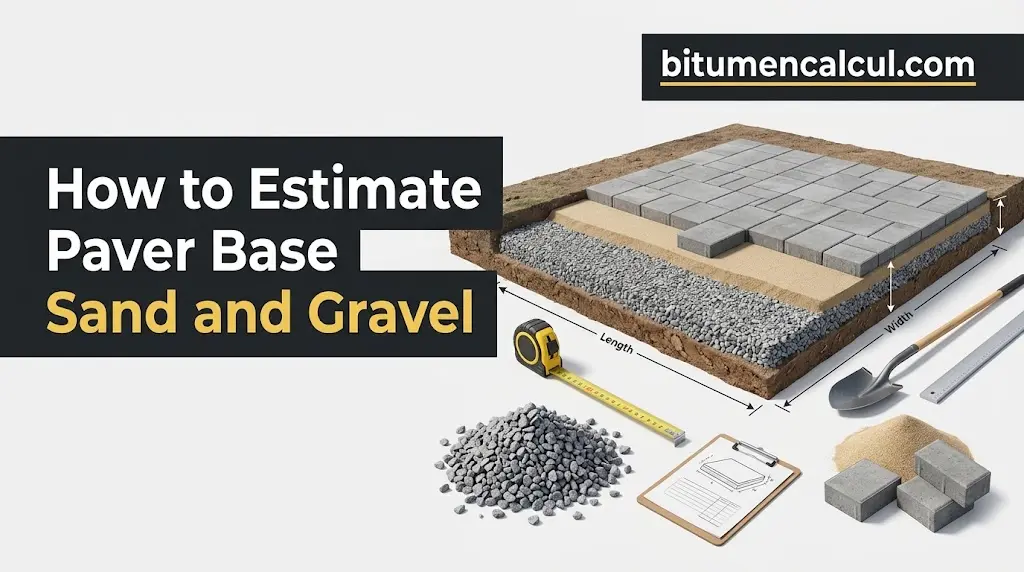
A beautiful, long-lasting paver patio, driveway, or walkway starts with a solid base. A paver base consists of compacted crushed gravel topped with a layer of sand. Use a paver base calculator square feet estimate to account for the project area and a paver base calculator cubic feet estimate to determine the amount of material needed.
A solid base helps prevent pavers from shifting, sinking, and upheaving. Make sure you have the correct amounts of base material on hand, whether you use a paver base calculator Lowe's tool or another calculator to estimate your needs.
How to Find Cubic Yards of Base Material
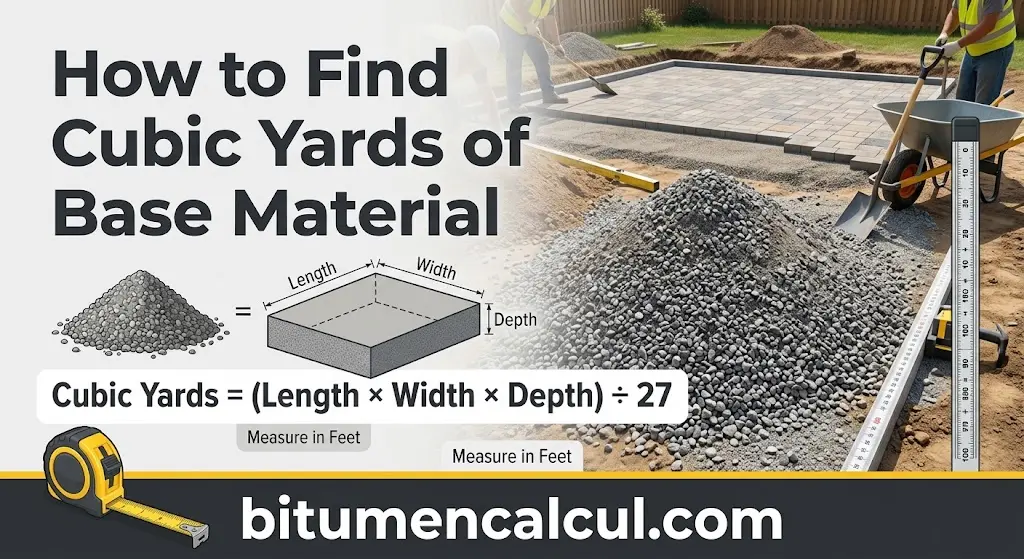
To calculate the cubic yards of gravel needed for a paver base, follow these steps using a paver base calculator or a paver base calculator home depot tool:
- Step One: Measure the patio's length and width in inches.
- Step Two: Multiply the length by the width to determine the area in square inches.
- Step Three: Multiply the area by the gravel depth in inches to calculate the volume in cubic inches. Traditional pavers are generally set on a compacted gravel base that is 4″–6″ deep.
- Step Four: Divide the cubic-inch volume by 46,656 to determine the amount of gravel in cubic yards.
You can also use a gravel calculator to estimate the amount of material required or a paver base calculator bags estimate when working out the quantity needed for your project.
To estimate the amount of sand required, use the area in square inches calculated by multiplying the length and width in inches. The sand layer only needs to be 1 inch deep to prevent the pavers from moving, so the area in square inches is equal to the volume in cubic inches. Divide this volume by 46,656 to calculate the cubic yards of sand required for the job.
How to Find Cubic Metres of Base Material
Calculating the cubic metres of gravel needed follows a similar process, whether you use a paver base calculator Menards tool or calculate the materials for your project manually.
- Step One: Measure the patio’s length and width in centimetres.
- Step Two: Multiply the length by the width to find the area in square centimetres.
- Step Three: Multiply the area by the gravel depth in centimetres to calculate the volume in cubic centimetres.
- Step Four: Divide the volume by 1,000,000 to find the amount of gravel required in cubic metres.
To estimate the sand needed, multiply the area in square centimetres by the desired sand depth in centimetres to calculate the volume in cubic centimetres. Then divide the result by 1,000,000 to determine the required cubic metres of sand. For circular projects, a paver base calculator circle can help estimate the base materials needed for the layout.
How Deep Should a Paver Base Be?
For a typical patio, the paver base should include a 4″–6″ layer of compacted gravel topped with 1″ of sand. For heavier-duty projects, such as driveways or commercial spaces, a gravel base of 6″–8″ is recommended. A paving base calculator or paver base estimator can help estimate the amount of material needed for your chosen depth.
Remember that gravel shrinks in volume during compaction. If you need a 4″-deep base, estimate an additional 20% of material to ensure the compacted layer reaches the desired depth.
What the Paver Base Calculator Computes
The calculator estimates the amount of Paver Base required, using a density of 2,800 lb per cubic yard, which is typical for a fine-graded 0–¼-inch crushed stone base.
The required paver base depth depends on the load the surface must support. Walkways and small patios generally need 4–6 inches of base, while driveways used by passenger cars require 6–8 inches. Commercial installations that support delivery trucks typically need 10–12 inches, laid in two or three lifts.
The calculator multiplies the estimated material quantity by 1.15 to account for compaction losses. Across two compaction passes, the compactor reduces the depth of the loose material by approximately 15%.
Amount of Paver Base Material Needed for a Patio
The table below shows the estimated gravel and sand required for patios or walkways of different sizes, based on a 4″–6″ gravel base and a 1″ sand layer.
| Patio Size | Gravel Needed (4″–6″ Base) | Sand Needed (1″ Base) |
|---|---|---|
| 50 sq. ft. | 0.75–1.12 cu. yds. | 0.15 cu. yds. |
| 100 sq. ft. | 1.48–2.22 cu. yds. | 0.31 cu. yds. |
| 150 sq. ft. | 2.22–3.34 cu. yds. | 0.46 cu. yds. |
| 200 sq. ft. | 2.96–4.44 cu. yds. | .62 cu. yds. |
| 250 sq. ft. | 3.71–5.56 cu. yds. | 0.77 cu. yds. |
| 300 sq. ft. | 4.44–6.67 cu. yds. | 0.93 cu. yds. |
| 350 sq. ft. | 5.18–7.78 cu. yds. | 1.08 cu. yds. |
| 400 sq. ft. | 5.93–8.89 cu. yds. | 1.23 cu. yds. |
| 450 sq. ft. | 6.67–10.01 cu. yds. | 1.39 cu. yds. |
| 500 sq. ft. | 7.4–11.11 cu. yds. | 1.54 cu. yds. |
| 550 sq. ft. | 8.15–12.23 cu. yds. | 1.7 cu. yds. |
| 600 sq. ft. | 8.89–13.34 cu. yds. | 1.85 cu. yds. |
| 650 sq. ft. | 9.62–14.45 cu. yds. | 2.01 cu. yds. |
| 700 sq. ft. | 10.67–15.56 cu. yds. | 2.16 cu. yds. |
Base Course Composition and Why It Matters
Paver Base consists of a graded mixture of stone dust and crushed fragments measuring up to 1/4 inch. This range of particle sizes allows the material to compact effectively: larger stones provide the supporting structure, smaller particles fill the gaps, and fine stone dust helps bind the mixture together. When properly compacted, the base forms a firm foundation for the pavers above.
The base course lies between the native soil and a 1-inch bedding layer of Stone Dust (Screenings). Using larger base fragments as the bedding layer can create uneven joints because the material cannot be screeded to a consistently flat surface. The screenings layer is essential; skipping it is identified as the leading cause of paver settling within the first 12 months.
Recommended Paver Base Depths for Different Loads
The appropriate base depth depends on the type of traffic the finished paver surface will support. For a small patio used only for foot traffic, measuring less than 200 square feet and without wheeled furniture or grills, 4 inches of compacted Paver Base is sufficient. Larger patios and walkways with regular foot traffic generally need 6 inches. This additional depth helps distribute loads over a wider area and reduces local settling beneath heavy chairs and tables over time.
For driveways used by passenger cars, a minimum of 8 inches of paver base is recommended, installed in two compacted lifts of 4 inches each. Where trucks and SUVs are common and winters are severe, a 10–12-inch base installed in three lifts provides a more durable foundation. Commercial installations should follow project-specific engineering tables, although residential projects rarely require more than the 12-inch maximum described here.
For sites with wet soil, such as poorly drained clay, a high water table, or drainage problems on slopes, increase the base depth by 2 inches. Place 4–6-ounce filter fabric between the native soil and the base layer to help prevent soil from migrating into the base during repeated freeze-thaw cycles and preserve its strength over time.
FAQs
Conclusion
A strong, long-lasting paver project starts with the right measurements, suitable base depth, and proper compaction. Use the paver base calculator to estimate the gravel and sand needed for your patio, walkway, or driveway, allowing extra material for compaction and installation waste. With a stable foundation, a level bedding layer, and properly filled joints, your finished pavers will be better prepared to resist shifting and settling over time.
Read More: