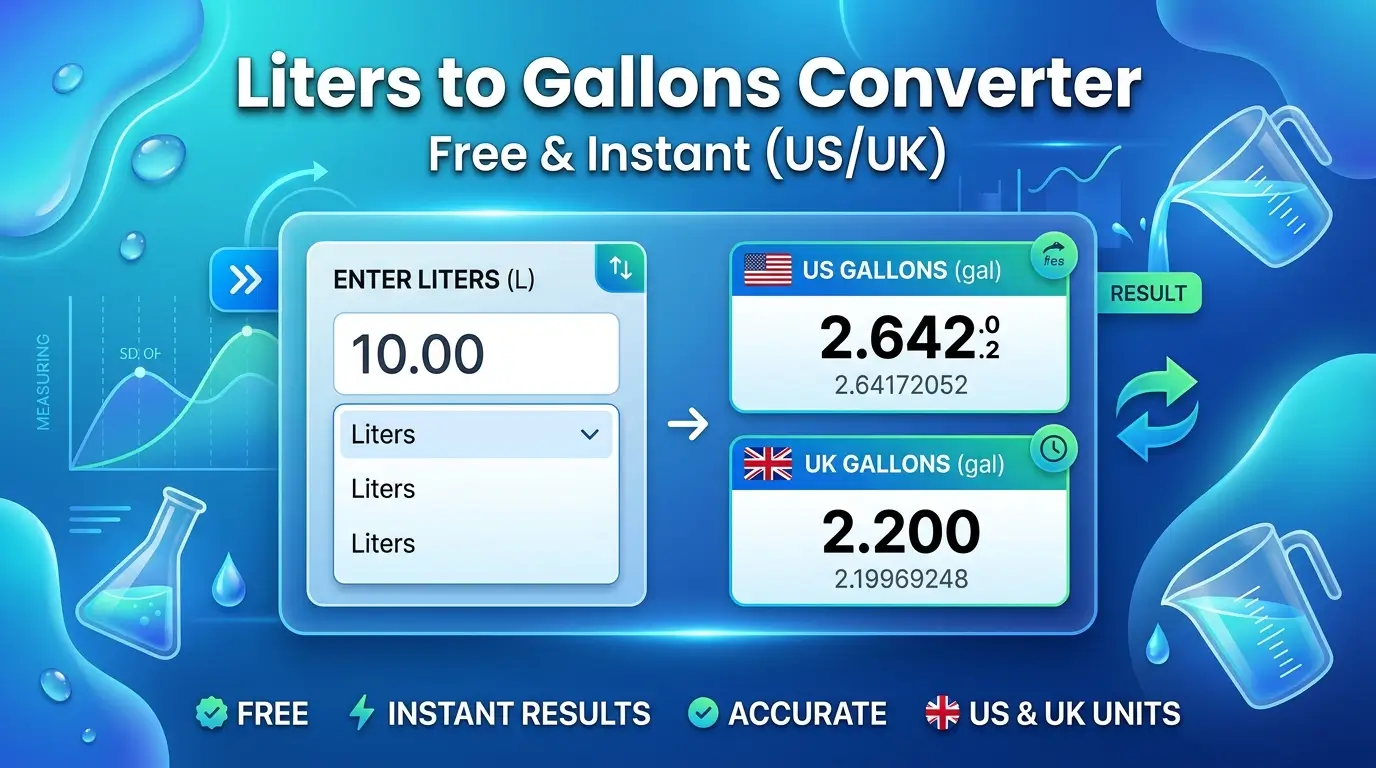
Liters to Gallons Converter – Free & Instant (US/UK)
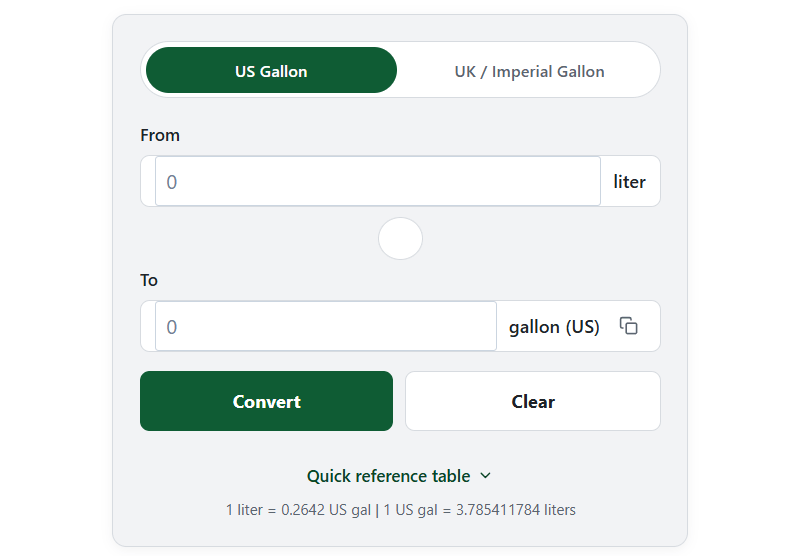
Liters to Gallons Converter
Convert liters to US gallons, UK (imperial) gallons, or both.
Formulas: US gallons = liters ÷ 3.785411784 | UK gallons = liters ÷ 4.54609
Understanding the litre and gallon requires grasping how metric and imperial systems diverged historically. The conversion between these two liquid capacity measurements affects drivers daily, directly influencing practical fuel consumption calculations and purchasing decisions globally.
Today’s interconnected world necessitates bridging volume definitions across regions. Whether measuring fuel at the forecourt or comparing vehicle efficiency, mastering these conversions between litres and gallons empowers informed consumption and reduces calculation errors during travel.
How To Convert Litres To Gallons
Converting litres requires two formulas: imperial gallons equal 4.546 litres; US gallons equal 3.785 litres. Apply instantly. Calculate fuel economy. Track mpg. Examine fuel tank. Values become routine. Volume transformations occur instantly. Memorize these factors.
Understanding differences between imperial and US gallons proves essential. The imperial gallon measures 20% larger than US gallons. This distinction affects fuel economy calculations when comparing performance figures. Convert measurements using free online conversion tables.
How many litres in a gallon?
One UK gallon equals 4.546 litres, while one US gallon equals 3.785 litres. The UK uses the imperial gallon standard, which is significantly larger than the American gallon measurement. This difference matters when calculating fuel costs or comparing vehicle efficiency ratings between regions.
When using a fuel calculator for journey planning, understanding this conversion helps you input accurate fuel consumption data. If your vehicle’s MPG is listed in imperial measurements but you’re checking UK petrol station prices per litre, knowing that one gallon holds 4.546 litres ensures your cost calculations remain precise. This knowledge prevents budgeting errors and helps you accurately track real fuel expenses across different fuel types like petrol, diesel, or LPG.
Litres To Gallons Conversion Table
| LITRES | US GALLON | IMPERIAL GALLON |
|---|---|---|
| 1 | 0.264 | 0.22 |
| 2 | 0.528 | 0.44 |
| 3 | 0.793 | 0.66 |
| 4 | 1.057 | 0.88 |
| 5 | 1.321 | 1.1 |
| 6 | 1.585 | 1.32 |
| 7 | 1.849 | 1.54 |
| 8 | 2.114 | 1.76 |
| 9 | 2.378 | 1.98 |
| 10 | 2.642 | 2.2 |
| 11 | 2.906 | 2.42 |
| 12 | 3.17 | 2.64 |
| 13 | 3.435 | 2.86 |
| 14 | 3.699 | 3.08 |
| 15 | 3.963 | 3.3 |
| 16 | 4.227 | 3.52 |
| 17 | 4.491 | 3.739 |
| 18 | 4.756 | 3.959 |
| 19 | 5.02 | 4.179 |
| 20 | 5.284 | 4.399 |
| 21 | 5.548 | 4.619 |
| 22 | 5.812 | 4.839 |
| 23 | 6.077 | 5.059 |
| 24 | 6.341 | 5.279 |
| 25 | 6.605 | 5.499 |
| 26 | 6.869 | 5.719 |
| 27 | 7.133 | 5.939 |
| 28 | 7.398 | 6.159 |
| 29 | 7.662 | 6.379 |
| 30 | 7.926 | 6.599 |
| 31 | 8.19 | 6.819 |
| 32 | 8.454 | 7.039 |
| 33 | 8.719 | 7.259 |
| 34 | 8.983 | 7.479 |
| 35 | 9.247 | 7.699 |
| 36 | 9.511 | 7.919 |
| 37 | 9.775 | 8.139 |
| 38 | 10.04 | 8.359 |
| 39 | 10.304 | 8.579 |
| 40 | 10.568 | 8.799 |
| 41 | 10.832 | 9.019 |
| 42 | 11.096 | 9.239 |
| 43 | 11.361 | 9.459 |
| 44 | 11.625 | 9.679 |
| 45 | 11.889 | 9.899 |
| 46 | 12.153 | 10.119 |
| 47 | 12.417 | 10.339 |
| 48 | 12.682 | 10.559 |
| 49 | 12.946 | 10.778 |
| 50 | 13.21 | 10.998 |
| 51 | 13.474 | 11.218 |
| 52 | 13.738 | 11.438 |
| 53 | 14.003 | 11.658 |
| 54 | 14.267 | 11.878 |
| 55 | 14.531 | 12.098 |
| 56 | 14.795 | 12.318 |
| 57 | 15.059 | 12.538 |
| 58 | 15.324 | 12.758 |
| 59 | 15.588 | 12.978 |
| 60 | 15.852 | 13.198 |
| 61 | 16.116 | 13.418 |
| 62 | 16.38 | 13.638 |
| 63 | 16.645 | 13.858 |
| 64 | 16.909 | 14.078 |
| 65 | 17.173 | 14.298 |
| 66 | 17.437 | 14.518 |
| 67 | 17.701 | 14.738 |
| 68 | 17.966 | 14.958 |
| 69 | 18.23 | 15.178 |
| 70 | 18.494 | 15.398 |
| 71 | 18.758 | 15.618 |
| 72 | 19.022 | 15.838 |
| 73 | 19.287 | 16.058 |
| 74 | 19.551 | 16.278 |
| 75 | 19.815 | 16.498 |
| 76 | 20.079 | 16.718 |
| 77 | 20.343 | 16.938 |
| 78 | 20.608 | 17.158 |
| 79 | 20.872 | 17.378 |
| 80 | 21.136 | 17.598 |
| 81 | 21.4 | 17.818 |
| 82 | 21.664 | 18.037 |
| 83 | 21.929 | 18.257 |
| 84 | 22.193 | 18.477 |
| 85 | 22.457 | 18.697 |
| 86 | 22.721 | 18.917 |
| 87 | 22.985 | 19.137 |
| 88 | 23.25 | 19.357 |
| 89 | 23.514 | 19.577 |
| 90 | 23.778 | 19.797 |
| 91 | 24.042 | 20.017 |
| 92 | 24.306 | 20.237 |
| 93 | 24.571 | 20.457 |
| 94 | 24.835 | 20.677 |
| 95 | 25.099 | 20.897 |
| 96 | 25.363 | 21.117 |
| 97 | 25.627 | 21.337 |
| 98 | 25.892 | 21.557 |
| 99 | 26.156 | 21.777 |
| 100 | 26.42 | 21.997 |
| 125 | 33.025 | 27.496 |
| 150 | 39.63 | 32.995 |
| 175 | 46.235 | 38.495 |
| 200 | 52.84 | 43.994 |
| 250 | 66.05 | 54.992 |
| 300 | 79.26 | 65.991 |
| 350 | 92.47 | 76.989 |
| 400 | 105.68 | 87.988 |
| 450 | 118.89 | 98.986 |
| 500 | 132.1 | 109.985 |
| 1000 | 264.201 | 219.969 |
| 2000 | 528.402 | 439.938 |
| 3000 | 792.602 | 659.908 |
| 4000 | 1056.803 | 879.877 |
| 5000 | 1321.004 | 1099.846 |
| 6000 | 1585.205 | 1319.815 |
| 7000 | 1849.406 | 1539.785 |
| 8000 | 2113.606 | 1759.754 |
| 9000 | 2377.807 | 1979.723 |
| 10000 | 2642.008 | 2199.692 |
| 25000 | 6605.02 | 5499.231 |
| 50000 | 13210.04 | 10998.462 |
| 100000 | 26420.079 | 21996.925 |
Litres to Imperial Gallons (UK)
The imperial gallon, standard in UK and Canada, defines a distinct volume equal to 4.54609 litres. Rooted in historical units, this gallon became the accepted standard throughout British territories. Grasping the conversion linking litres to imperial gallons matters significantly for accurate calculations and practical application.
When converting litres to imperial gallons, multiply the litre value by 0.219969 for accuracy. This ratio, derived from 4.54609 litres equivalence, ensures results across contexts. From household fuel to shipping specifications, applying this formula systematically prevents errors and maintains consistency in international transactions and measurements.
The imperial gallon’s prominence in UK, Caribbean nations reflects colonial history. Practitioners encounter this unit in fuel pricing, pharmaceuticals, and industrial specifications. Recognizing that 4.54609 litres defines one imperial gallon enables seamless navigation between litres and gallons in professional and everyday scenarios throughout these territories.
Litres To US Gallons
Mastering the 0.264172 conversion factor requires understanding how litres relate to US gallons instantly. The 3.785411784 anchors calculations. Multiply your litre amount by 0.264172 yielding accurate US gallon figures. This formula supports fuel tank capacity planning, consumption tracking, efficiency assessment, cost analysis, and geographic differentiation.
A worked example demonstrates: 50 litres divided by 3.785411784 yields 13.2 US gallons. This calculation method advantages those preferring divide approaches. Real applications show fuel costs, efficiency, and miles per gallon figures require accurate litre-to-gallon conversion for meaningful comparisons and informed purchasing decisions.
Why does instantly matter? Fuel prices fluctuate; quick calculations preserve finances. The converter automatically processes litres into US gallons, eliminating friction. Whether checking fuel economy, planning journeys, or comparing efficiency across markets, mastering conversion establishes confidence in fuel consumption management and daily financial awareness globally.
What Is A Litre?
A litre represents volume measurement fundamentally different from American capacity calculations rooted in metric system standardization. Understanding this unit truly means grasping historical differences between European measurements and traditional imperial approaches to liquid measurements globally.
One litre equals roughly 0.264 US gallons or 0.220 imperial gallons. Whether purchasing fuel, milk, or calculating vehicle fuel economy, understanding litres within measurement units remains essential for consumers navigating increasingly international commerce transactions worldwide.
What Is A Gallon?
The gallon constitutes a liquid capacity measurement standardized across the United States and imperial system territories. A US gallon precisely measures 3.785411784 litres, containing four quarts, sixteen cups, and thirty-two gills in mathematically proportioned subdivisions.
Gallon derives from Old Northern French, standardized in England via wine gallon and ale gallon customs. Fuel-economy figures, half-gallon ice cream containers, and one-gallon milk cartons showcase how measurement remains embedded in consumer choices today.
US Gallons Vs Imperial Gallons: The Difference That Trips People Up
The UK gallon holds 160 fluid ounces while the US gallon contains only 128 fluid ounces, establishing a 20.1% larger capacity that functions as the fundamental yardstick for global measurement standards. When examining fuel efficiency ratings, this difference becomes strikingly apparent: 40 mpg imperial represents an entirely different metric than 33 mpg US, a distinction that impacts car owners across Canada and US territories significantly.
Practitioners in the automotive industry recognize that this volumetric difference reshapes how consumption calculations work between regions. The conversion factor × 0.264172 serves as the mathematical bridge between systems, yet most consumers remain unaware of this critical difference. Understanding whether your fuel economy reference uses imperial or US measurements proves essential when comparing vehicle efficiency, since the same car’s performance appears dramatically different depending on which gallon measurement applies to your regional yardstick.
Why Drivers Need This Conversion
Understanding conversion principles directly impacts financial planning daily. Drivers navigating miles per gallon discrepancies across different regions must calculate accurate cost per mile figures to optimize overall fuel expenditure and predict vehicle operating expenses effectively.
Drivers comparing petrol versus diesel performance need fuel consumption data translated accurately between regions. Regional mpg standards create confusion when evaluating vehicle efficiency, making precise conversion knowledge absolutely essential for informed purchasing and maintenance decisions.
MPG And Fuel Consumption Basics
Understanding fuel consumption requires recognizing that MPG and miles per gallon operate inversely to litres per 100 km. Higher is better describing MPG, yet lower is better for L/100km an inverted scale. Every vehicle needs this knowledge when comparing petrol or diesel efficiency ratings.
Consider an example: 35 mpg converts to approximately 6.72 L/100km. Divide using 1 US gallon equals 3.785411784 L plus distance ratio 1 mile equals 1.609344 km. This clarifies how mpg (US) and mpg (imperial) standards diverge.
Is A UK Gallon The Same As A US Gallon?
Absolutely no. The US gallon is NOT the same as UK gallon. A US gallon holds 3.785 litres while the imperial UK gallon holds 4.546 litres, making the UK gallon approximately 20% larger in capacity.
Recognizing this critical distinction matters considerably when comparing fuel consumption across borders. The American 3.785 litre volume versus Britain’s 4.546 litre standard demonstrates how each nation independently established measurement protocols. This 20% variance affects calculations.
Why Is Fuel Sold In Litres But Economy Quoted On Mpg?
Fuel comes sold in litres across Europe, yet efficiency remains quoted as miles per gallon in Britain and America an artifact of regulatory divergence. These competing units reflect geopolitical measurement standards rather than practical logic. Vehicles display both metrics today because manufacturers cannot ignore regional requirements. The conversion happens automatically on dashboards, though consumers rarely understand the divide between volume and distance efficiency measures.
Cost calculations demand understanding this split litre-based fuel pricing seems disconnected from consumption figures displayed as mpg. Petrol station pumps measure output volumetrically while dashboard economy reports track distance achieved per unit. This misalignment complicates consumer comparisons. Drivers cannot easily calculate cost per mile without performing manual conversions. The fragmented approach wastes cognitive effort despite being technically straightforward two different frameworks attempting simultaneous measurement of an identical phenomenon.
Is 4.5 Litres A Gallon?
4.5 litres approximates 1 imperial gallon, which converts at 4.54609 litres exactly. This minimal gap makes 4.5 litres functionally equivalent to an imperial gallon for daily use, historical standards, and practical applications requiring volumetric precision.
While US gallons equal 3.785 litres, the imperial gallon standard historically dominated UK measurements. Understanding this conversion factor clarifies whether 4.5 litres matches imperial or American metrics, requiring careful context-aware consideration during practical measurement applications.
FAQs
Conclusion
Mastering litre-to-gallon conversions transforms from abstract mathematics into practical necessity in today’s globalized world. Whether you’re a driver comparing fuel efficiency across borders, a consumer evaluating product volumes, or someone navigating international commerce, understanding that imperial gallons measure 4.546 litres while US gallons contain 3.785 litres eliminates confusion and prevents costly calculation errors. This 20% difference isn’t merely academic it directly shapes your fuel purchasing decisions, vehicle efficiency comparisons, and financial planning. By recognizing which measurement system applies to your region and applying the correct conversion factor, you gain clarity on consumption patterns and make genuinely informed decisions about vehicle performance and cost management in an interconnected marketplace.