
Asphalt Calculator USA: Estimate Tonnage & Costs
|

Asphalt Calculator USA: Estimate Tonnage & Costs

Asphalt Calculator

Estimate required asphalt area, volume, weight, and waste allowance.

Please enter a valid positive length.
Please enter a valid positive width.
Please enter a valid positive thickness.
Please enter a valid positive density.

Whether tackling potholes on your asphalt roadway or planning a major highway, understanding tonnage demands has become essential. The blacktop calculator emerged from field necessity contractors needing quick cost calculator responses before important meetings end.

Real planning for paving projects from asphalt driveway installations in Bay Area to airfield projects demands precise measurements and material knowledge. H&K Group's materials team understands that accurate estimate fundamentals calculate what your job requires.

HOW TO USE THE ASPHALT CALCULATOR
Asphalt Calculator USA Estimate Tonnage & Costs

CALCULATOR INPUT REQUIREMENTS

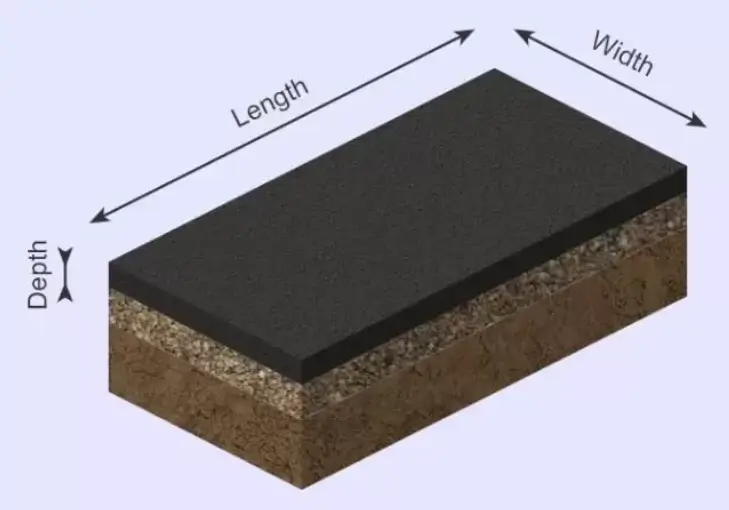
The asphalt calculator demands precision from the start. Length, width, and compacted thickness form your foundation, but decimal values often prove more reliable than rough estimates. When you enter measurements, the tool transforms raw dimensions into tons required, making material planning tangible and actionable immediately.

Understanding rectangular area calculations separates amateurs from professionals. Your project's area multiplied by depth creates asphalt volume a critical intermediate step. Many overlook how thickness in inches dramatically influences final tonnage. The square footage calculator function exists precisely because dimensions alone mislead; density considerations prove essential for accuracy.

Most operators fixate on the click of a button, forgetting proper length and width input accuracy determines results. Parameters demand detail whether measuring in feet or entering fractional values, small errors compound downstream. The calculator accepts 0.25 inches precision because real projects require true exactness and reliability.

ACCURATE MEASUREMENTS GUIDANCE

Reliable results demand obsessive attention during precise measurement phases. The asphalt calculator truly rewards precision accurate measurements of length, width, and depth transform planning into concrete needs. I've witnessed projects falter from negligent measurement. Measure twice, maybe three times when stakes involve significant project costs.

Double check your numbers before processing error dimensions cascade through calculations with alarming speed. Project area precision matters because every miscalculation inflates or deflates your tonnage estimates dangerously. Converting measurements to feet standardizes the process, reducing confusion. The difference between successful installation and expensive failure hinges on this foundational accuracy.

Asphalt required calculations hinge directly on accurate measurements. I recommend digital tools over tape measures for project area determination, though both work carefully. Cross-verify all inputs before trusting outputs. The asphalt calculator represents your project's financial blueprint; measurement integrity directly influences project costs and outcomes.

How To Determine Asphalt Requirements
How To Determine Asphalt Requirements

Understanding your intended use requires examining the project area and expected traffic load simultaneously. Home driveways with one to two cars demand different thickness than commercial spaces. Soil conditions and climate variations influence decisions bay area moisture differs from intense summer heat zones. Begin by clarifying whether you're managing light residential driveway activity or heavy-duty parking lot operations needing structural reinforcement and longevity planning.

Base material preparation determines everything following installation. Your gravel foundation and subgrade material must remain stable, preventing future puddle formation and asphalt settlement. Crushed stones need proper arrangement to support surface layers above. Removing large debris, rocks, and twigs creates a clean, compacted surface. Proper drainage through well-prepared soil type ensures asphalt pavement performs optimally across different seasonal weather patterns.

Volume calculations stem from measuring length, width, and desired thickness precisely. Multiply these dimensions to establish square footage requirements, then convert using lbs per cubic foot formulas for accurate material estimation. Fraction values matter significantly when computing cubic yards or tons needed. Professional contractors often refine estimates through on site evaluation, adjusting for irregular shapes and surface variations unique to your project.

Calculating Asphalt Weight

The industry standard weight for asphalt measures 145 lbs per cubic foot consistently. Multiply your project area in feet by desired depth to determine total cubic feet needed. Divide final pounds calculation by 2000 pounds to convert into tons of asphalt needed. This mathematical foundation applies regardless of whether you're calculating driveway, parking lots, or residential roads requiring different performance specifications.

Asphalt density typically reaches 2300 kg per cubic meter or approximately 4.83 tonnes per cubic meter under proper compaction. Your specific asphalt mixture may vary based on aggregate to bitumen ratios and local material composition. Hot mix asphalt selection influences final weight outcomes significantly. Real-world examples show that a 7 meters by 6 meters surface at 5 centimeters thickness yields approximately 4830 kg total this weight drives both logistics and cost per weight calculations throughout your project.

Total asphalt weight directly determines delivery cost and cost per weight pricing structure. Understanding whether suppliers charge per tonne or per square foot affects budgeting accuracy completely. Local asphalt material cost variations mean identical weight calculations produce different financial outcomes regionally. Experienced contractors cross-reference multiple suppliers and compare quotes carefully, examining whether bulk ordering reduces per-unit pricing and impacts your total investment substantially.

What Is Asphalt?
Asphalt Calculator USA Estimate Tonnage & Costs

Bitumen-based construction materials form the backbone of modern infrastructure, creating durable pavement surfaces through carefully engineered asphalt concrete mixtures. This dark, versatile material bonds aggregate particles through viscous binding properties, establishing blacktop that withstands extreme conditions while maintaining structural integrity across diverse environmental challenges throughout its lifespan.

At its core, asphalt represents a sophisticated engineering solution combining product innovation with practical durability. When properly installed, this paving material delivers exceptional waterproofing capabilities, making it the preferred choice for highways, driveways, and commercial applications where climate resilience matters most.

Asphalt Pricing / Cost

Understanding how asphalt gets priced requires examining variables that influence your project cost. The cost per ton typically ranges from $40 to $80, depending heavily on rock size, total volume ordered, and your work location. Regional fluctuations, supplier proximity, and material quality significantly impact final expenditure calculations.

What ultimately determines your final cost isn't just material expenses it reflects regional market conditions and contractor expertise. Local material availability and seasonal demand create price fluctuations that property owners monitor before initiating their asphalt projects. Timing purchases strategically can substantially reduce overall investment while maintaining quality standards.

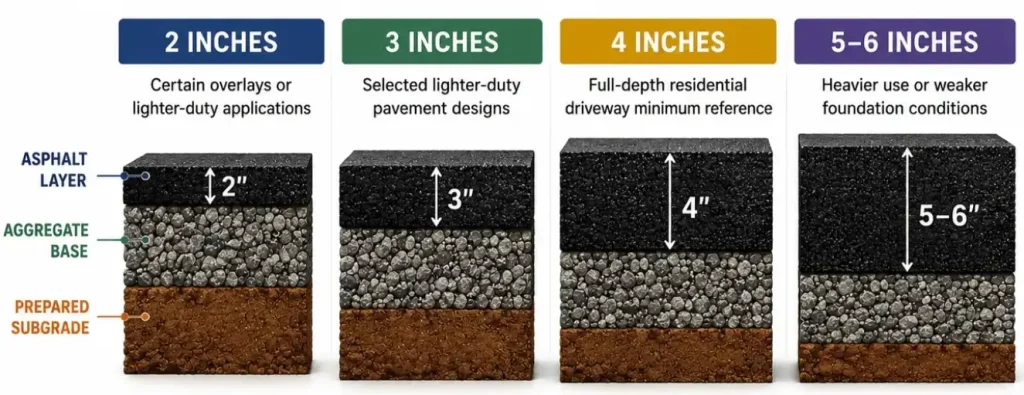
Asphalt Thickness Requirements

Thickness varies significantly based on your specific project intended use requirements. For home driveways serving one to two cars, a 2 inch layer provides the standard foundation that works well. However, accommodating heavier vehicle traffic or heavy trailer loads demands upgrading to a 3 inch layer.
Asphalt Thickness Requirements

Commercial applications demand distinctly different specifications. Lighter use parking lots typically require only 4 inches of compacted material for adequate performance. Conversely, heavier use parking lots handling substantial traffic volume warrant 6 to 8 inches, ensuring resilience against wear patterns and extending overall structural integrity.

Notes To Consider When Applying Asphalt

Soil condition fundamentally determines success before any overlay begins. Professional installation requires understanding subsurface characteristics clay soil retains moisture differently than sandy soil, which affects longevity. Property owners often overlook that preparation precedes application; rushing this phase courts expensive consequences. Achieve density through methodical groundwork, recognizing that traffic load specifications demand specific asphalt type selections. Cutting corners on preparatory phases inevitably leads to costly repairing, transforming modest upfront investments into substantial future liabilities affecting pavement durability.

Asphalt thickness decisions stem from intended usage patterns rather than uniform standards. Lighter use parking lots function optimally with 4 inches, while heavier use parking lots demand 6 to 8 inches for structural integrity. Load requirements vary across applications residential driveways differ fundamentally from commercial installations regarding resilience. Maximum performance emerges when proper equipment operators understand compaction rates and density specifications unique to each project. Practitioners recognize that pavement lifespan extends considerably when thickness correlates directly with anticipated stress levels, creating economically sensible solutions.

Understanding warm mix asphalt and reclaimed asphalt pavement options represents contemporary sophistication in material selection. Multiple layers construction methodology builds strong, rut-resistant surfaces through sequential compaction phases rather than monolithic approaches. Local material costs fluctuate based on asphalt type availability and mixing process complexities specific to geographic regions. Upfront cost consciousness shouldn't compromise structural longevity through inferior material choices. Useful starting point conversations with asphalt suppliers clarify whether traditional hot mix or alternatives better serve particular environmental conditions affecting long-term performance.

Compaction And Installation

Compaction requires understanding asphalt surfaces under conditions beneath pavement. Clearing weeds and plants precedes proper installation. Well prepared soil eliminates poor drainage. Groundwork maximizes asphalt layer performance and delivers stable long lasting surface outcomes effectively.

Asphalt driveway stability depends on proper compaction and consistency. The area receives asphalt sealer for additional durability once asphalt cures. Understanding pavement lifespan helps plan maintenance. Professional execution ensures performance reliability throughout service with oversight.

Advantages Of Using Asphalt

The silent pavement characteristic genuinely transforms highway and airfield experiences—sound reduction at high speeds absolutely isn't trivial. Asphalt's beautiful clean dark look provides substantial benefits, while its high waterproofing capability outperforms competing materials significantly.

Asphalt's proven lifespan extends beyond 20 years when maintained, particularly resilient in freezing climates. This longevity represents exceptional value, making it the practical choice for demanding conditions requiring durability and consistent performance across weather scenarios.

FAQs

Working out the exact quantity of asphalt required for a paving job comes down to a straightforward volumetric calculation. Because asphalt is ordered and sold by weight (tons), you must convert the dimensions of your paved area into cubic feet, multiply by the density of the material, and convert the total into tons.

The Core Calculation Formula

To figure out your material needs, follow this simple mathematical sequence:

  1. Surface Area: $\text{Length (ft)} \times \text{Width (ft)} = \text{Area (sq ft)}$
  2. Depth Conversion: $\text{Depth (inches)} \div 12 = \text{Depth (ft)}$
  3. Total Volume: $\text{Area (sq ft)} \times \text{Depth (ft)} = \text{Volume (cu ft)}$
  4. Base Weight: $\frac{\text{Volume (cu ft)} \times 145 \text{ lbs/cu ft}}{2,000 \text{ lbs}} = \text{Weight (Tons)}$
  5. Waste Factor: $\text{Weight (Tons)} \times 1.07 = \text{Final Required Tonnage}$

Key Takeaway: Standard hot-mix asphalt weighs approximately 145 lbs per cubic foot. Always add a 7% safety margin to your final number to account for compaction, spillage, and site irregularities.

Practical Example: Driveway Calculation

If you are laying a driveway measuring 50 feet long, 10 feet wide, and 2 inches thick:

  • Calculate the area: $50 \text{ ft} \times 10 \text{ ft} = 500 \text{ sq ft}$
  • Convert depth to feet: $2 \text{ in} \div 12 = 0.166 \text{ ft}$
  • Determine volume: $500 \text{ sq ft} \times 0.166 \text{ ft} = 83.3 \text{ cu ft}$
  • Calculate raw weight: $83.3 \text{ cu ft} \times 145 \text{ lbs/cu ft} = 12,078.5 \text{ lbs}$
  • Convert to tons: $12,078.5 \text{ lbs} \div 2,000 \text{ lbs/ton} = 6.04 \text{ tons}$
  • Account for waste (7%): $6.04 \text{ tons} \times 1.07 \approx \mathbf{6.5 \text{ tons}}$

Quick Reference Conversion Table

Depth (Inches)Depth (Feet)Approximate Coverage per Ton
1 inch$0.083 \text{ ft}$$\approx 138 \text{ sq ft}$
2 inches$0.166 \text{ ft}$$\approx 69 \text{ sq ft}$
3 inches$0.250 \text{ ft}$$\approx 46 \text{ sq ft}$
4 inches$0.333 \text{ ft}$$\approx 34 \text{ sq ft}$

A standard 20 × 20 foot (400 sq ft) asphalt driveway typically costs between $2,000 and $4,800 for professional installation.

Because 400 square feet is on the smaller side for paving jobs, where the final price lands depends on the scope of the prep work and contractor minimums.

Project Breakdown & Cost Tiers

  • Asphalt Resurfacing / Overlay ($1,200 – $2,800): If you already have a solid, stable asphalt base with only minor surface wear, applying a fresh top coat typically costs $3 to $7 per sq ft.
  • New Installation ($2,800 – $5,200): Building a driveway from scratch on unpaved dirt or grass requires excavation, grading, and a compacted gravel sub-base. This runs about $7 to $13 per sq ft for materials and labor.
  • Full Replacement / Tear-Out ($3,200 – $6,000): Removing and hauling away an existing, badly cracked concrete or asphalt driveway adds an extra $1 to $3 per sq ft to the overall price.

Key Cost Factors

  1. Minimum Equipment Charges: Transporting heavy machinery (rollers, pavers, haul trucks) incurs fixed costs. Many paving contractors charge a $1,500 to $2,500 base minimum charge regardless of how small the square footage is.
  2. Sub-Base & Site Prep: A long-lasting asphalt driveway relies heavily on its sub-base. Clearing roots, grading for water drainage, or adding extra crushed rock can account for up to 30%–40% of the quote.
  3. Location & Accessibility: Regional labor rates and proximity to an asphalt batch plant will impact material pricing.

To narrow down a tighter estimate, consider what is currently on the ground (dirt, gravel, or old pavement), whether the terrain requires grading for slope, and local contractor minimums in your area.

At a standard compacted density of 145 lbs/cu ft, 1 ton (2,000 lbs) of hot-mix asphalt covers approximately 80 to 85 square feet at a 2-inch thickness.

For most project estimates, the construction industry uses a baseline rule of thumb of 83 square feet per ton.

How the Calculation Works

  1. Volume of 1 Ton: At a standard compacted density of 145 lbs/cu ft, 1 ton of asphalt occupies about 13.79 cubic feet of space ($2,000 \text{ lbs} \div 145 \text{ lbs/cu ft} = 13.79 \text{ cu ft}$).
  2. Thickness Conversion: Convert 2 inches into feet ($2 \text{ in} \div 12 = 0.166 \text{ ft}$).
  3. Surface Coverage: Divide volume by depth ($13.79 \text{ cu ft} \div 0.166 \text{ ft} \approx \mathbf{83 \text{ sq ft}}$).

Coverage Reference by Depth

Because asphalt is sold by weight, the surface area covered per ton changes based on your target thickness:

Compacted ThicknessApproximate Coverage per Ton
1 inch$\approx 165 \text{ sq ft}$
1.5 inches$\approx 110 \text{ sq ft}$
2 inches$\approx 83 \text{ sq ft}$
3 inches$\approx 55 \text{ sq ft}$
4 inches$\approx 41 \text{ sq ft}$

Practical Considerations Before Ordering

  • Compaction Loss: Loose asphalt shrinks in depth by roughly 20%–25% when rolled and pressed. The 83 sq ft metric applies strictly to the final, compacted depth.
  • Sub-Base Uniformity: If your gravel base is uneven or rutted, asphalt will fill those low spots, which decreases your overall surface coverage per ton.
  • Safety Margin: Always add a 5% to 10% waste factor to your total tonnage to cover spillage, edge trimming, and site variations.

A 2,000-square-foot asphalt project typically costs between $6,000 and $26,000 for professional installation. On a per-square-foot basis, this ranges from $3 to $13+ per sq ft, depending primarily on whether you are paving over an existing base or building from scratch.

Cost Estimates by Project Type

  • Asphalt Resurfacing / Overlay ($6,000 – $10,000): If your current pavement is structurally sound with minimal damage, laying a fresh 1.5- to 2-inch top coat costs about $3 to $5 per sq ft.
  • New Asphalt Installation ($14,000 – $26,000): Installing pavement over dirt or grass requires excavation, site grading, and a compacted gravel sub-base. Expect to pay $7 to $13 per sq ft for labor and materials.
  • Full Removal & Replacement ($16,000 – $30,000): Completely tearing out and hauling away an old, failing concrete or asphalt driveway before laying a new base and top layer costs $8 to $15 per sq ft.

Material vs. Labor Breakdown

  • Materials Alone ($1,800 – $3,600): Hot-mix asphalt delivered to the site costs between $100 and $200 per ton. Paving 2,000 sq ft at a standard residential thickness of 2.5 to 3 inches requires roughly 18 to 22 tons of asphalt.
  • Labor & Heavy Equipment ($5 to $7+ per sq ft): Professional installation makes up the bulk of the expense. Paving requires heavy machinery including dump trucks, graders, and steamrollers as well as a full crew.

Key Variables Affecting Total Cost

  1. Thickness: Standard residential driveways are 2 to 3 inches thick. If the area needs to support heavy trucks or RVs, a 4- to 5-inch depth increases material volume by up to 50%.
  2. Site Grading & Drainage: Leveling sloped terrain or clearing trees and roots can add several thousand dollars to excavation fees.
  3. Local Labor Rates: Regional labor costs and proximity to an active asphalt batch plant significantly influence overall contractor quotes.

A 200-foot asphalt driveway typically costs between $14,000 and $36,000 for a new installation, with most homeowners paying around $24,000.

Because asphalt is priced by square footage, the overall total depends heavily on how wide the driveway is, the local labor rates, and the level of site preparation needed.

1. Cost Breakdown by Width

A 200-foot length requires a significant amount of material. The overall square footage changes considerably based on width:

  • 10-Foot Wide (Single-Car Width / 2,000 sq ft): $14,000 to $30,000
  • 12-Foot Wide (Standard Two-Car Width / 2,400 sq ft): $16,800 to $36,000
  • 16- to 20-Foot Wide (Wide Two-Car or Turnaround / 3,200–4,000 sq ft): $22,000 to $50,000+

2. Pricing by Scope of Work

The existing surface plays a massive role in labor and prep fees:

Work TypeInstalled Cost / Sq FtEstimated Total (200 ft × 12 ft)What It Involves
Asphalt Overlay$3 – $7$7,200 – $16,800Paving a new top layer directly over an existing, structurally sound driveway.
New Installation$7 – $13$16,800 – $31,200Excavating bare dirt/grass, grading, laying a gravel sub-base, and paving.
Full Replacement$8 – $15$19,200 – $36,000Demolishing, ripping out, and hauling away old concrete or asphalt before rebuilding.

3. Expense Distribution

For a brand-new driveway, costs generally break down as follows:

  • Labor (~45%): Covers machine operators, hand rakers, rollers, and hauling crews.
  • Asphalt Materials (~40%): The hot-mix asphalt mixture ($100–$200/ton delivered).
  • Gravel Base (~15%): The compacted crushed stone sub-base that prevents sinking and shifting.

4. Extra Variables for Long Driveways

  • Land Clearing & Grading: Long 200-foot paths through woods or uneven terrain can add $1,000 to $3,000+ for tree removal, stump grinding, or soil leveling.
  • Slopes and Curves: Straight, flat driveways are straightforward to pave. Steep inclines or sharp turns require specialized machinery and extra hand labor.
  • Permits: Municipalities often require a right-of-way or driveway permit ranging from $50 to $200 when connecting a long driveway to a public road.

Yes, 2 inches of compacted hot-mix asphalt is sufficient for a standard residential driveway, provided it is built over a solid, well-compacted gravel sub-base (typically 6 to 8 inches) and used primarily for regular passenger cars.

However, asphalt thickness needs to match how the driveway will be used and the conditions of the site.

When 2 Inches Is Enough

  • Standard Passenger Vehicles: It easily handles everyday cars, crossover SUVs, and light sedans.
  • Resurfacing / Overlays: Applying a 2-inch top coat is the industry standard when paving over an existing, structurally sound asphalt or concrete base.
  • Budget-Conscious Builds: It provides a reliable surface while keeping material costs down.

When You Should Upgrade to 2.5 or 3 Inches

  • Heavy Loads: If you regularly park heavy pickup trucks, large RVs, commercial vans, or boats, a 2.5- to 3-inch layer provides the extra load-bearing strength needed to prevent rutting and indentations.
  • Weak Sub-Base or Poor Soil: Asphalt itself relies on the foundation beneath it. If your subsoil is high in clay or your crushed stone base is less than 6 inches thick, a thicker asphalt layer helps prevent cracking.
  • Harsh Climates: Regions with severe freeze-thaw cycles put additional stress on pavement. A 3-inch layer offers better flex resistance against frost heaves.

Key Takeaway

For a long-lasting installation, 2 inches of compacted asphalt over a 6- to 8-inch crushed aggregate base is the sweet spot for basic residential use. If you anticipate heavier vehicle traffic or questionable soil conditions, spending a little extra for a 3-inch layer will significantly extend the driveway's lifespan.

Blacktop (asphalt) is significantly cheaper upfront, but concrete is often cheaper over its total lifetime.

Choosing between the two depends on whether your priority is lower initial installation expenses or minimal long-term maintenance.

Upfront Installation Costs

Installing asphalt costs roughly 40% to 50% less per square foot than standard poured concrete.

  • Blacktop (Asphalt): $3 to $7 per sq ft ($1,200 – $2,800 for a standard 400 sq ft driveway).
  • Plain Concrete: $5 to $15 per sq ft ($2,000 – $6,000 for a standard 400 sq ft driveway).
  • Stamped or Decorative Concrete: $8 to $18+ per sq ft ($3,200 – $7,200+ for a standard 400 sq ft driveway).

Long-Term Value & Maintenance Expenses

While blacktop saves money on day one, its ongoing maintenance balance shifts the lifetime value over a 30-year span:

MetricBlacktop (Asphalt)Concrete
Typical Lifespan15 – 30 years30 – 40+ years
Maintenance WorkRequires sealcoating every 3–5 yearsPeriodic pressure washing; optional clear sealer every 4–5 years
Repair DifficultyCheap and easy to patch or resurfacing overlayDifficult to patch seamlessly; repairs are visible and costlier
Best ClimateCold / Freezing (expands/contracts without cracking easily)Warm / Hot (doesn't soften under extreme sun heat)

Key Verdict

  • Choose Blacktop if you want the lowest initial cost, have a large/long driveway, or live in a cold northern climate where freeze-thaw cycles cause rigid concrete to crack.
  • Choose Concrete if you prefer a "set it and forget it" low-maintenance surface, want a longer lifespan, or live in a hot southern climate where asphalt can soften in summer heat.

The best time of year to install asphalt is late spring through early fall (typically May through September), when air temperatures consistently stay above 50°F to 70°F and the ground is thoroughly dry.

Hot-mix asphalt is applied at temperatures between 275°F and 300°F, so warm weather is essential to keep the material pliable long enough for heavy rollers to properly compact it before it cools down.

Seasonal Breakdown

  • Late Spring (May – June): Air temperatures rise reliably, creating good paving conditions. However, lingering spring rain or saturated ground from winter snowmelt can delay projects, as asphalt cannot be laid over wet soil or standing water.
  • Summer (July – August): Peak paving season with consistently high temperatures and dry weather. The primary drawback is that extreme heat (above 95°F) can keep the mix soft for longer, requiring a bit more care during rolling and setting.
  • Early Fall (September – October): Frequently considered the "sweet spot" by paving contractors. Temperatures remain comfortably warm during the day, humidity drops, and the ground is thoroughly dry from summer, creating ideal compaction conditions before the winter frost sets in.
  • Winter (Late November – March): Avoid entirely. Cold air and freezing ground cause the hot asphalt to harden almost instantly. This prevents proper compaction, leading to weak spots, early cracking, and structural failure within the first year.

Key Installation Requirements

  1. Ambient Temperature: Air temperatures should be at least 50°F and rising (preferably 60°F or warmer for thinner layers).
  2. Ground Moisture: The underlying soil or gravel sub-base must be completely dry. Trapped water under fresh asphalt creates steam and prevents bonding, leading to early potholes.
  3. Wind Conditions: Strong cold winds cool fresh asphalt rapidly, reducing the working window for installation crews.

While people often use the terms interchangeably in casual conversation, blacktop is technically a specific variation of asphalt. The primary differences lie in their mixture ratios, production temperatures, and intended heavy-duty applications.

Key Differences at a Glance

FeatureStandard AsphaltBlacktop
Material RatioHigher proportion of liquid bitumen binder.Higher ratio of crushed stone to bitumen.
Mixing TemperatureMixed at lower temperatures (around 250°F).Heated to higher temperatures (300°F+).
Texture & SurfaceDense, dark, and smooth.Slightly porous with a subtle sparkling texture from crushed stone.
Primary UseHighways, city roads, commercial parking lots.Residential driveways, playgrounds, tennis courts, paths.
Weight CapacityEngineered for heavy vehicles and high-volume traffic.Best suited for lighter passenger vehicles and foot traffic.

Composition and Production

  • Standard Asphalt: Features a heavier concentration of petroleum bitumen (the black liquid binder) relative to stone aggregates. Because it is mixed at slightly lower temperatures, it forms a dense, tightly bound surface designed to resist deep wear from heavy loads.
  • Blacktop: Contains more natural stone aggregate relative to the bitumen binder and is processed at higher temperatures (300°F+). Heating it to higher temperatures makes the mixture more pliable and easier for small crews to work with on residential jobs.

Where Each Is Used

  • Asphalt: Chosen for projects requiring high load-bearing capacity, such as interstate highways, heavy-equipment staging areas, and commercial shipping yards.
  • Blacktop: Ideated for light-duty residential and recreational projects like residential driveways, basketball courts, and walking paths.

A full dump truck of hot-mix asphalt typically costs between $550 and $1,800, including delivery.

Because raw asphalt is sold by weight averaging $80 to $160 per ton for hot-mix the total price depends primarily on the carrying capacity of the truck.

Cost Breakdown by Dump Truck Capacity

Truck TypePayload CapacityHot-Mix Asphalt Total (Material + Delivery)Recycled Asphalt Millings Total
Small Dump Truck~5 – 8 tons$300 – $700$100 – $250
Tandem-Axle (10-Wheeler)~12 – 16 tons$550 – $1,150$450 – $550
Tri-Axle / Quad-Axle~18 – 22 tons$850 – $1,800$500 – $700

Major Cost Factors

  1. Material Type:
    • Hot-Mix Asphalt: Standard material for driveways and roads; costs $80 to $160 per ton.
    • Cold-Mix Asphalt: Typically used for quick temporary repairs or winter patching; costs $90 to $130 per ton.
    • Recycled Asphalt Millings: Crushed recycled pavement used as a cheap base or gravel alternative; costs $10 to $20 per ton.
  2. Delivery & Hauling Fees:
    • Hot-mix asphalt must stay hot to remain workable, so distance from the asphalt plant matters. Local delivery usually adds $15 to $40 per ton to the bill.
  3. Regional Price Differences:
    • Southeastern US: Generally lower rates at $80 to $110 per ton.
    • West Coast & Northeast: Higher rates ranging from $110 to $180 per ton due to higher labor costs and local environmental regulations.

Important Note: These numbers reflect material drop-off only. If you need a crew to grade, spread, and roll the asphalt, total installed costs will run between $7 and $13 per square foot.

Conclusion

Ultimately, executing a durable and cost-effective paving project requires balancing accurate volumetric calculations with an understanding of site-specific demands. While precise measurement inputs (length, width, and compacted depth) ensure you order the correct tonnage and avoid material waste, the long-term success of the pavement hinges on proper ground preparation, choosing the right thickness for intended load capacities, and timing installation during warm, dry weather. Factor in contractor baseline minimums and regional material variations early on, as a solid gravel sub-base combined with correct material compaction remains the single most critical investment for preventing structural failure.

Read More:

Similar Posts

Leave a Reply

Your email address will not be published. Required fields are marked *