

French Drain Gravel Calculator: Estimate Materials & Cost USA
French Drain Gravel Calculator
Calculate the aggregate required for your drainage trench
Note: Requirements are estimates. Actual gravel needs vary based on exact trench excavation uniformity, pipe displacement, stone size, and material compaction.
Planning a drainage project? This French Drain Gravel Calculator determines the precise amount of gravel, drainage piping, and filter fabric needed to complete your setup. It also doubles as a comprehensive cost estimator to help you budget accurately before purchasing materials. Beyond the numbers, you'll discover how French drains operate, explore illustrated system diagrams, and learn how to construct both traditional piped and pipeless variations.
What is a French drain? How does a French drain work?
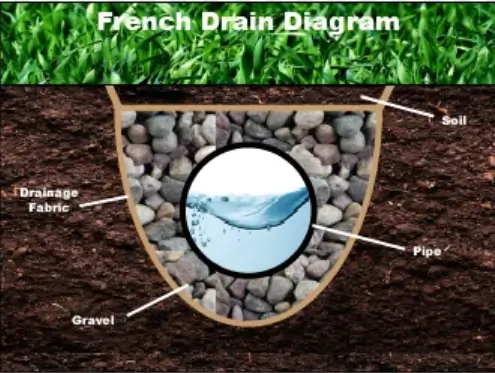
A French drain is a specialized subsurface drainage system designed to manage surface runoff and rising groundwater. Constructing one involves digging a trench at a lower elevation, lining it with a porous aggregate such as gravel or river rock, and placing a perforated pipe at the base.
The system operates through a straightforward process:

- Managing Surface Runoff: Rainwater or excess garden runoff flows toward the lowest point in your yard, penetrating the gravel layer and draining through the perforations into the base pipe. The pipe accelerates the water flow, redirecting it away from your property into a catch basin or municipal stormwater system.
- Handling Groundwater: When heavy rainfall causes the subterranean water table to rise, excess groundwater enters the perforated pipe from below and is safely channeled away before it can flood surrounding soil.
How do I build a French drain?
Installing a French drain involves digging a sloping trench, laying down a perforated pipe along a clean path, and backfilling the space with aggregate.
1. Plan and Line the Trench
Dig your trench along a natural gradient, ensuring it follows a continuous path toward your discharge point. Line the excavated trench with geotextile or landscaping filter fabric. This barrier prevents surrounding soil and fine particles from filtering into the gravel and clogging the pipe perforations over time.
2. Ensure Proper Gradient
To keep water moving efficiently and prevent stagnant pooling, set your pipe at the correct minimum slope. The required slope determines the necessary depth of your trench as it extends toward the outlet.
| Pipe Size | Minimum Recommended Slope (Inches per Foot) |
| 1/8" – 2 1/2" | 0.2500 (1/4") |
| 3" – 6" | 0.1250 (1/8") |
| 8" or larger | 0.0625 (1/16") |
Tip: If your pipe route needs to bend or maneuver around tree roots or garden structures, calculate the exact pipe length needed for offset angles before digging your full trench.
3. Lay the Pipe and Bedding
Deposit a base layer of gravel inside the fabric-lined trench, place your perforated pipe on top, and surround it completely with aggregate. Fully encapsulating the pipe in gravel ensures optimal water filtration while keeping soil away from the perforations. Wrap the remaining filter fabric over the top layer of gravel before replacing topsoil.
When placing a perforated drain pipe into your trench, position the holes so they face directly downward. Orienting the openings downward lets rising groundwater enter the pipe immediately at the base of the aggregate bed. If you install the pipe with the perforations facing upward, water can only enter after the entire trench fills to the top of the pipe, defeating the purpose of efficient drainage.
If you are constructing a pipeless French drain relying solely on an aggregate channel without a pipe ensure the base of the excavated trench maintains a consistent, continuous slope directed toward your discharge outlet.
How to Use the French Drain Calculator
Calculating your drainage materials is straightforward with this tool. Follow these steps to determine your total excavation volume, gravel weight, and pipe requirements:
1. Choose Your System Type
- Piped vs. Pipeless: By default, the calculator is set for a traditional installation with a perforated pipe (indicated by the checked "With perforated drain pipe?" option). Ticking or unticking this box reveals or hides the pipe calculations accordingly.
- Filter Fabric Options: Select your fabric preference to update the system visualiser and tailor the material outputs.
2. Enter Trench Dimensions
- Input your planned depth, width, and length to instantly calculate the total excavation volume.
- If using landscaping fabric, enter your desired filter fabric overlap length during this step.
3. Configure Pipe Details (If Applicable)
- Select your preferred pipe schedule and diameter from the drop-down menu, or input a custom outside diameter.
- The tool automatically calculates the pipe's subterranean volume and subtracts it from your total excavation space, ensuring you only buy the exact volume of gravel required.
- Check the "Display more pipe details" option to review your overall pipe length, minimum recommended slope, total pipe drop, and total pipe segments needed.
4. Account for Material Wastage & Gravel Density
- Wastage Factor: Adjust the percentage-based wastage variable to add a safety buffer for gravel lost during handling or over-excavation.
- Gravel Weight: The tool uses a standard aggregate density of 1,680 kg/m³ (105 lb/ft³) by default. To adjust this for different river rock or stone types, check "Display gravel density and weight" to customise your density figures.
Using our tool as a French drain cost calculator
The overall cost of installing a French drain depends directly on your trench dimensions, total run length, and chosen materials.
To calculate your total budget, locate the Cost of materials needed section in the tool and input your localized material pricing:
- Gravel / Aggregate: Input either the price per unit volume (e.g., per cubic metre or cubic yard) or the price per unit weight (e.g., per tonne).
- Drain Piping: Enter the individual price per pipe section or piece.
- Filter Fabric: Provide the price per unit area (e.g., per square metre or square foot).
Once these values are entered, the calculator combines your calculated material quantities with your pricing inputs to give you an accurate, itemized material cost estimate for your French drain project.
How do I calculate the gravel for a French drain?
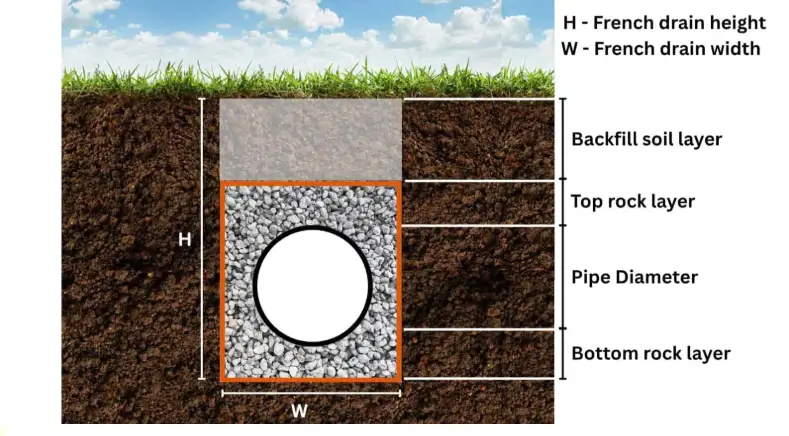
Determining the volume of gravel required for a French drain involves calculating the total trench capacity and subtracting the space occupied by the drain pipe.
The Formula
The required volume of gravel ($V$) is calculated using the following equation:
$$V = (w \times d \times L_t) - \left( \frac{\pi \times D_o^2}{4} \times L_p \right)$$
Where:
- $V$ = Total gravel volume required
- $w$ = Trench width
- $d$ = Trench depth
- $L_t$ = Total trench length
- $D_o$ = External diameter of the drain pipe
- $L_p$ = Total length of the sloped drain pipe, calculated as:
$$L_p = \sqrt{L_t^2 + \left( L_t \times \frac{s}{12} \right)^2}$$
(here $s$ represents the recommended minimum pipe slope in inches per foot).
Reference Chart: External Pipe Diameters
To determine $D_o$ for your formula, use the corresponding external dimensions based on your chosen pipe standard and nominal size:
| Nominal Pipe Size | Schedule 40 PVC (Do) | SDR35 Sewer Drain (Do) |
| 1/8" | 0.41 in (10.29 mm) | — |
| 1/4" | 0.54 in (13.72 mm) | — |
| 3/8" | 0.68 in (17.15 mm) | — |
| 1/2" | 0.84 in (21.34 mm) | — |
| 3/4" | 1.05 in (26.67 mm) | — |
| 1" | 1.32 in (33.40 mm) | — |
| 1 1/4" | 1.66 in (42.16 mm) | — |
| 1 1/2" | 1.90 in (48.26 mm) | — |
| 2" | 2.38 in (60.33 mm) | — |
| 2 1/2" | 2.88 in (73.03 mm) | — |
| 3" | 3.50 in (88.90 mm) | — |
| 3 1/2" | 4.00 in (101.60 mm) | — |
| 4" | 4.50 in (114.30 mm) | 4.22 in (107.06 mm) |
| 5" | 5.56 in (141.30 mm) | — |
| 6" | 6.63 in (168.28 mm) | 6.28 in (159.39 mm) |
| 8" | 8.63 in (219.08 mm) | 8.40 in (213.36 mm) |
| 10" | 10.75 in (273.05 mm) | 10.50 in (266.70 mm) |
| 12" | 12.75 in (323.85 mm) | 12.50 in (317.50 mm) |
| 14" | 14.00 in (355.60 mm) | — |
| 15" | — | 15.30 in (388.60 mm) |
| 16" | 16.00 in (406.40 mm) | — |
| 18" | 18.00 in (457.20 mm) | 18.70 in (475.00 mm) |
| 20" | 20.00 in (508.00 mm) | — |
| 21" | — | 22.05 in (560.00 mm) |
| 24" | 24.00 in (609.60 mm) | 24.80 in (630.00 mm) |
| 27" | — | 27.95 in (710.00 mm) |
| 30" | 30.00 in (762.00 mm) | 32.00 in (812.80 mm) |
| 36" | 36.00 in (914.40 mm) | 38.30 in (972.80 mm) |
| 42" | 42.00 in (1066.80 mm) | 44.50 in (1130.30 mm) |
| 48" | 48.00 in (1219.20 mm) | 50.80 in (1290.30 mm) |
Sample calculation of needed gravel for a French drain system
To understand how these formulas apply to a real-world project, let's walk through a sample calculation for a standard French drain setup.
Example Project Specifications
- Trench Dimensions: 10 inches wide ($10/12\text{ ft}$), 1 foot deep, and 20 feet long
- Pipe Selection: 4-inch nominal Schedule 40 PVC ($D_o = 4.5\text{ inches}$ or $0.375\text{ ft}$)
- Recommended Minimum Slope ($s$): 0.125 inches per foot
Step 1: Calculate Total Pipe Length ($L_p$)
First, calculate the actual pipe length required along the sloped trench run:
$$L_p = \sqrt{(20\text{ ft})^2 + \left(20\text{ ft} \times \frac{0.125}{12}\right)^2} = 20.001\text{ ft} \approx 20\text{ ft}$$
Note: Because standard drainage slopes are gradual, the required pipe length typically closely mirrors the horizontal length of the trench.
To determine the exact number of pipe lengths to purchase, divide $L_p$ by the stock length available at your supplier and round up to the next full segment.
Step 2: Calculate Gravel Volume ($V$)
Next, determine total excavation capacity and subtract the volume occupied by the drain pipe:
$$V = \left( \frac{10}{12}\text{ ft} \times 1\text{ ft} \times 20\text{ ft} \right) - \left( \frac{\pi \times (0.375\text{ ft})^2}{4} \times 20\text{ ft} \right)$$
$$V = 16.667\text{ ft}^3 - 2.209\text{ ft}^3 = 14.458\text{ ft}^3 \approx 14.5\text{ ft}^3$$
You will need approximately 14.5 cubic feet of aggregate for this trench.
Step 3: Determine Filter Fabric Requirements
To find the total area of geotextile fabric required:
- Calculate the inner perimeter of the trench (bottom width + both side walls) plus your intended top overlap length.
- Multiply this total fabric width by the overall trench length ($L_t$) to get the total required surface area in square feet or square metres.
The Two Things a French Drain Can't Work Without
While a French drain relies on stone and perforated piping to redirect water, its performance and longevity depend heavily on two critical elements:
- Woven Geotextile Fabric: The fabric acts as a protective barrier. Lining the excavated trench and wrapping the perforated pipe in a quality woven geotextile prevents surrounding soil and silt from washing into the gravel bed. Omitting filter fabric usually leads to severe clogging within just a couple of years.
- A Consistently Sloped Trench: Slope is what forces water to flow toward your discharge point. Digging to the proper depth while maintaining a uniform gradient requires careful excavation, with a sturdy round-point shovel being the most practical tool for the job.
Choosing the Right Gravel: Size and Material Selection Guide
Selecting the right aggregate is just as important as digging the correct slope. The type and size of stone you choose determines how quickly water enters your drainage pipe, how well the trench filters out debris, and how long the system lasts before needing maintenance.
Recommended Gravel Sizes for French Drains
Not all gravel performs the same underground. Smaller stones compact too tightly and restrict water movement, while overly large rocks create wide voids that allow silt to migrate into your system.
| Gravel Size | Flow Rate | Clogging Risk | Best Used For |
| 1/4" to 3/8" (Pea Gravel) | Low | High | Surface decorative tops only; bad for trench bedding |
| 1/2" to 3/4" (Standard Crushed / River Rock) | High | Low | Ideal choice for main trench backfill and pipe surrounding |
| 1" to 1 1/2" (Heavy Aggregate) | Very High | Very Low | High-volume groundwater zones and heavy clay soils |
Material Types: Angular Crushed Stone vs. Smooth River Rock
When buying materials by the tonne or cubic yard, you will generally choose between two primary types of stone:
- Washed Crushed Stone (e.g., #57 Granite or Limestone): Features angular, irregular edges that interlock slightly while preserving generous void space. This angular structure provides superior stability, making it the best option under driveways or walkways where soil shifting must be minimized. Always ensure you purchase washed stone so fine stone dust does not wash down and clog your filter fabric.
- Smooth River Rock (Round Aggregate): Features naturally rounded edges created by water erosion. It offers excellent natural drainage voids and is easier to handle manually. Because round stones do not lock together, river rock is ideal for exposed surface drains where aesthetics matter, but it should be avoided under heavy vehicular loads.
Critical Material Pitfalls
- Avoid Compactable Gravels: Never use materials containing binder, fine particles, or "crusher run" (such as Road Base or Class 5 gravel). These mixes are designed to pack tight and freeze into solid layers, which completely blocks water filtration.
- Avoid Unwashed Limestone in Acidic Soils: Unwashed or soft limestone can break down over time in acidic groundwater environments, releasing a milky sediment that blinds geotextile pores.
Pro Tip: Always order 1/2" to 3/4" washed angular crushed granite or washed river rock. This size strikes the perfect balance between structural stability and high water permeability, keeping your drain running freely for decades.
FAQs
Conclusion
A successful French drain installation comes down to getting three main factors right: maintaining a continuous downward slope, choosing clean $1/2\text{"}$ to $3/4\text{"}$ washed aggregate, and wrapping the system in quality geotextile fabric to prevent clogging. By accurately calculating your trench dimensions and accounting for pipe displacement, you can order the exact volume of gravel, piping, and fabric required without costly overspending. Use our calculator tools to lock in your material quantities and project budget so you can build a reliable, maintenance-free drainage solution that protects your property for decades to come.
Read More:
- Free Concrete Block Calculator (2026)
- Asphalt Calculator USA: Estimate Tonnage & Costs
- Cubic Yards to Tons Calculator: Fast Material Conversion Online
- Topsoil Calculator – Exact Yards, Bags & Coverage Needed
- Sand Calculator | How Much Sand Do I Need?
- Log Board Foot Calculator | Estimate Yield & Volume