PPM Calculator Convert PPM to Percent PPB and Other Units
PPM Calculator
Calculate parts per million, convert concentration units, and work out how much substance you need.
Enter the amount of substance (solute) and the total amount of the solution. The calculator returns the concentration in ppm.
Enter a concentration and choose its unit. It is converted into ppm and other common concentration units.
Convert between molarity and ppm (mg/L) using the molar mass of the substance.
Enter the target concentration and the final amount of solution to find how much solute you need to add.
Convert a gas concentration between ppmv (parts per million by volume) and mg/m³ using the molar mass, temperature and pressure.
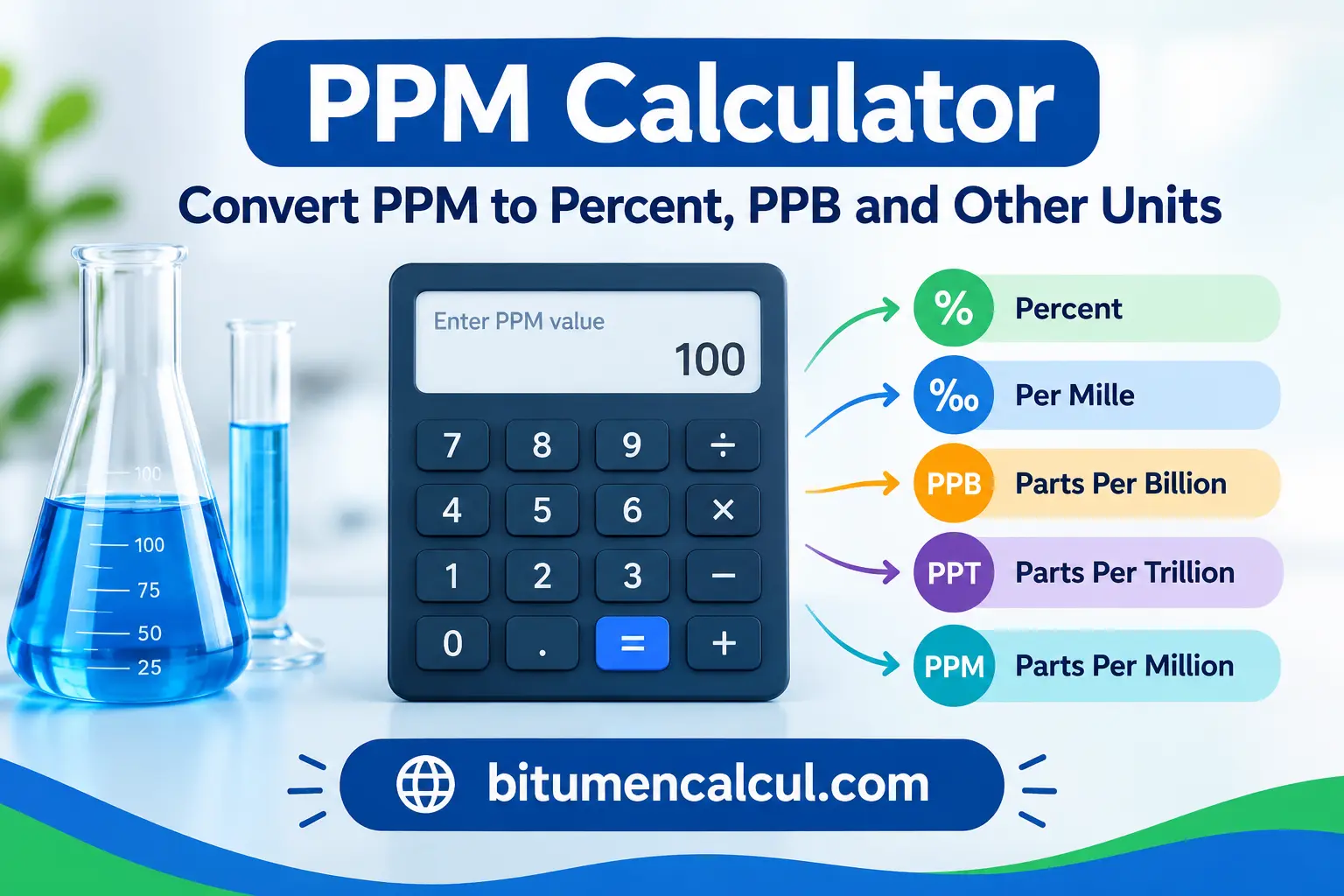
If you often find it difficult to understand percentages, per mille, and parts per million, this PPM calculator can make things much easier. It is a handy tool that helps you convert PPM into other units, including percent and parts per billion (PPB), without unnecessary complications. In this article, we will briefly introduce each proportion metric and explain in detail how to calculate PPM and percentages, making these concepts easier to understand and apply.
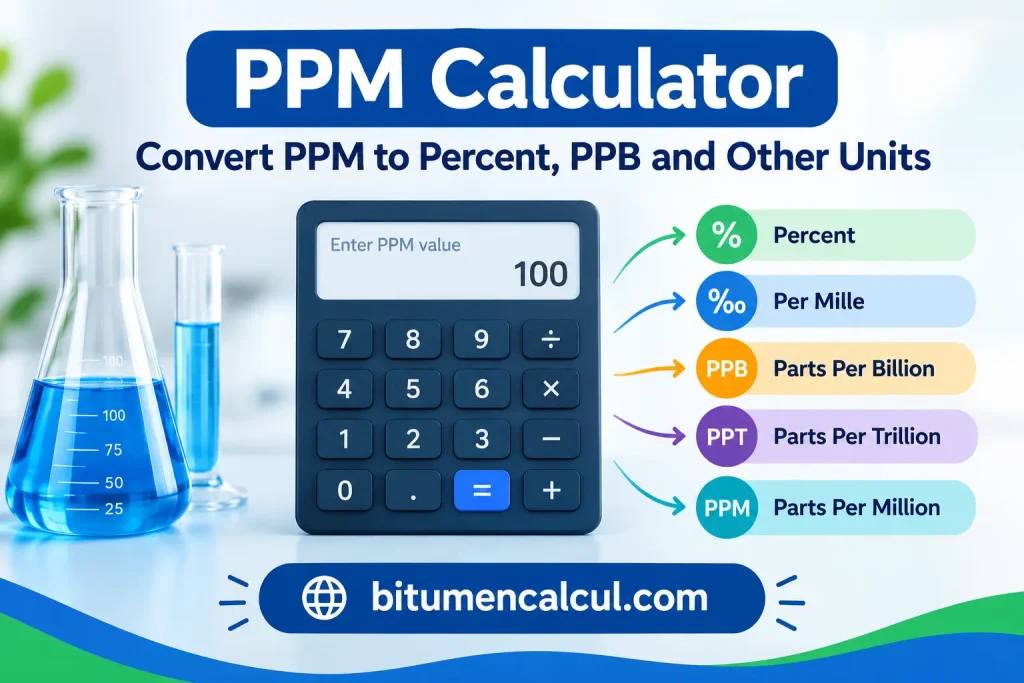
How to Calculate PPM and Percents
All proportion metrics work in a similar way, as they represent small fractions of dimensionless quantities. One example is the volumetric concentration of NO2 in the air. PPM stands for "parts per million." For instance, if the concentration of NO2 is 1 ppm, it means that out of one million equal parts of an air sample, one part contains NO2.
The commonly used proportion metrics include the following:
- Percentage: Represents 1 part out of 100.
- Per mille: Represents 1 part out of 1,000.
- PPM: Represents 1 part out of 1,000,000.
- PPB: Represents 1 part out of 1,000,000,000.
- PPT: Represents 1 part out of 1,000,000,000,000.
PPM Conversion: An Example

Suppose you have prepared a salt (NaCl) solution by mixing 0.005 grams of salt with water, and the total mass of the solution is 1 kilogram. How can you determine the salt concentration in parts per million (PPM)?
- Convert the concentration into a decimal. First, convert 1 kilogram into 1,000 grams. Since the solution contains 0.005 grams of salt in 1,000 grams of solution, the decimal concentration is:
0.005\text{ g} / 1{,}000\text{ g} = 0.000005 - Calculate the percentage. Multiply the decimal value by 100 to express the concentration as a percentage:
0.000005 \times 100\% = 0.0005\% - Calculate the per mille value. To convert the decimal concentration into per mille, multiply it by 1,000:
0.000005 \times 1{,}000\text{‰} = 0.005\text{‰} - Convert the value into PPM. Multiply the decimal concentration by one million to determine the parts per million:
0.000005 \times 1{,}000{,}000 = 5\text{ PPM} - Calculate the PPB value. Finally, multiply the decimal concentration by one billion to express it in parts per billion:
0.000005 \times 1{,}000{,}000{,}000 = 5{,}000\text{ PPB}
PPM calculations are useful in many practical situations, including checking and adjusting the salinity level of swimming pool water.
What Is a PCS Calculator?

A PCS (Permanent Change of Station) calculator is a free online tool designed to help military personnel estimate their moving expenses and potential reimbursements for 2026. It calculates various moving costs and allowances for service members in the Navy, Army, Air Force, Marines, Coast Guard, and Space Force who are relocating to a new duty station.
When a PCS Pays Nothing
No orders, no entitlement. Every estimate on this page depends on having authorized PCS orders. If you move for personal reasons, such as following your spouse's job, moving off post, or relocating between quarters on the same installation without a change of duty station, you generally cover the moving costs yourself. Your orders determine which benefits you qualify for, and the calculator estimates the costs and allowances they authorize.
A government move does not earn an incentive. The PPM incentive is intended for service members who arrange and manage their own move. Choosing a government-arranged move is a valid option and may be the most practical choice in many situations, but it does not provide a PPM incentive payment. Comparing the estimated costs and benefits can help you make an informed decision instead of choosing an option by default.
Exceeding your weight allowance can cost you money. If your shipment exceeds the authorized weight limit, the government may charge you for the excess weight. These charges are generally calculated proportionally based on the cost of the entire shipment and may be recovered from your pay. This is the one estimate on this page that can result in a negative amount, which is why estimating your shipment's weight before packing begins is much better than discovering an excess after everything has been moved.
How to Claim Your PCS Money
Submit your travel voucher using DD 1351-2. Most travel-related allowances are claimed through a single document: DD Form 1351-2, also known as the travel voucher. Submit it to your finance office along with a copy of your PCS orders. This form is used to claim DLA, MALT, and eligible per diem payments. The claim is your responsibility, so make sure you submit the required paperwork to receive the money you are entitled to.
A PPM requires a complete document packet. In addition to your travel voucher, you will need DD Form 2278 from your move-counselling session, certified weight tickets showing the empty and loaded weights of every vehicle or truck used, and receipts for rental costs, fuel, tolls, and weighing fees. Missing weight tickets or using a scale that is not certified can prevent the incentive from being calculated correctly. These documentation issues are a common reason why PPM payments get delayed.
An unsettled advance may be deducted from your pay. If you received an advance operating allowance but fail to submit the required settlement documents, the outstanding amount may be recovered from your pay. Many transportation offices use a 45-day submission window after the move is completed. However, this is service-specific guidance rather than a universal deadline established by the JTR or DTR. Check the exact deadline with your transportation office and submit your paperwork as soon as possible after completing the move.
PPM incentive payments are taxable, and withholding reduces the amount you receive. Federal supplemental tax withholding may be deducted before your payment reaches you, meaning the amount deposited into your account can be lower than the incentive estimated by this calculator. Keeping receipts for eligible moving expenses is also important because they may help determine your tax liability when filing your return, subject to applicable IRS rules and eligibility requirements. IRS Form 3903 may be relevant when reviewing qualifying moving expenses, although deductions for moving expenses are generally restricted under current federal tax law.
FAQs
Conclusion
Understanding PPM, percentages, per mille, PPB, and PPT makes it easier to measure small concentrations and convert them into different units accurately. Whether you are calculating chemical concentrations, checking water quality, adjusting swimming pool salinity, or preparing a solution, knowing the correct formula helps you get reliable results. A PPM calculator can simplify these conversions, save time, and reduce calculation errors, while understanding the measurement units and using the correct values ensures more accurate results for everyday and laboratory applications.
Read More: