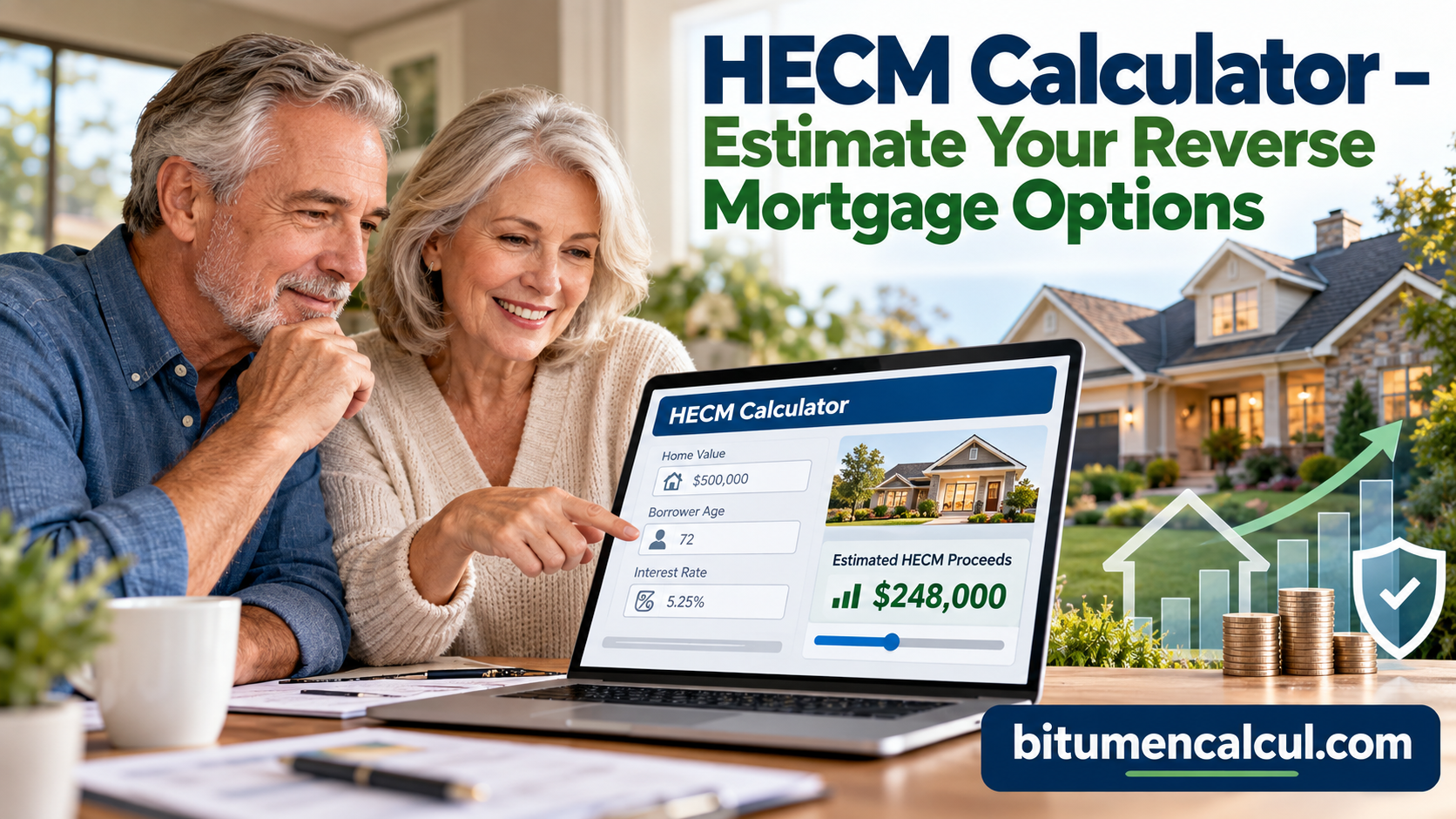
HECM Calculator Estimate Your Reverse Mortgage Options
HECM Calculator
Home Equity Conversion Mortgage (Reverse Mortgage) Estimator
Your Information
HECM Estimate Results
Calculating…
How This HECM Estimate Is Calculated
Step 1: Maximum Claim Amount (MCA)
The lesser of your home’s appraised value or the FHA maximum limit ($1,249,125 in 2026).
Step 2: Principal Limit (PL)
MCA × Principal Limit Factor (PLF). The PLF is based on your age (younger = higher factor) and expected interest rate (lower = higher factor). This calculator uses a simplified approximation; actual HECM lenders use HUD’s official PLF tables.
Step 3: Mandatory Obligations
Includes existing mortgage/liens, upfront MIP (2% of MCA), origination fee, and closing costs. These reduce what’s available to you.
Step 4: Net Principal Limit
Principal Limit minus Mandatory Obligations. This is the net amount available.
Step 5: First-Year Disbursement Limit (60% Rule)
In the first 12 months, you can receive the greater of: (1) 60% of your Principal Limit, or (2) Mandatory Obligations plus 10% of Principal Limit. This is a HUD safety rule to preserve equity.
Step 6: Payment Options
Depending on your choice:
- Line of Credit: Draws as needed. Unused funds grow at the interest rate + annual MIP rate.
- Tenure: Fixed monthly payment for as long as you live in the home (if at least 62).
- Term: Fixed monthly payment for a set number of years.
Step 7: Balance Growth
Over time, your loan balance grows as interest and annual MIP (0.5% per year) accrue on the outstanding balance. Home equity decreases as loan balance increases.
Limitations: This estimate does not account for property taxes, insurance set-asides (LESA), servicing fees, property appreciation/depreciation, or rate changes over time. Contact an approved HECM lender for exact figures.
A HECM calculator can help homeowners estimate the down payment they may need and better understand the potential financial benefits of the Home Equity Conversion Mortgage for Purchase program. To qualify for this federally backed programme, at least one homeowner must be 62 or older.
The HECM for Purchase option allows eligible homeowners to use proceeds from selling their existing property toward a new home and finance the remaining amount with a reverse mortgage. For those who prefer working with their own figures, a HECM calculator Excel format can also be useful for organising and comparing estimates.
Likewise, a free HECM calculator provides a convenient starting point for exploring possible costs before making financial decisions. This programme can make relocating in retirement possible without requiring monthly mortgage payments, although borrowers must still meet applicable loan obligations and property-related expenses.
How To Use It
Using the calculator only requires a few basic details about the planned home purchase. Enter the estimated purchase price of the property, select the state where the home is located, and provide the borrower’s date of birth. Once these details are entered, the calculator generates an estimate of the amount the borrower may qualify for. Keep in mind that the result is an estimate only, and actual figures can vary between individual lenders.
What Is a Reverse Mortgage and How Does It Work?

A reverse mortgage is a type of loan that lets homeowners aged 62 or older access part of the equity they have built in their home as cash. Repayment is generally deferred until the borrower dies, sells the property, or no longer lives in the home as their principal residence.
A HECM for purchase calculator can be useful for estimating figures when considering a Home Equity Conversion Mortgage to purchase another home, while a reverse mortgage calculator Excel format may suit borrowers who want to organise and compare estimates in a spreadsheet. People researching their options may also search for the best reverse mortgage calculator AARP to better understand how factors such as age, home value, and available equity can affect estimates.
What Are the Requirements for a Reverse Mortgage?

Reverse mortgage borrowers must meet specific eligibility and financial requirements. When researching these qualifications, a HECM Calculator HUD search may help borrowers explore HECM-related estimates, while a Reverse mortgage calculator AARP search may be useful when comparing available reverse mortgage information and calculation resources.
To be eligible for a reverse mortgage loan, borrowers must:
- Be at least 62 years old.
- Have a considerable amount of equity in the home.
- Use the property as their primary residence.
- Complete a consumer counselling session with a HUD-approved counsellor.
- Show that they can keep up with required property tax and insurance payments.
- Meet applicable FHA standards and flood requirements.
- Have no delinquent federal debt.
What Are the Different Types of Reverse Mortgages?

HECM Reverse Mortgages
A Home Equity Conversion Mortgage (HECM) is the most common type of reverse mortgage and the only one insured by the Federal Housing Administration (FHA). It is available to homeowners aged 62 and older and allows eligible borrowers to turn part of their home equity into cash or establish a growing line of credit. Repayment of the outstanding balance can generally be deferred while the borrower continues living in the property and keeps up with required property taxes, insurance, and home maintenance costs.
The HECM balance usually becomes due when the last surviving borrower permanently leaves the property. Because a HECM is structured as a non-recourse loan, FHA insurance ensures that when the loan becomes due and the property is sold, neither the borrower nor their heirs will owe more than the home’s value at the time of sale.
For an initial estimate, borrowers can use a reverse mortgage calculator without personal information to explore what they may qualify for without providing personal details.
Proprietary Reverse Mortgages
Private or “proprietary” reverse mortgages are investor-owned alternatives to HECMs that have become more widely available in recent years. Although these products can share several characteristics with HECMs, their eligibility rules and lending terms may differ.
A proprietary reverse mortgage may be worth considering instead of a HECM when:
- The borrower is younger than 62.
- The property is a condominium that is not FHA-approved.
- The home has a very high property value, such as $1 million or more, and the borrower wants to access a larger share of its equity. HECM initial disbursement limits are based on the home’s appraised value up to $1,249,125.
What Are the Options to Receive My HECM Loan Proceeds?
HECM borrowers can choose from several ways to receive their loan proceeds, depending on how and when they want access to the available funds.
- One-time lump-sum payment: Receive the available amount as a single disbursement at closing.
- Line of credit: Draw funds when needed rather than taking everything at once. Unused funds in the line of credit do not accrue charges, and the amount available to borrow can grow over time.
- Fixed monthly advances: Choose tenure payments to receive regular monthly advances for as long as at least one borrower continues living in the home. Alternatively, term payments provide monthly advances for a predetermined number of months. A shorter payment term generally results in larger monthly advances.
- Combination option: Use a line of credit alongside fixed monthly advances, providing flexibility in how the HECM proceeds are received.
How Much Money Do You Get on a Reverse Mortgage?
The amount you may receive through a HECM depends on several factors, including your age, the interest rate on the loan, and your home’s value up to the current HECM limit of $1,249,125. A free reverse mortgage calculator can provide an estimate of how much of your available home equity you may qualify to access.
If you select a one-time lump-sum disbursement at closing, the amount available may be the greater of two figures: 60% of your principal limit, or your mandatory obligations such as paying off an existing mortgage plus 10%. For other payment methods, including a line of credit or monthly advances, this restriction applies during the first 12 months. Once that period has passed, you may access the remaining portion of your principal limit.
When Does a Reverse Mortgage Make Sense?
A reverse mortgage may serve different purposes depending on a homeowner’s retirement strategy, financial circumstances, and plans for using their home equity.
Financial Planning
Some homeowners choose to incorporate home equity into their retirement planning from the time they become eligible for a reverse mortgage. They may still be working or have substantial financial resources but see potential advantages in treating home equity as another part of their broader retirement strategy.
Portfolio Hedging
A reverse mortgage can provide another source of funds during periods of market decline. Instead of selling investments when markets are down, borrowers may use available reverse mortgage proceeds to cover certain expenses.
Accessing Home Equity Gains
For homeowners whose properties have appreciated, a reverse mortgage offers a way to access part of that accumulated equity while continuing to live in the home. This can provide an alternative to selling the property and moving to a smaller home simply to realise some of its value.
Meeting Cash Needs
Reverse mortgage proceeds can be used for purposes such as home improvements, long-term care planning, and everyday living expenses. Access to home equity may therefore help some older homeowners meet financial needs while continuing to age in place.
Lifestyle Enhancement
Not every borrower takes out a reverse mortgage because of an immediate financial need. Some homeowners choose to access their equity to give their existing budget greater flexibility and support lifestyle expenses during retirement.
FAQs
Conclusion
A HECM can give eligible homeowners a practical way to access home equity, supplement retirement finances, or purchase another property without required monthly mortgage payments. However, the amount available, loan costs, payment options, and ongoing homeowner responsibilities can vary, so use the calculator as a starting estimate and carefully compare lender terms before deciding whether a reverse mortgage fits your long-term financial plans.
Read More: