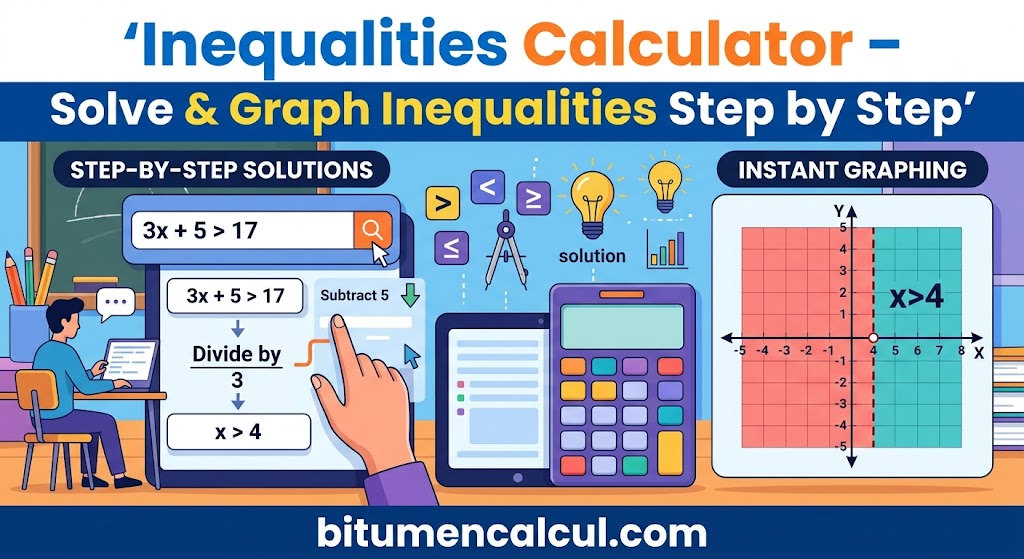
Inequalities Calculator – Solve & Graph Inequalities Step by Step
Inequalities Calculator
Solve algebraic inequalities step by step
- 2x + 5 > 11
- x^2 – 5x + 6 > 0
- -2 < 3x + 1 ≤ 10
- x^2 + 2x – 8 ≤ 0
Inequalities use symbols like <, ≤, >, and ≥ to describe limits and comparisons in math and everyday situations, such as staying within a budget. An Inequalities calculator with steps can explain the solving process, while an Inequality Calculator graph helps visualize solutions. You can also use an Inequalities calculator Mathway to check inequality problems and better understand the results.
How to Use the Symbolab Inequalities Calculator

The Symbolab Inequalities Calculator helps you solve inequality problems and understand the process step by step. Whether you need an Inequalities calculator with steps for learning or an Inequality Calculator graph to visualize a solution, you can enter your problem and review the result clearly.
Step 1: Enter the Expression
Type your inequality using symbols such as <, >, ≤, or ≥. You can also use the math keyboard for fractions, square roots, and exponents. After entering the complete expression, click “Go” to calculate the result.
Step 2: View the Step-by-Step Breakdown
The calculator displays the solution in individual steps, allowing you to follow how the inequality is simplified and solved. Each stage explains the mathematical operation being used, making it easier to understand the reasoning behind the final solution rather than simply seeing the answer.
Types of Inequalities

Not all inequalities look or behave the same. Just as some decisions are quick and simple while others involve several possibilities, inequalities come in different forms. Each type helps compare values, set limits, or describe a range of possible solutions.
1. Linear Inequalities in One Variable
This is one of the simplest and most common types. It compares a single variable with a number or another expression.
For example:
2x + 3 < 7
Here, x might represent the number of hours you can spend online before finishing your homework. The solution tells you which values of x satisfy the given limit.
2. Linear Inequalities in Two Variables
These inequalities contain two variables, often x and y, and compare pairs of possible values.
For example:
y ≥ 0.5x + 1
Imagine planning a fundraiser where x represents the number of tickets sold and y represents the money raised. The inequality can describe all combinations that meet your goal. Solutions are often displayed as shaded regions on a graph rather than individual points.
3. Quadratic and Polynomial Inequalities
These inequalities contain squared terms or variables raised to higher powers.
For example:
x² − 4x + 3 > 0
The solutions can be more complex than those of linear inequalities and are often expressed as intervals. Inequalities can also contain variables in exponents, and an Exponential inequalities calculator can help solve and interpret these types of problems.
4. Compound Inequalities
Sometimes a value needs to satisfy two boundaries at the same time.
For example:
5 < x ≤ 12
This could represent a safe temperature range for a fish tank. The temperature must be higher than 5°C but can be as high as 12°C. Both limits matter and together define the acceptable range.
5. Absolute Value Inequalities
Absolute value inequalities describe how far a value can be from a particular number or target.
For example:
|x − 4| < 2
This expression means that x must remain within 2 units of 4. Because these problems can involve two possible boundaries, an Absolute value inequality Calculator can help identify the correct solution range and make the result easier to understand.
Each type of inequality describes boundaries in a different way. Some establish a single limit, while others define an entire range or region of possible answers. When you encounter an inequality, identifying its type first can make choosing the right solving method much easier.
How to Solve Inequalities Manually
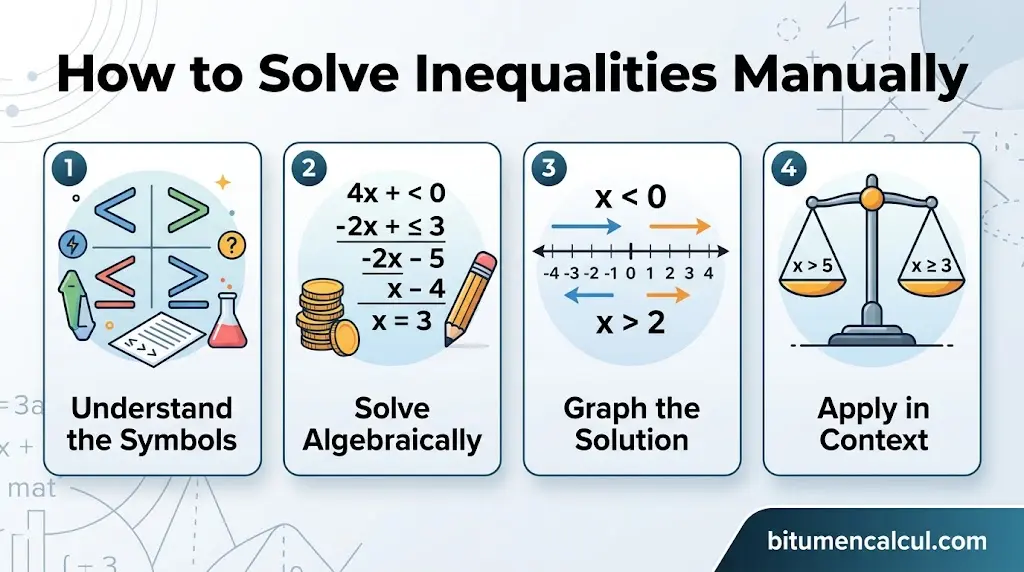
Solving inequalities means isolating the variable while keeping the comparison true. The process is similar to solving equations, but there is one important extra rule: if you multiply or divide by a negative number, you must reverse the inequality symbol.
Step 1: Read the Inequality
Consider:
2x + 5 < 11
This asks which values of x make 2x + 5 less than 11.
Step 2: Isolate the Variable
Subtract 5 from both sides:
2x + 5 − 5 < 11 − 5
2x < 6
Now divide both sides by 2:
x < 3
So, any value of x less than 3 satisfies the inequality.
Step 3: Be Careful With Negative Numbers
When multiplying or dividing both sides by a negative number, reverse the inequality sign.
For example:
−3x > 9
Divide both sides by −3 and change > to <:
x < −3
Forgetting to reverse the symbol will produce an incorrect solution.
Step 4: Check Your Solution
For x < 3, try x = 2:
2(2) + 5 = 9
Since 9 < 11, the value works.
Now try x = 4:
2(4) + 5 = 13
Since 13 < 11 is false, 4 is outside the solution set.
Step 5: Show the Solution
The answer can be represented in several ways:
- Inequality: x < 3
- Number line: an open circle at 3 with shading to the left
- Interval notation: (−∞, 3)
Each format represents the same set of possible values.
Compound Inequalities
A compound inequality contains more than one boundary:
2 < x ≤ 5
This means x must be greater than 2 and less than or equal to 5. When solving more complicated problems with multiple boundaries, a Compound inequalities calculator can help verify the solution range.
Absolute Value Inequalities
Consider:
|x − 4| < 2
This asks which values of x are less than 2 units away from 4. An Absolute value inequality Calculator can be useful for checking these problems, but you can also solve them manually by writing:
−2 < x − 4 < 2
Add 4 to all three parts:
2 < x < 6
Therefore, x must be between 2 and 6. If the original inequality were |x − 4| ≤ 2, the endpoints would also be included, giving 2 ≤ x ≤ 6.
Practicing inequalities manually helps you understand why each step works, making it easier to solve linear, compound, and absolute value inequalities accurately.
What Is an Inequality?
At its core, an inequality is a way of comparing two values. It tells you whether one thing is bigger, smaller, at least as much, or no more than something else. Inequalities use four main symbols: < means “less than,” > means “greater than,” ≤ means “less than or equal to,” and ≥ means “greater than or equal to.” An Inequalities calculator math tool can also help you interpret these symbols and solve problems involving different ranges of values.
Think of a family sharing a pizza. If you want everyone to have a fair slice, you might say, “No one should take more than two pieces.” That includes 0, 1, or exactly 2 slices; anything 3 or higher breaks the rule. In math, that’s x ≤ 2, where x stands for the number of slices someone takes. Or maybe your bus leaves in less than ten minutes. That’s t < 10, where t is the time you have left.
Equations ask for balance and equality, like a set of perfectly even scales. Inequalities, though, leave room for a range of answers. When you see y > 5, you know y could be 6, 10, 100, or anything bigger than 5. If the symbol were y ≥ 5, the value 5 itself would also be allowed. For problems involving two or more conditions at once, a Compound inequalities calculator can help determine the values that satisfy all the given boundaries.
Inequalities show up in all sorts of everyday choices, whether you are stretching your budget, checking if you made the team, or hoping your phone battery lasts at least until you get home. They can also appear in more advanced mathematics involving trigonometric functions, where a Trigonometric inequalities calculator can be useful for working with inequalities containing sine, cosine, tangent, and related functions.
Everyday Inequality Examples
- Budgeting for a Movie Night: Suppose you have 20 USD and want to buy a movie ticket plus snacks. You might say the total cost, c, should not be more than 20, so c ≤ 20.
- Minimum Score to Pass: If you need at least 70 percent to pass your math test, and your score is s, the requirement becomes s ≥ 70.
- Water Bottle for a Hike: If your backpack can hold up to 2 liters of water, the amount you carry, w, must satisfy w ≤ 2.
- Cooking with Eggs: A recipe calling for “no more than three eggs” can be represented as e ≤ 3.
- Catching the Last Bus: If the last bus leaves at 9 p.m. and you must arrive before then, the condition can be written as t < 9.
Equalities vs. Inequalities: Knowing the Difference
It helps to remember that not all math statements set boundaries. An equality is a statement where two things must be exactly the same, marked by the = sign. For example, 2x + 3 = 11 asks what value of x makes both sides equal.
An inequality is different because it can allow a whole range of possibilities rather than just one answer. The symbols < and > mean strictly less than and greater than, while ≤ and ≥ mean less than or equal to and greater than or equal to, respectively. When you solve an equation, you generally look for specific values that make the statement true. When solving an inequality, the answer often represents a set or range of values that satisfy the condition.
Common Mistakes When Solving Inequalities
Even a small mistake can change the final solution of an inequality. Here are the most common errors to avoid:
- Not Flipping the Inequality Sign: When multiplying or dividing both sides by a negative number, always reverse the inequality sign. For example, > becomes < and ≥ becomes ≤.
- Using the Wrong Circle on a Number Line: Use an open circle for < or > because the endpoint is excluded, and a closed circle for ≤ or ≥ because the endpoint is included.
- Ignoring Part of a Compound Inequality: Compound inequalities contain multiple conditions, so make sure your answer satisfies every required boundary.
- Leaving the Variable on the Right: Although it may still be mathematically correct, placing the variable on the left usually makes the solution easier to read and interpret.
- Misunderstanding Absolute Value Inequalities: These problems often require considering two boundaries or cases. An Absolute value inequality Calculator can help you check whether you have included the complete solution.
- Treating Inequalities Exactly Like Equations: Many solving steps are similar, but inequalities have special rules, particularly when negative multiplication or division is involved.
- Not Checking the Final Answer: Substitute a test value from your solution into the original inequality. You can also use an Inequalities calculator math tool to verify more complicated answers and catch calculation errors.
FAQs
Conclusion
Inequalities are a practical way to understand limits, ranges, and comparisons, from simple everyday situations to more complex math problems. Learning how to identify inequality types, isolate variables, handle negative values correctly, and check solutions builds a strong foundation for solving them confidently. An Inequalities Calculator can make the process even clearer by providing step-by-step solutions, interval notation, critical points, and number-line results for checking your work.
Read More: