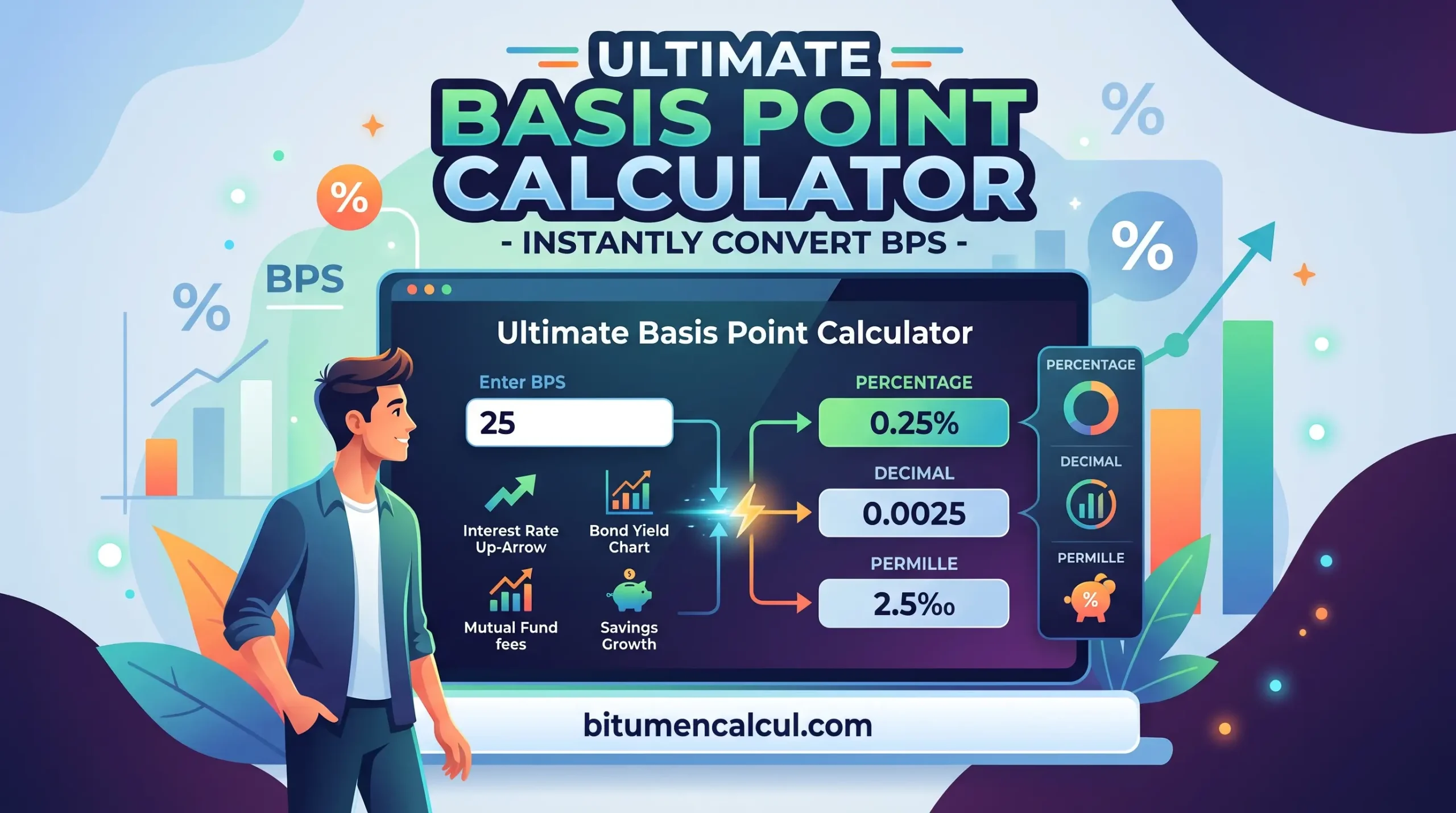
Ultimate Basis Point Calculator – Instantly Convert BPS
Basis Point Calculator
Convert basis points instantly and calculate their real dollar impact on rates and amounts.
1 bps = 0.01% = 0.0001This Interest Rate Change Calculator tool effortlessly handles conversions across basis points (BPS), percentages, permilles, and decimals. Entering a single figure immediately updates all corresponding values. Below, you will find a clear explanation of what a basis point is, how to calculate it, and its primary practical uses.
What is a basis point?
A basis point, commonly abbreviated as BPS and pronounced as "bip", is a standard financial metric used to quantify changes in interest rates, bond yields, and asset percentages.
Unit Values and Relationships
One basis point represents 0.01% (one-hundredth of one percent) or a decimal value of 0.0001. The mathematical relationships between these units of measurement are structured as follows:
| Unit | Symbol | Ratio | Fractional Value | Decimal Equivalent | Basis Point Equivalent |
| Percent | % | 1 per 100 | $\frac{1}{100}$ | 0.01 | 100 BPS |
| Permille | ‰ | 1 per 1,000 | $\frac{1}{1,000}$ | 0.001 | 10 BPS |
| Permyriad | ‱ | 1 per 10,000 | $\frac{1}{10,000}$ | 0.0001 | 1 BPS |
| Basis Point | BPS / BP | 1 per 10,000 | $\frac{1}{10,000}$ | 0.0001 | 1 BPS |
Quick Conversion Formulas
- Basis Points to Percentage: Divide the BPS value by 100 ($150\text{ BPS} \div 100 = 1.5\%$).
- Percentage to Basis Points: Multiply the percentage by 100 ($0.25\% \times 100 = 25\text{ BPS}$).
- Basis Points to Decimal: Divide the BPS value by 10,000 ($50\text{ BPS} \div 10,000 = 0.0050$).
Why Basis Points Are Used
Financial institutions and markets use basis points to maintain precision and eliminate ambiguity. Statements involving small fractional percentages can cause confusion in speech; for example, saying an interest rate increased by "a quarter of a percent" from 5% could mean it rose to either 5.25% (an absolute increase of 25 BPS) or 5.0125% (a relative increase of 0.25%). Specifying an increase of 25 basis points explicitly clarifies that the new rate is 5.25%.
How to Convert Basis Points to Decimal?
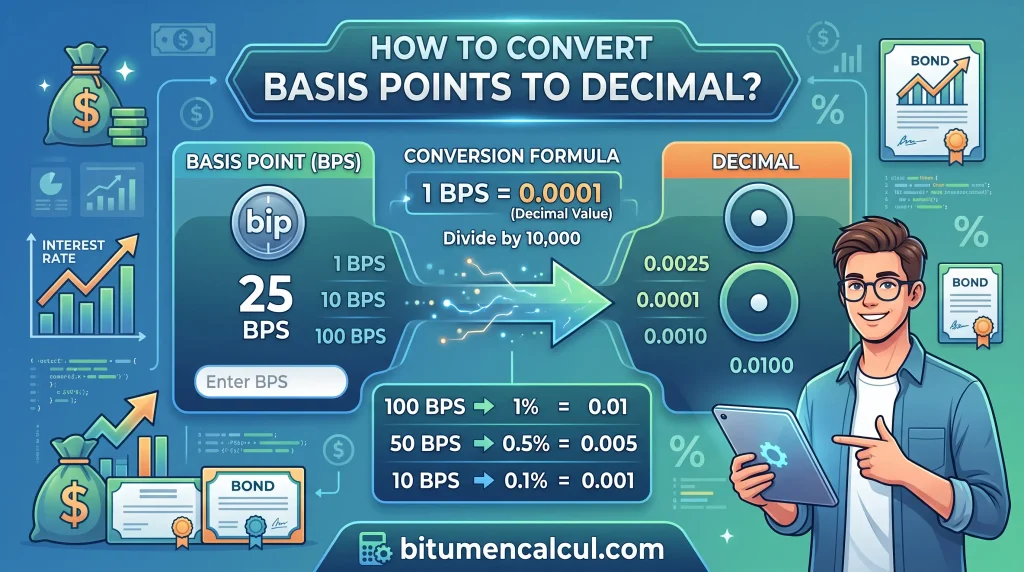
To convert basis points (BPS) to a decimal, divide the number of basis points by 10,000.
Because 1 basis point equals 0.0001, this conversion is equivalent to moving the decimal point four places to the left.
Conversion Formula
$$\text{Decimal Value} = \frac{\text{Basis Points (BPS)}}{10,000}$$
Step-by-Step Examples
Example 1: Standard Conversion
Convert 50 BPS to a decimal:
- Apply the formula:$$\frac{50}{10,000} = 0.0050$$
- Decimal Value: 0.005
Example 2: Fractional Basis Points
Convert 12.5 BPS to a decimal:
- Move the decimal point 4 places to the left:$$12.5 \rightarrow 0.00125$$
- Decimal Value: 0.00125
Quick Reference Table
| Basis Points (BPS) | Percentage Equivalent | Decimal Value |
| 1 BPS | 0.01% | 0.0001 |
| 5 BPS | 0.05% | 0.0005 |
| 10 BPS | 0.10% | 0.0010 |
| 25 BPS | 0.25% | 0.0025 |
| 50 BPS | 0.50% | 0.0050 |
| 100 BPS | 1.00% | 0.0100 |
| 250 BPS | 2.50% | 0.0250 |
| 500 BPS | 5.00% | 0.0500 |
Reverse Conversion: Decimal to Basis Points
To convert a decimal back into basis points, multiply the decimal by 10,000:
$$\text{Basis Points} = \text{Decimal Value} \times 10,000$$
- Example: $0.0075 \times 10,000 = \mathbf{75\text{ BPS}}$
Why do we have basis points?

While basis points and permyriads represent the same numerical fraction ($\frac{1}{10,000}$ or $0.0001$), they serve distinct purposes in financial terminology. A permyriad denotes a fixed fraction, whereas a basis point expresses absolute changes in percentage values.
Resolving Ambiguity in Percentage Changes
The principal reason for using basis points is to avoid confusion between relative and absolute changes in financial figures a key concept when evaluating Basis Points vs Percentage Difference.
Consider an economy where the unemployment rate increases from $6\%$ to $16\%$:
- The Ambiguity: Stating that unemployment "increased by $10\%$" creates confusion. It could imply a relative growth of $10\%$ on the original figure ($6\% \times 1.10 = 6.6\%$), or it could describe a direct $10$-point addition ($6\% + 10\% = 16\%$).
- The Solution: Specifying that unemployment "rose by $1,000$ basis points" removes all ambiguity. It explicitly denotes an absolute increase of $10$ percentage points.
Practical Differences
| Feature | Basis Point (BPS) | Permyriad (‱) | Percentage Point |
| Primary Role | Expresses changes or margins in rates and yields. | Defines a static ratio or baseline fraction. | Expresses simple arithmetic differences between percentages. |
| Typical Usage | Interest rate movements, bond yield shifts, fee structures. | Specialized mathematical or statistical contexts. | Public policy metrics, inflation rates, polling changes. |
| Relation | $100\text{ BPS} = 1\text{ Percentage Point}$ | $1\text{ Permyriad} = 0.01\%$ | $1\text{ Percentage Point} = 1\%$ change |
By establishing a clear distinction between fractional growth and point movement, basis points ensure financial communication remains precise across global markets.
How to convert basis points to percents?
Converting between basis points (BPS) and percentages involves simple mental arithmetic. Since 1 percentage point equals 100 basis points, you can switch between the two formats using basic division or multiplication.
Conversion Rules
- To convert Basis Points to Percentage: Divide the BPS value by 100 using the standard BPS to Percentage Formula.
- To convert Percentage to Basis Points: Multiply the percentage by 100.
Step-by-Step Practical Examples
Example 1: Finding a Historical Interest Rate
Suppose a 30-year fixed mortgage rate is currently 4.09%, which reflects a recent increase of 9 basis points. To calculate the previous interest rate:
- Convert BPS to a percentage:$$\frac{9\text{ BPS}}{100} = 0.09\%$$
- Subtract the increase from the current rate:$$4.09\% - 0.09\% = 4.00\%$$
The original mortgage rate was 4.00%.
Example 2: Expressing Rate Changes in Basis Points
Suppose a central bank lowers its benchmark interest rate from 1.50% to 1.25%. To express this change in basis points:
- Find the difference in percentage:$$1.50\% - 1.25\% = 0.25\%$$
- Convert the percentage to BPS:$$0.25 \times 100 = 25\text{ BPS}$$
The central bank reduced the interest rate by 25 basis points.
Quick Reference Conversion Table
| Percentage | Basis Points (BPS) |
| 0.01% | 1 BPS |
| 0.05% | 5 BPS |
| 0.10% | 10 BPS |
| 0.25% | 25 BPS |
| 0.50% | 50 BPS |
| 0.75% | 75 BPS |
| 1.00% | 100 BPS |
| 2.50% | 250 BPS |
| 5.00% | 500 BPS |
Where are basis points used?
Basis points (BPS) are the standard unit of measurement across financial markets. They are primarily used to express percentage changes, interest rate differentials, or cost structures especially when dealing with small fluctuations under 1% where precision is critical.
Key Areas of Application
- Fixed Income & Bond Markets: Yields on corporate bonds, treasury bonds, and government debt are quoted in basis points. For example, if a bond yield rises from 3.50% to 3.65%, traders report a 15 BPS increase.
- Central Bank & Mortgage Rates: Financial institutions and central banks express interest rate adjustments and loan products (such as fixed or adjustable-rate mortgages) in basis points. A rate drop from 4.25% to 4.00% is described as a 25 BPS cut, which you can analyze using a Federal Reserve Rate Hike Impact Calculator.
- Investment & Fund Fees: Mutual funds, exchange-traded funds (ETFs), and wealth management services express their annual expense ratios in basis points. An ETF with a 10 BPS expense ratio charges £10 annually for every £10,000 invested.
- Derivatives & Credit Markets: Pricing for credit default swaps (CDS), interest rate swaps, and other financial derivatives relies on basis points to calculate risk premiums and rate shifts.
Practical Market Impact
Although a single basis point represents just $\frac{1}{100\text{th}}$ of 1% (or $0.0001$), small adjustments lead to substantial financial outcomes when applied to large principal amounts:
| Financial Context | Portfolio / Loan Value | BPS Adjustment | Annual Impact |
| Mortgage Financing (Mortgage Rate Basis Point Estimator) | £400,000 Loan | 25 BPS shift | £1,000 difference in annual interest |
| Corporate Debt | £100,000,000 Issue | 10 BPS shift | £100,000 change in annual debt service |
| Institutional Fund | £500,000,000 Portfolio | 5 BPS fee reduction | £250,000 saved annually by investors |
By standardising these calculations, basis points ensure clear communication and eliminate mathematical ambiguity across international trading and banking platforms.
FAQs
Conclusion
Basis points provide a universal language across financial markets by transforming potentially confusing percentage changes into clear, precise figures. Whether you are tracking central bank rate adjustments, calculating bond yields, or measuring investment fees, converting between basis points, percentages, and decimals ensures absolute clarity and eliminates costly ambiguity in global trading and personal finance alike.
Read More: