
Tax Calculator: Fast, Accurate & Easy Tax Estimates Online
Tax Calculator
Calculate sales tax / VAT or progressive income tax using your own rates.
Tax brackets
Enter each bracket in order, from lowest to highest. Leave “Income up to” empty on the last bracket to cover all remaining income.
| Bracket | Taxed amount | Rate | Tax |
|---|
Results are estimates based only on the rates and amounts you enter. Everything is calculated in your browser and nothing is sent or stored.

The Sales Tax Calculator can determine any one of these three values when the other two are known:
- Before-tax price (original price)
- Sales tax rate (%)
- After-tax (final) price
Here are the formulas:
- Final Price Final Price=Before-Tax Price×(1+100Tax Rate)
- Before-Tax Price Before-Tax Price=1+100Tax RateFinal Price
- Sales Tax Rate Tax Rate (%)=(Before-Tax PriceFinal Price−Before-Tax Price)×100
Example
- Before-tax price: $100
- Sales tax rate: 8%
Sales tax:
- $100 × 8% = $8
Final price:
- $100 + $8 = $108
If you’re creating content for a website, you could describe it like this:
The Sales Tax Calculator helps you calculate the before-tax price, sales tax rate, or final price. Simply enter any two values, and the calculator will instantly determine the third, making it easy to estimate taxes and total costs for purchases.
What Is Sales Tax?
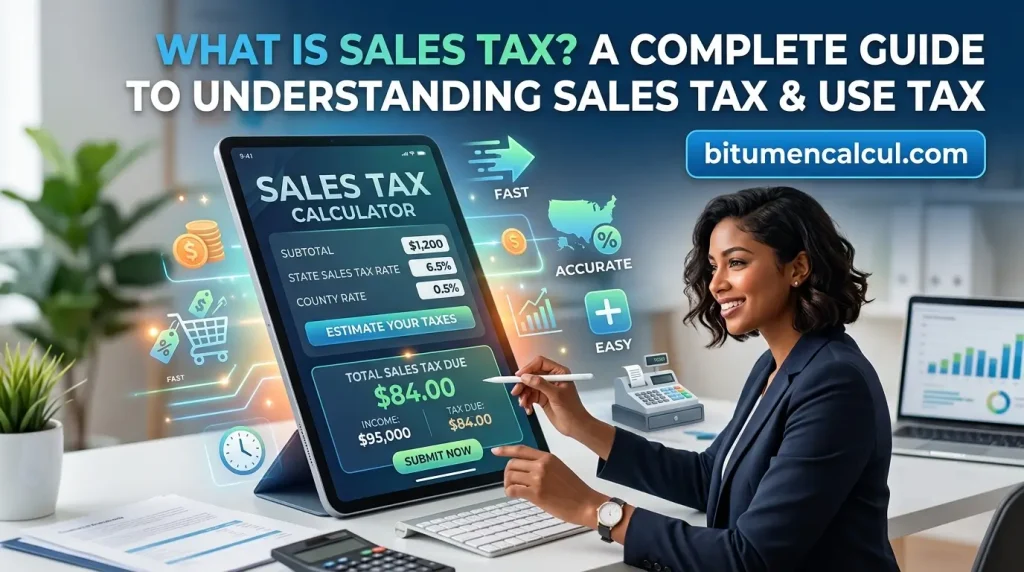
Sales tax is a type of consumption tax charged by the government on the purchase of eligible goods and services. When a customer buys a taxable product or service, the seller collects the tax and later sends it to the appropriate tax authority.
In many countries, a similar tax is known as Value-Added Tax (VAT) or Goods and Services Tax (GST). Although these taxes serve a similar purpose, VAT and GST are different systems from traditional sales tax because they are collected at multiple stages of production and distribution rather than only at the final sale.
The way sales tax is displayed also varies by country. In some places, product prices are shown before tax, and the sales tax is added during checkout. In others, the displayed price already includes all applicable taxes, so the amount customers see is the total they pay at purchase.
U.S. Sales Tax

Unlike many countries, the United States does not impose a federal sales tax. Instead, sales tax is managed at the state and local levels, meaning the amount you pay depends on where you make your purchase. While most states charge sales tax, Alaska, Delaware, Montana, New Hampshire, and Oregon do not have a statewide sales tax. However, some of these states may still allow certain local governments to levy their own taxes.
Sales tax rates and rules vary significantly across the country. In addition to statewide rates, many counties, cities, and special districts apply local taxes, increasing the total amount charged at checkout. Unlike Value-Added Tax (VAT), which is collected throughout the supply chain, U.S. sales tax is generally applied only to the final retail sale. Most business-to-business purchases are exempt unless the goods are intended for final consumption.
Taxable items also differ by state. For example, Texas exempts prescription medications and certain agricultural products such as food seeds from sales tax. Vermont applies its standard 6% sales tax to most purchases but charges a higher tax on alcoholic beverages consumed on the premises. These differences highlight how each state sets its own tax laws, exemptions, and special rates.
Sales tax plays a major role in funding state governments. On average, Americans pay about 2% of their personal income in sales taxes, and this tax generates nearly one-third of total state tax revenue. Its importance varies by region, with states in the South and West often relying more heavily on sales tax than those in the Northeast or Midwest. States such as Florida, Washington, Tennessee, and Texas receive more than half of their tax revenue from sales taxes, while New York relies on it for a much smaller share of its overall tax collections.
U.S. State Sales Tax Rates
| State | State Sales Tax | Maximum Combined Rate (State + Local) |
|---|---|---|
| Alabama | 4.00% | 13.50% |
| Alaska | 0.00% | 7.00% |
| Arizona | 5.60% | 10.725% |
| Arkansas | 6.50% | 11.625% |
| California | 7.25% | 10.50% |
| Colorado | 2.90% | 10.00% |
| Connecticut | 6.35% | 6.35% |
| Delaware | 0.00% | 0.00% |
| District of Columbia | 6.00% | 6.00% |
| Florida | 6.00% | 7.50% |
| Georgia | 4.00% | 8.00% |
| Guam | 4.00% | 4.00% |
| Hawaii | 4.166% | 4.712% |
| Idaho | 6.00% | 8.50% |
| Illinois | 6.25% | 10.25% |
| Indiana | 7.00% | 7.00% |
| Iowa | 6.00% | 7.00% |
| Kansas | 6.50% | 11.60% |
| Kentucky | 6.00% | 6.00% |
| Louisiana | 4.45% | 11.45% |
| Maine | 5.50% | 5.50% |
| Maryland | 6.00% | 6.00% |
| Massachusetts | 6.25% | 6.25% |
| Michigan | 6.00% | 6.00% |
| Minnesota | 6.875% | 7.875% |
| Mississippi | 7.00% | 7.25% |
| Missouri | 4.225% | 10.85% |
| Montana | 0.00% | 0.00% |
| Nebraska | 5.50% | 7.50% |
| Nevada | 6.85% | 8.375% |
| New Hampshire | 0.00% | 0.00% |
| New Jersey | 6.625% | 12.625% |
| New Mexico | 5.125% | 8.688% |
| New York | 4.00% | 8.875% |
| North Carolina | 4.75% | 7.50% |
| North Dakota | 5.00% | 8.00% |
| Ohio | 5.75% | 8.00% |
| Oklahoma | 4.50% | 11.00% |
| Oregon | 0.00% | 0.00% |
| Pennsylvania | 6.00% | 8.00% |
| Puerto Rico | 10.50% | 11.50% |
| Rhode Island | 7.00% | 7.00% |
| South Carolina | 6.00% | 9.00% |
| South Dakota | 4.00% | 6.00% |
| Tennessee | 7.00% | 9.75% |
| Texas | 6.25% | 8.25% |
| Utah | 6.10% | 8.35% |
| Vermont | 6.00% | 7.00% |
| Virginia | 5.30% | 7.00% |
| Washington | 6.50% | 10.60% |
| West Virginia | 6.00% | 7.00% |
| Wisconsin | 5.00% | 7.90% |
| Wyoming | 4.00% | 6.00% |
U.S. History of Sales Tax
The history of sales tax in the United States dates back to the colonial era and has played a significant role in shaping the nation’s financial policies. During the 18th century, when America was under British rule, the British government imposed taxes on various goods sold to the colonies. These taxes were introduced without allowing the colonists any representation in Parliament, giving rise to the famous protest against “taxation without representation.”
One of the most well-known responses to these taxes was the Boston Tea Party, where American colonists protested British taxation by dumping tea into Boston Harbor. This event became a major turning point that, along with other growing conflicts, eventually led to the American Revolution. Because of this historical experience, taxation especially sales-related taxes has remained a sensitive topic throughout U.S. history.
Following independence, the United States avoided introducing a nationwide sales tax for many years. Several early proposals faced strong public resistance and proved difficult to implement. It was not until the Great Depression of the 1930s, when state governments faced severe financial shortages, that sales taxes became a practical solution for raising public revenue.
Mississippi became the first state to adopt a modern state sales tax in 1930. As the economic crisis continued, many other states introduced similar taxes to support public services and stabilize government finances. The approach spread rapidly because taxing consumer purchases provided a reliable and consistent source of revenue during a challenging economic period.
Today, sales tax is a key part of the U.S. tax system. Although there is still no federal sales tax, most states rely on state and local sales taxes to fund essential services such as education, transportation, healthcare, emergency services, and public infrastructure. This state-based system allows each jurisdiction to establish its own tax rates, exemptions, and collection rules according to local needs.
How to Deduct Sales Tax in the U.S.
U.S. taxpayers may be able to deduct sales tax on their federal income tax return, but only if they choose to itemize deductions instead of taking the standard deduction. Since the standard deduction is simpler and often provides a greater tax benefit, it is the option selected by most taxpayers.
Choosing to itemize requires maintaining detailed financial records throughout the year. The Internal Revenue Service (IRS) may require documentation of deductible expenses, so keeping receipts and purchase records is essential for accurately calculating the total amount of sales tax paid.
After deciding to itemize deductions, taxpayers must make another choice: deduct state and local income taxes or state and local sales taxes. Federal tax rules allow only one of these deductions, not both. In many cases, claiming state income tax provides a larger deduction, making it the preferred option for most individuals.
However, deducting sales tax may be more beneficial for people who made significant purchases during the tax year. Buying items such as a new vehicle, engagement or wedding ring, household appliances, furniture, or paying for a large vacation can result in substantial sales tax payments. If the total sales tax paid exceeds the amount of state income tax, claiming the sales tax deduction could reduce taxable income more effectively.
Although this deduction is available, it is relatively uncommon. Only a small percentage of U.S. taxpayers choose to deduct sales tax each year, largely because most people benefit more from taking the standard deduction or claiming state income tax instead.
Value-Added Tax (VAT)
Value-Added Tax (VAT) is a widely used form of consumption tax that applies in more than 160 countries worldwide. Unlike the U.S. sales tax system, which is generally charged only when a product is sold to the final consumer, VAT is collected throughout the production and distribution process whenever value is added to a product or service.
Under a VAT system, businesses involved in the supply chain—including manufacturers, suppliers, wholesalers, distributors, and retailers—collect and pay tax on the value they add before passing the product to the next stage. Many countries also apply VAT to imported goods, while exports may be treated differently depending on local tax regulations.
The amount of VAT owed is typically based on the value added during each stage of production. In simple terms, it can be determined by subtracting the cost of previously taxed materials or components from the final selling price, ensuring that tax is paid only on the additional value created.
Advantages of VAT
VAT offers several benefits compared with a traditional retail sales tax:
- Reduces tax evasion because tax is collected at multiple stages of production and distribution.
- Encourages accurate record-keeping as businesses claim credits for VAT already paid on purchases.
- Improves cost control since every participant in the supply chain has an incentive to maintain proper financial records.
- Generates stable government revenue, often raising more revenue than a comparable retail sales tax rate.
Disadvantages of VAT
Despite its advantages, VAT also has some drawbacks:
- It can be regressive, meaning lower-income households may spend a larger share of their income on VAT than higher-income households.
- Businesses face additional administrative responsibilities, including detailed accounting and regular tax reporting.
- Tax applied throughout the production process may increase overall costs, which can contribute to higher consumer prices.
- In some situations, VAT may place a greater burden on new or small businesses and can reduce the competitiveness of exports if refunds or exemptions are not properly managed.
Overall, VAT is one of the world’s most widely adopted tax systems because it provides governments with a consistent source of revenue while spreading tax collection across the entire supply chain rather than relying solely on the final retail sale.
Goods and Services Tax (GST)
Goods and Services Tax (GST) is a broad-based indirect tax applied to the sale of goods and services. Like Value-Added Tax (VAT), GST is collected at multiple stages of the production and distribution process, with businesses paying tax on the value they add before passing products or services to the next stage of the supply chain.
Although GST and VAT operate on similar principles, the rules, tax rates, exemptions, and filing requirements vary significantly from one country to another. As a result, the terms GST and VAT are often used differently depending on the country’s tax system, even though both are designed to tax consumption rather than income.
Under a GST system, businesses generally collect tax on sales while receiving credits for the GST paid on eligible business purchases. This credit mechanism helps ensure that the tax is ultimately borne by the final consumer rather than businesses within the supply chain.
Key Features of GST
- Applied to the sale of eligible goods and services.
- Collected at multiple stages of production, distribution, and retail.
- Businesses can typically claim credits for GST paid on business-related purchases.
- The final tax burden falls on the end consumer.
- Rules, exemptions, and tax rates differ by country.
Several countries use the term Goods and Services Tax (GST) for their consumption tax system. According to the source content, these include:
- Spain
- Greece
- India
- Canada
- Singapore
- Malaysia
Although GST and VAT share many similarities, each country’s tax framework has its own regulations, making the systems unique in their implementation and administration.
Conclusion
Understanding sales tax, VAT, and GST helps you make smarter financial decisions and estimate purchase costs with confidence. A Sales Tax Calculator makes the process quick and accurate by calculating the tax amount, before-tax price, or final price instantly, making it a practical tool for everyday shopping, budgeting, and business use.