

Ideal Gas Law Calculator Pressure Volume Moles & Temperature
Ideal Gas Law Calculator
Calculate pressure, volume, moles, or temperature
The Ideal gas law calculator physics tool uses PV = nRT to solve for pressure, volume, moles, or temperature and also supports Ideal gas law calculator specific volume and Ideal gas law calculator with mass calculations. It works best at low pressure and high temperature; for your entered values, the calculated pressure is 1.0006558 atm.
What is an ideal gas?
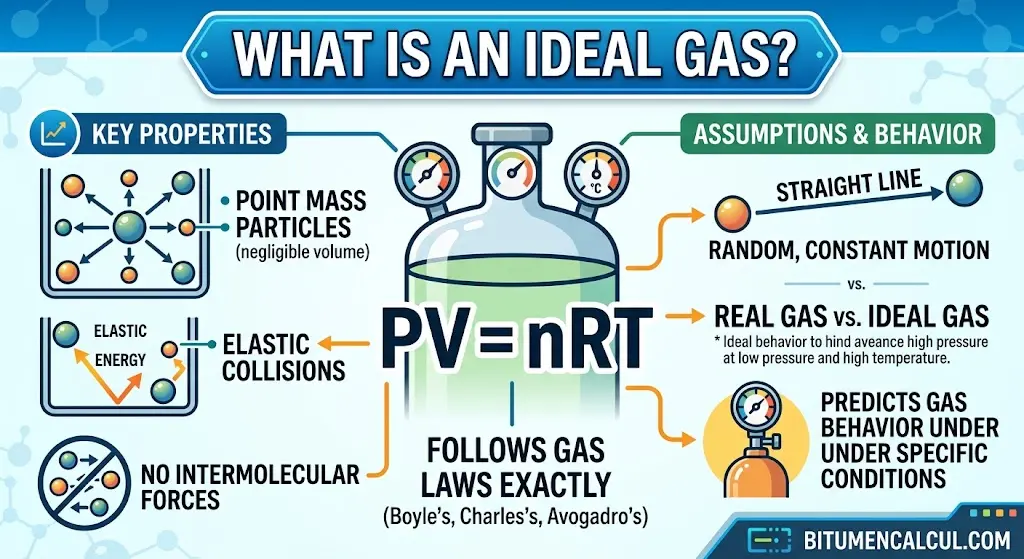
An ideal gas is a theoretical gas made up of many randomly moving, point-like particles that occupy no volume and do not interact except during perfectly elastic collisions. Its particles follow Newton’s laws of motion, assumptions commonly used when working with an Ideal gas law calculator for air or comparing changing pressure, volume, and temperature conditions with a Combined gas law calculator.
Ideal Gas Law Equation
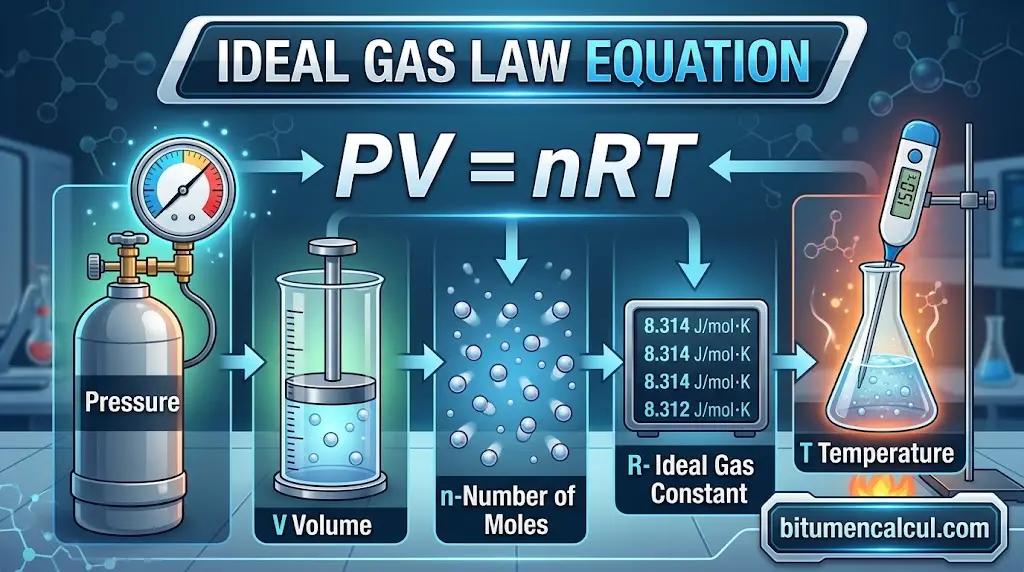
The ideal gas law connects four important properties of an ideal gas pressure, volume, temperature, and the amount of gas in a single equation:
p × V = n × R × T
In this equation:
- p represents the gas pressure, measured in pascals (Pa).
- V is the volume occupied by the gas, measured in cubic metres (m³).
- n is the amount of gas, measured in moles.
- R is the ideal gas constant.
- T represents the absolute temperature, measured in kelvins (K).
If you know all but one of these quantities, you can rearrange the equation to calculate the missing value with an ideal gas law calculator.
For example, suppose you have 40 moles of gas at a temperature of 250 K and a pressure of 1013 hPa. First, the pressure is expressed as 101,300 Pa. The volume can then be calculated as:
V = nRT ÷ p
V = (40 × 8.31446261815324 × 250) ÷ 101,300
V ≈ 0.82 m³
So, under these conditions, the ideal gas occupies approximately 0.82 cubic metres.
Ideal Gas Constant
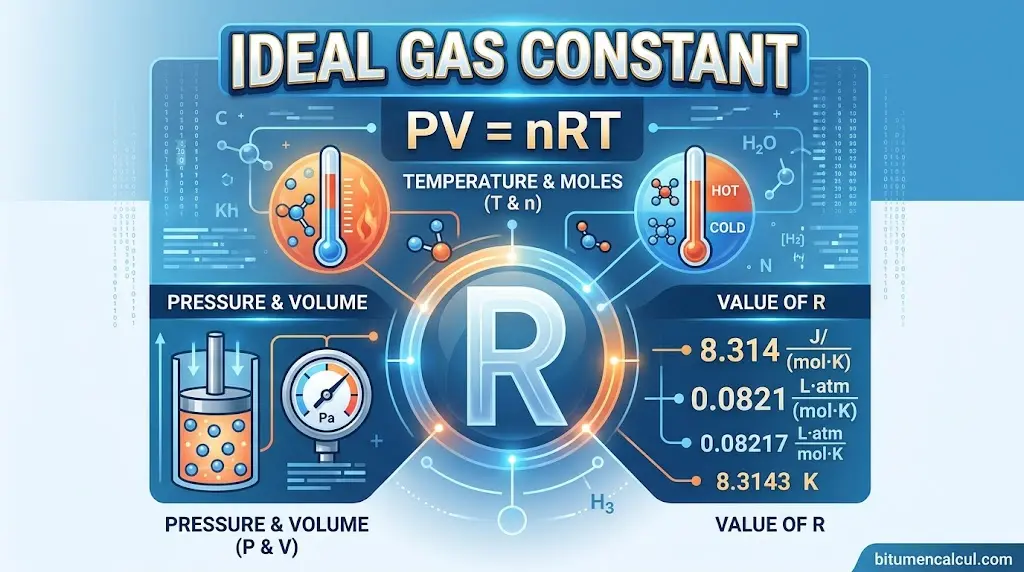
The ideal gas constant, represented by R, is a fundamental physical constant used in the ideal gas law and many other equations involving gases. It is also commonly known as the universal gas constant or molar gas constant.
Its value is:
R = 8.31446261815324 J/(mol·K)
The universal gas constant can also be expressed using two other important constants: Avogadro’s number (Nₐ) and the Boltzmann constant (k). Their relationship is:
R = Nₐ × k
Using their values:
R = (6.02214076 × 10²³ mol⁻¹) × (1.38064852 × 10⁻²³ J/K)
This gives:
R ≈ 8.3144626 J/(mol·K)
The Boltzmann constant connects temperature with the energy of particles, while Avogadro’s number represents the number of particles contained in one mole. Multiplying these constants gives the universal gas constant used for calculations involving amounts of gas measured in moles.
When calculations require a constant for a particular gas rather than the universal molar value, the specific gas constant can be used instead. Related calculations may also use atmospheric pressure and altitude when examining how gases behave under changing environmental conditions.
When to Use Each Variable
The variable you choose to calculate depends on which gas properties you already know and what information you need to find.
- Solve for Pressure (P): Choose pressure when the volume, number of moles, and temperature are known. A typical example is calculating the pressure inside a sealed container at a specified temperature.
- Solve for Volume (V): Use this option when you know the pressure, amount of gas, and temperature. For example, you can determine how much volume a given quantity of gas occupies at STP.
- Solve for Moles (n): Calculate the number of moles when pressure, volume, and temperature are available. This is useful for determining how much gas is present inside a container.
- Solve for Temperature (T): Select temperature when the pressure, volume, and number of moles are known. For instance, you can calculate the temperature required for a gas to reach a particular pressure.
- Solve for Density (ρ): Use the density calculation when you have the pressure, specific gas constant, and temperature. One practical application is estimating the density of air at a particular altitude.
- Solve for P₁ with Boyle’s Law: Choose this calculation when the final gas state and initial volume are known and the temperature remains constant. It can be used, for example, to determine the gas’s starting pressure before compression.
Common Mistakes to Avoid
Even a straightforward gas-law calculation can produce an incorrect result if the units or assumptions are wrong. Keep these common mistakes in mind:
- Using Celsius or Fahrenheit instead of kelvin: Gas-law equations require an absolute temperature, so convert the temperature to kelvins before calculating.
- Using the ideal gas law at very high pressures: The ideal-gas approximation becomes less reliable as pressure increases. At pressures above roughly 10 atm, consider a real-gas model such as the van der Waals equation.
- Combining incompatible units: The numerical value and units of R must match the pressure and volume units in your calculation. For example, calculations using Pa and m³ require a different form of R from those using atm and litres.
- Using Boyle’s law when temperature changes: Boyle’s law assumes that the temperature remains constant. If the gas temperature changes during the process, use the full ideal gas law rather than treating pressure and volume alone as the changing variables.
FAQs
Conclusion
The ideal gas law provides a practical way to understand and calculate how pressure, volume, temperature, and the amount of gas relate to one another. By choosing the correct value of R, keeping units consistent, and using temperature in kelvins, you can reliably solve a wide range of gas problems while remembering that real gases may require a different model under extreme conditions.
Read More: