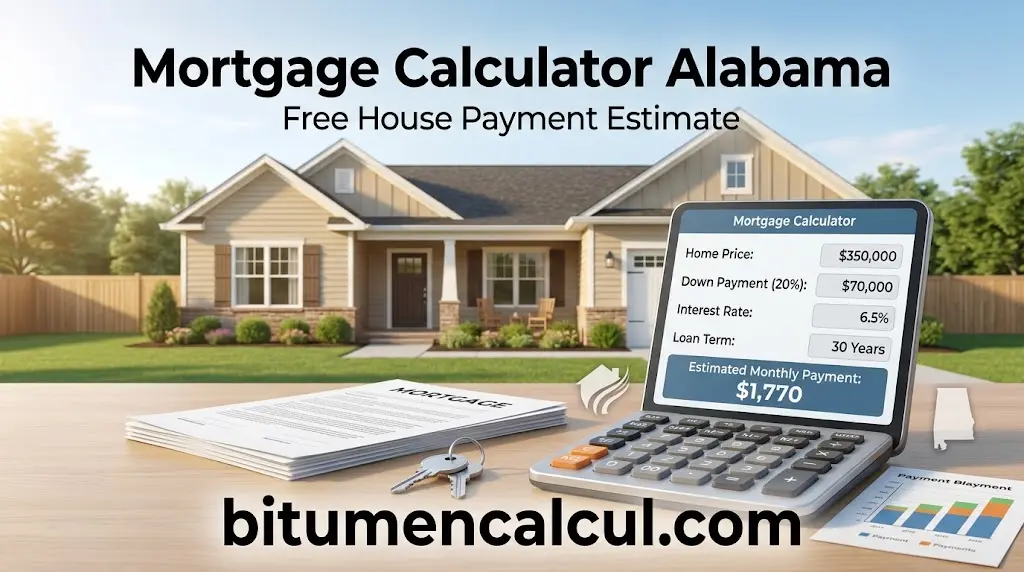
Mortgage Calculator Alabama – Free House Payment Estimate
Alabama Mortgage Calculator
Estimate your monthly mortgage payment, including taxes, insurance, PMI and HOA.
Loan Details
Your Estimate
Monthly Breakdown
- Principal & Interest
- —
- Property Taxes
- —
- Homeowners Insurance
- —
- PMI (estimate)
- —
- HOA
- —
Loan Summary
- Loan Amount
- —
- Down Payment
- —
- Total Interest
- —
- Total Principal & Interest Payments
- —
For estimation only. Actual Alabama property taxes vary by county and local taxing jurisdiction, and actual lender PMI may differ.
Alabama, known as the Yellowhammer State, remains one of the more affordable places in the U.S. to buy or rent a home. While residents generally earn less than the national average, housing costs are comparatively manageable, with 26.8% of Alabamians spending at least 30% of their income on housing below the U.S. average. Home prices have risen in recent years, although the pace of growth has remained slower than the national rate. Among Alabama’s pricier housing markets is Hoover, a Birmingham suburb that also gained national attention as the setting for an MTV reality series centred on its high school football programme.
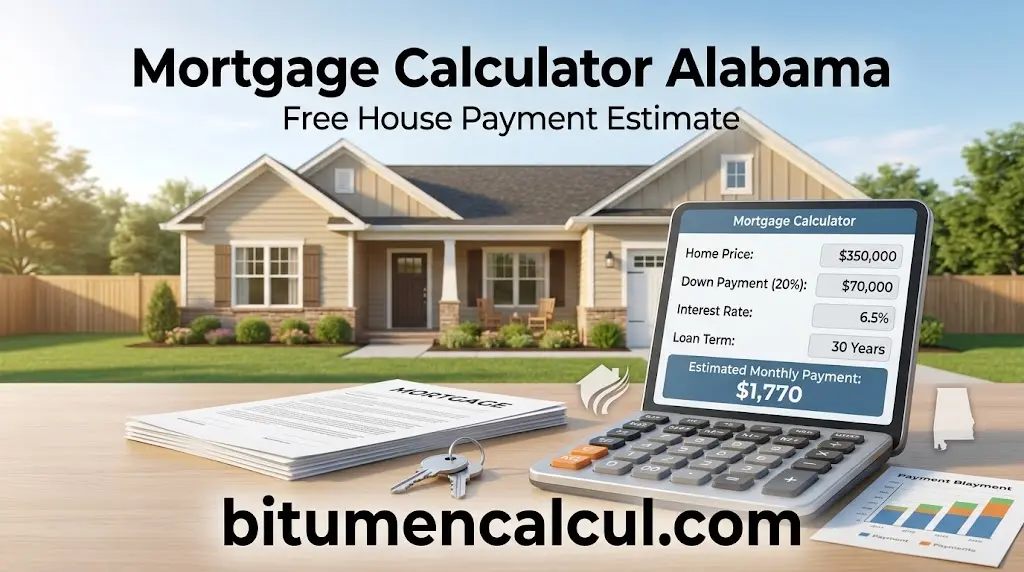
How to Use a Mortgage Calculator
Getting an estimate takes only a few key details. Enter the following information into the calculator:
- Home price — the purchase price of the property.
- Down payment — the amount you plan to pay upfront.
- Interest rate — the annual rate applied to your mortgage.
- Loan term — the number of years you expect to take to repay the loan.
Once these figures are entered, the calculator provides your estimated monthly payment in the Loan Estimate section. You can also see a broader picture of your borrowing costs, including:
- Total principal — the amount originally borrowed.
- Total interest — the interest paid over the life of the loan.
- Total loan payments — principal and interest combined.
- Payoff date — the estimated date when the mortgage will be fully repaid.
How much could your monthly mortgage payment be?
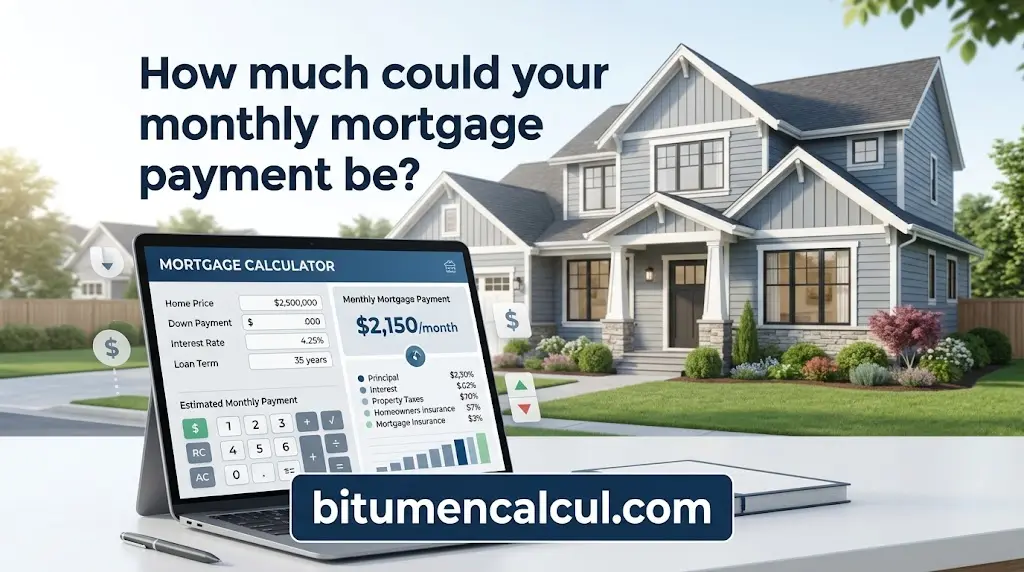
The amount you pay each month depends on more than the home’s purchase price. Your down payment, mortgage interest rate and loan term all play a major role in determining the monthly payment. Putting down 20% or more can reduce your monthly payment and may also allow you to avoid private mortgage insurance (PMI). A lower interest rate can bring the payment down as well, while choosing a longer loan term typically lowers the monthly amount but increases the total interest you pay over the life of the loan.
The estimates below are based on a 30-year fixed-rate mortgage at 6%, with a 20% down payment. The principal-and-interest (P&I) figures show the estimated mortgage payment, while the second estimate gives an indication of monthly property taxes and homeowners insurance. These figures exclude PMI and HOA fees, so your actual monthly housing cost could be higher. The assumptions can be changed using the advanced options in a mortgage calculator.
| Home price | Mortgage amount | Monthly mortgage payment (P&I) | Estimated monthly taxes & insurance |
|---|---|---|---|
| $100K | $80,000 | $480 | $123 |
| $200K | $160,000 | $959 | $247 |
| $300K | $240,000 | $1,439 | $370 |
| $400K | $320,000 | $1,919 | $493 |
| $500K | $400,000 | $2,398 | $617 |
| $600K | $480,000 | $2,878 | $740 |
| $700K | $560,000 | $3,357 | $863 |
| $800K | $640,000 | $3,837 | $987 |
How to calculate mortgage payments
A mortgage calculator lets you enter the details of a home loan and adjust them as you learn more about your purchase. When you don't yet know certain figures, the calculator can provide assumptions or pre-filled values that you can replace later.
Your monthly mortgage payment isn't limited to the money you borrowed. Principal is the original amount of the loan that you must repay, while interest is what the lender charges for allowing you to borrow that money.
Depending on your loan, your monthly payment may also cover property taxes, homeowners insurance and other housing costs. With an escrow account, these expenses are collected alongside your principal and interest payment. The lender holds the funds until your tax or insurance bills are due, then pays them on your behalf. If your mortgage requires private mortgage insurance (PMI), or you have homeowners association (HOA) dues, those costs may also form part of your overall monthly payment.
Home price
Enter the amount you paid for the property, or the price you expect to pay if you're planning a future purchase. This figure provides the starting point for calculating the size of your mortgage and related costs.
Down payment
Many home loans require a down payment of at least 3% of the home's purchase price, although some programmes, including VA loans and certain USDA loans, may allow you to buy with no down payment. A 20% down payment isn't a universal requirement for getting a mortgage.
The amount you put down still matters. A larger down payment generally means borrowing less, which can reduce your monthly payment. Putting 20% down can also help you avoid private mortgage insurance.
Loan programme
The mortgage programme you select can change both your interest rate and monthly payment. A mortgage calculator can compare options such as 30-year fixed-rate, 15-year fixed-rate and 5-year adjustable-rate mortgages (ARMs), helping you see how different loan structures affect the amount you pay each month.
Interest rate
Your mortgage interest rate represents the annual cost of borrowing from the lender. It's expressed as a percentage and has a direct effect on your monthly payment. A mortgage calculator may automatically populate an average current rate, which you can adjust when you know the rate available to you.
PMI
Private mortgage insurance, or PMI, is an additional monthly expense that may apply when the amount you borrow exceeds 80% of the home's purchase price. The cost can vary according to factors such as your credit score and down payment.
Because PMI protects the lender's investment, having a smaller down payment can result in a higher monthly mortgage payment when PMI is required.
Property taxes
Property taxes can make up a significant portion of your overall housing costs. A mortgage calculator estimates your annual tax bill based on the home's purchase price, then divides that amount across 12 monthly payments.
If you already know the property's actual annual tax bill, you can enter that figure instead of relying on the estimate.
Home insurance
Homeowners insurance is typically entered as an annual premium and then divided into monthly amounts for the mortgage calculation. The estimated cost is based on the home's price.
Average annual premiums generally cost less than 1% of the home's value. This insurance helps protect you against covered hazards and losses and provides liability protection as the property owner.
HOA dues
Some homeowners pay fees to a homeowners association (HOA), particularly in planned communities, townhomes and condominiums. These monthly dues can help cover shared amenities, maintenance and certain insurance costs.
If the property you're considering has an HOA, enter the monthly fee into the calculator to get a more complete picture of your housing costs. If there are no HOA dues, you can leave this field blank.
Mortgage payment equation
Your total monthly mortgage payment can be broken down into several components:
Principal + Interest + Mortgage Insurance (if required) + Escrow (if applicable) = Total monthly payment
Here’s what each part represents:
- Principal: The amount you originally borrowed to purchase the home.
- Interest: The cost charged by the lender for borrowing the money.
- Mortgage insurance: Insurance that may be required to protect the lender when the loan represents 80% or more of the home's value.
- Escrow: The portion of your monthly payment set aside for expenses such as property taxes, HOA dues and homeowners insurance.
- Number of payments: Multiply the loan term in years by 12 to determine how many monthly payments you'll make. For example, a 30-year mortgage has 360 payments (30 × 12 = 360).
Home Loan Types to Consider
The mortgage you choose can have a significant effect on your monthly payment, upfront costs and overall borrowing expenses. Compare the main loan options below to find one that suits your finances, down payment and home-buying situation.
Conventional Loans
Conventional loans are offered by private lenders, such as banks, rather than being backed by the federal government. They generally have stricter credit score and debt-to-income requirements than government-backed mortgages.
If you have strong credit and can put 20% down, a conventional loan may be an attractive choice because it can offer competitive interest rates without private mortgage insurance (PMI). A down payment below 20% is also possible, although PMI will generally be required.
FHA Loans
FHA loans are insured by the Federal Housing Administration and are designed to make homeownership more accessible to borrowers who may not meet conventional loan requirements.
They typically have more flexible credit requirements and permit relatively low down payments. However, FHA financing includes mandatory mortgage insurance that generally remains for the life of the loan.
VA Loans
VA loans are partially guaranteed by the Department of Veterans Affairs and are available to eligible veterans and certain other qualified borrowers. In most cases, they allow you to buy a home with no down payment and offer competitive interest rates.
One major advantage is that VA loans don't require PMI. However, borrowers generally have to pay a VA funding fee.
USDA Loans
USDA loans are backed by the United States Department of Agriculture and are intended to help qualifying low-income borrowers buy homes in eligible rural areas.
These mortgages have relatively flexible credit requirements and may allow a down payment of 0%. Unlike conventional loans with less than 20% down, USDA loans don't require PMI, although an upfront funding fee applies.
Jumbo Mortgages
Jumbo mortgages are non-conforming loans used when the amount borrowed exceeds the applicable conforming loan limit. These limits are set according to the local market and can change each year.
Because jumbo loans are used to finance higher-priced properties and aren't insured by the federal government, lenders may impose stricter requirements. A 20% down payment is often expected, which could mean putting more than $100,000 towards the purchase at closing. Even so, jumbo mortgage rates can remain competitive.
Understanding Mortgage Options and Key Terms
Choosing a mortgage involves more than picking a loan type. The repayment period, interest-rate structure and loan classification can all affect your monthly payment, borrowing costs and financial flexibility. Here are several mortgage terms and programme differences worth understanding before choosing a loan.
Loan Term
The loan term is the maximum period you have to repay your mortgage. 15-year and 30-year terms are among the most common options.
A longer repayment period generally means lower monthly payments, although you may pay more interest over the life of the loan. A shorter term typically allows you to clear the mortgage sooner and reduce the total interest you pay.
You don't necessarily have to follow the full scheduled term. Making extra payments towards your principal can help you repay the balance sooner.
Fixed-Rate vs Adjustable-Rate Mortgages
With a fixed-rate mortgage, your interest rate stays unchanged throughout the loan term. This makes your principal-and-interest payment more predictable over time.
An adjustable-rate mortgage (ARM) starts with a fixed rate for a specified period before the rate changes at scheduled intervals. For example, a 5-year ARM keeps its initial rate for five years before adjusting annually for the rest of the loan term.
ARMs often begin with a lower interest rate than comparable fixed-rate mortgages. That initial period may suit borrowers who expect to move or refinance before the first adjustment, but it's important to consider the possibility of higher payments after the rate begins changing.
Conforming vs Non-Conforming Mortgages
Conforming loans follow loan-size limits and other eligibility requirements established for mortgages that can be backed by Fannie Mae or Freddie Mac. The applicable maximum loan amount can vary by location and is subject to government-set limits.
Non-conforming loans don't follow the same standardised requirements. Their eligibility rules, loan amounts and pricing can vary considerably between lenders.
A jumbo mortgage is one example of a non-conforming loan because it can exceed the applicable conforming loan limit. Government-backed mortgages, meanwhile, follow their own programme-specific guidelines rather than the standard conforming-loan rules.
Use a Mortgage Calculator to Explore Your Home-Buying Options
A mortgage calculator can do more than provide an estimated monthly payment. By changing the figures you enter, you can compare different borrowing scenarios, understand how your choices affect costs and get a clearer idea of what you may be able to afford.
Compare Different Down Payments
Try entering different down payment amounts to see how each option changes your estimated monthly payment. This can help you weigh the benefit of putting more money towards the home against keeping additional savings available after closing.
A larger down payment may also help you avoid private mortgage insurance (PMI), depending on the loan and your circumstances. When comparing options, look beyond principal and interest and consider the other costs that may form part of your monthly payment.
See How Interest Rates Affect Your Payment
Small changes in the mortgage rate can make a noticeable difference to your monthly payment and total borrowing cost. Adjust the rate in the calculator to see how different scenarios compare.
Mortgage rates can change from day to day, so you may also want to consider whether improving your credit profile could help you qualify for a better rate. Use the Schedule feature to view an interactive breakdown of how your payments could be allocated over time, including how the loan balance and interest change as you repay the mortgage. This works alongside an amortisation schedule calculator.
Test Your Home-Buying Budget
Changing the calculator inputs can help you determine whether you're financially prepared to take on a mortgage. For a more detailed assessment, an affordability calculator can help you consider factors such as income, existing debts and monthly payments.
Compare Different Mortgage Programmes
Don't assume every mortgage programme will produce the same payment. Select different loan programmes in the calculator and compare the estimated monthly costs to understand how your choice of financing could affect your budget.
FAQs
Conclusion
Overall, buying a home in Alabama can be an achievable goal when you understand how mortgage rates, down payments, loan terms, taxes, insurance and other costs affect your budget. A mortgage calculator makes it easier to compare loan options, estimate monthly payments and test different home-buying scenarios, while understanding the available loan programmes can help you choose financing that fits your circumstances. Before making a decision, look beyond the advertised home price and consider the full cost of owning the property, your existing financial commitments and how comfortably the payment fits your budget.
Read More: